
Temperature plays a decisive role in governing the maturity development of freshly placed concrete. Once concrete is cast, its internal temperature begins to rise primarily due to the exothermic hydration process, and this heat continues to accumulate as hydration progresses.
The initial temperature of the concrete mix significantly influences early-age strength gain. Higher temperatures accelerate cement hydration, leading to faster strength development in the early stages. However, this rapid heat buildup can also increase the risk of shrinkage and thermal cracking due to internal temperature gradients.
On the other hand, lower ambient or mix temperatures slow down hydration, delaying setting time and reducing the rate of early strength gain, which can extend construction schedules.
Hydration does not occur at a constant rate; instead, it evolves nonlinearly, leading to variations in temperature over time. These fluctuations directly affect how maturity is accumulated in concrete.
Short-term temperature spikes—caused either by environmental conditions or the heat of hydration—can temporarily increase maturity values. However, if this rise is not accompanied by corresponding microstructural development, it may lead to an overestimation of long-term strength.
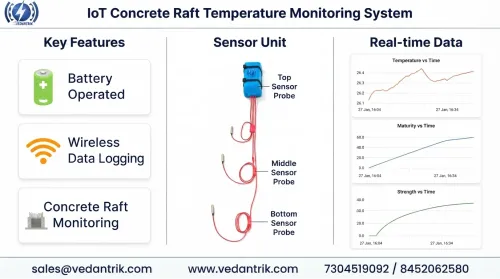
To accurately track these variations, temperature is continuously monitored using embedded sensors placed within the concrete. These readings help engineers record thermal history, which is then used to develop strength–maturity relationships using the Nurse–Saul equation.
In practice, controlling temperature is essential for reliable maturity-based strength prediction. Maintaining uniform curing conditions reduces thermal gradients and helps ensure consistent maturity development throughout the structure.
Ultimately, temperature controls the rate of hydration and therefore the rate of strength gain. A clear understanding of both stable and fluctuating thermal conditions is essential for precise maturity assessment.
Keywords