Maintaining stable temperature during the concrete curing process is a necessary requirement, especially for laboratories and fields, as variation can affect cement hydration of the concrete.
Cement hydration is a temperature sensitive process, meaning that changes in temperature can severely affect the cement hydration, a critical factor that governs the strength gain, micro-structure formation, shrinkage behavior, and long-term durability achievement in concrete.
Cement hydration is an exothermic process, hence it is affected by the temperature of water inside the curing tank. Higher temperatures increase the rate of hydration reaction, whereas, lower temperature slows it down.
Although at higher temperatures, cement hydration is accelerated which reduces the time for early age strength development, it can also lead to uneven, coarser and less dense micro-structure formations, increasing the porosity of the concrete material, making it prone to chemical attacks.
In contrast, low curing temperatures can decrease the rate of cement hydration which then results in delayed early age strength development.
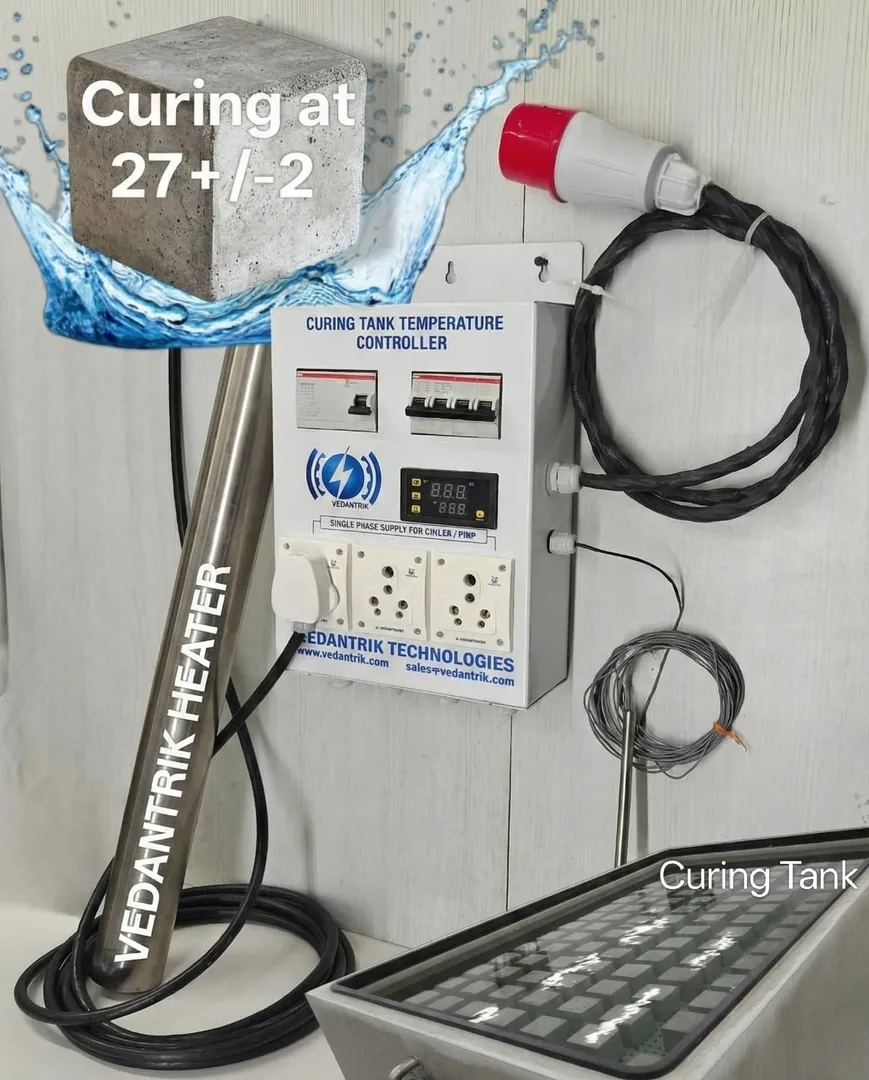
Standards such as IS 516 recommend that water temperature inside the curing tank must be maintained at 27+/-2°C, which is considered the ideal range for standard-strength concrete curing.
Any deviations in temperatures outside this range can compromise laboratory results and lead to incorrect conclusions about the performance of a concrete mix.
In conclusion, temperature fluctuations in curing tanks have a direct impact on both early-age and long-term concrete performance.
High temperatures cause rapid hydration that weakens durability, while low temperatures slow hydration and delay strength gain. Rapid or repeated temperature changes further contribute to micro-cracking and non-uniformity.
Therefore, maintaining stable curing temperatures within the limits defined by standards like IS 516 is essential for producing reliable and high-quality concrete.
Continuous monitoring and careful management of curing tank temperature support predictable hydration, improved durability, and consistent overall performance.
Keywords