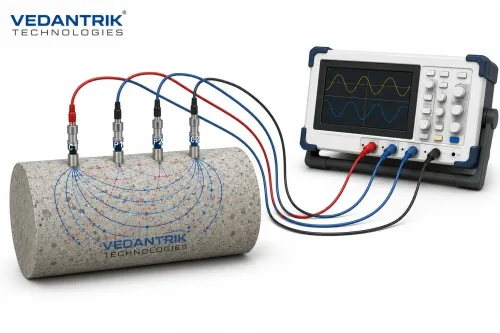

Cracks in mass concrete rafts mainly occur due to heat of hydration, temperature difference, shrinkage, and improper curing practices. Since raft foundations are thick concrete elements, they generate high internal heat and cool slowly. If temperature is not controlled properly, thermal stresses develop and lead to cracking.
To avoid cracks, proper planning, temperature control, and monitoring are essential from pouring to curing stage.
1. Control Heat of Hydration
The main reason for cracks in mass concrete is excess heat generation inside the concrete. This can be controlled by:
- Using low heat cement
- Using fly ash or GGBS in mix design
- Reducing cement content where possible
- Using chilled water or ice in concrete mix (if required)
This helps reduce internal temperature rise and prevents overheating of core concrete.
2. Control Temperature Difference (Most Important Factor)
Cracks mainly occur when there is a high temperature difference between core and surface. The temperature difference should generally be kept within 20°C.
To control this:
- Avoid sudden cooling of surface
- Do not expose concrete directly to sun or wind immediately
- Maintain uniform cooling rate across raft
3. Proper Insulation After Pouring
After concrete placement, proper insulation is very important. The top surface of raft should be covered with:
- 50 mm thermocol (EPS) sheets
- Tarpaulin sheets
This helps in:
- Reducing heat loss from surface
- Preventing rapid cooling
- Maintaining temperature balance between core and top
- Reducing shrinkage cracks
4. Avoid Water Curing in Early Stage
Direct water curing can cool the surface too quickly and increase temperature gradient. This sudden cooling creates thermal stress and leads to cracking. Instead, insulation curing is preferred in mass concrete.
5. Proper Pouring Sequence and Planning
Crack control also depends on how concrete is poured. Proper planning helps in reducing stress development:
- Pour concrete in planned segments
- Avoid long delays between layers
- Maintain continuous pour where possible
- Provide construction joints at correct locations
6. Correct Sensor Placement and Temperature Monitoring
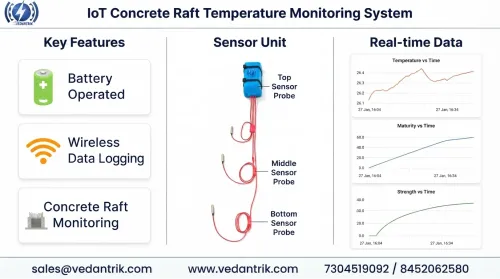
Temperature monitoring is very important for crack prevention. Thermocouples should be installed at:
- Top (about 150 mm below surface)
- Middle (core location)
- Bottom (about 150 mm above base)
This helps in tracking:
- Core temperature
- Surface temperature
- Temperature differential
- Cooling rate
If temperature difference exceeds limits, immediate corrective action can be taken.
7. Control Early Age De-Shuttering
Early removal of shuttering can cause sudden heat loss and increase temperature gradient. Shuttering should only be removed when:
- Temperature is stable
- Core temperature has started reducing
- Temperature difference is within safe limit
8. Provide Controlled Cooling
Cooling of mass concrete should be slow and uniform. Rapid cooling should be avoided. This can be achieved by:
- Keeping formwork in place longer
- Using insulation layers
- Avoiding direct sun exposure or wind cooling
9. Use Advanced Temperature Monitoring Systems
Real-time monitoring helps in early detection of unsafe conditions. Wireless systems allow engineers to track:
- Live core temperature
- Surface temperature
- Temperature difference
This helps in taking timely action before cracks form.
Conclusion
Cracks in mass concrete rafts can be avoided by controlling heat generation, maintaining temperature difference within limits, using proper insulation, avoiding early water curing, and following correct construction practices. Most importantly, continuous temperature monitoring at top, middle, and bottom levels helps ensure safe and crack-free raft construction.
Keywords