Thermal cracking in mass concrete happens mainly due to high heat of hydration and large temperature differences between the core and the surface of concrete. Since mass concrete elements like raft foundations, pile caps, dams, and retaining walls are thick, they retain heat for a long time. If this heat is not controlled properly, internal stresses develop and cracks can form.
Preventing thermal cracking requires proper planning, temperature control, and continuous monitoring from the time of pouring to curing.
1. Control Heat of Hydration
The first step is to reduce the heat generated inside the concrete itself. This can be done by:
- Using low heat cement
- Replacing cement partially with fly ash or GGBS
- Optimizing cement content in mix design
- Using chilled water or ice flakes in concrete (if required)
This helps reduce the peak core temperature in mass concrete.
2. Maintain Safe Temperature Difference
Thermal cracking mainly occurs when the temperature difference between core and surface becomes too high. In most projects, this difference should be kept within 20°C.
To maintain this:
- Avoid rapid cooling of surface
- Ensure uniform temperature distribution
- Prevent exposure to sudden wind or sunlight
3. Proper Insulation After Pouring
After concreting, insulation is very important to control heat loss. The top surface should be covered with:
- 50 mm thermocol (EPS) sheets
- Tarpaulin sheets
This helps to:
- Reduce heat loss from top surface
- Maintain uniform temperature inside concrete
- Prevent rapid cooling
- Reduce shrinkage and thermal stress
4. Avoid Water Curing in Early Stage
Water curing in mass concrete can cause sudden cooling of the surface. This increases temperature difference between surface and core, which can lead to cracks. Instead, insulation-based curing is preferred.
5. Proper Pour Planning and Execution
Good pouring practices help reduce thermal stress:
- Follow planned pour sequence
- Avoid cold joints
- Ensure continuous pouring where possible
- Provide proper construction joint locations
This helps in controlling internal stress distribution.
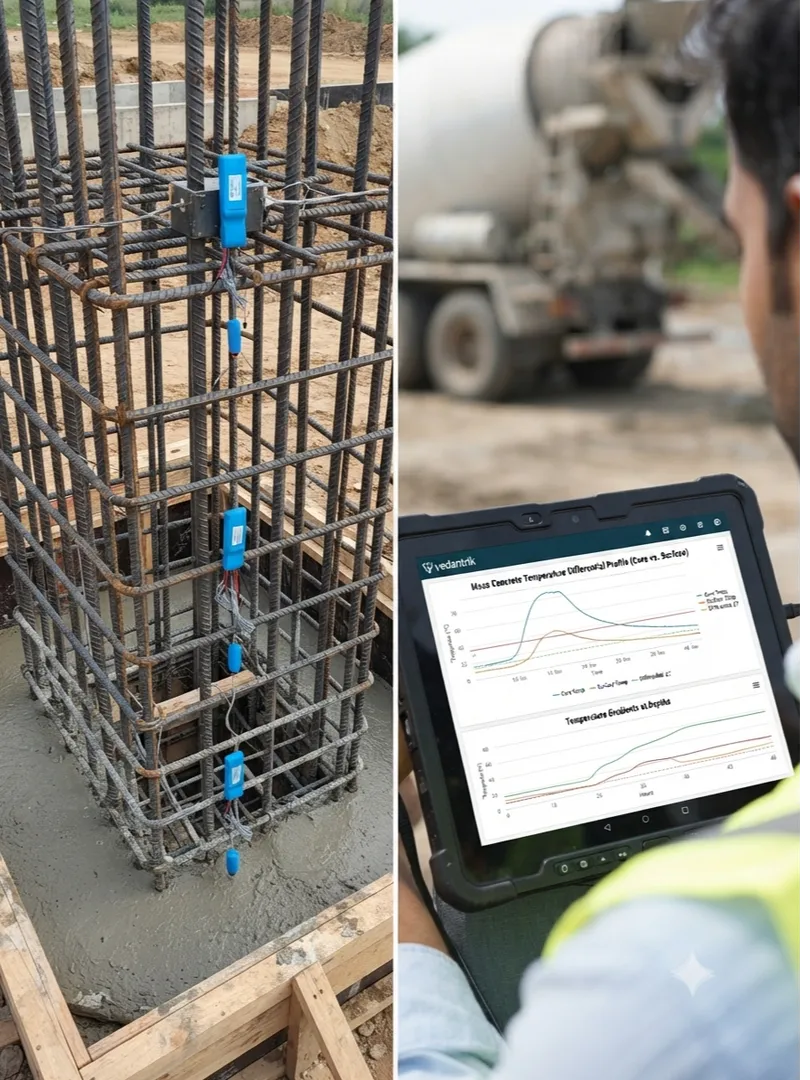
6. Correct Sensor Placement and Temperature Monitoring
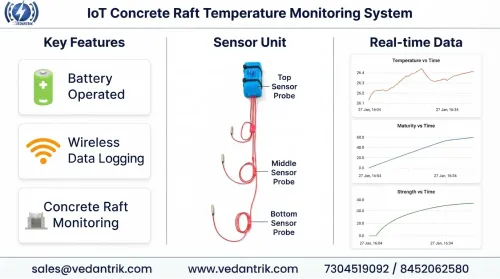
Continuous temperature monitoring is one of the most important methods for preventing thermal cracking. Thermocouples should be installed at:
- Top (about 150 mm below surface)
- Middle (core location)
- Bottom (about 150 mm above base)
This helps monitor:
- Core temperature
- Surface temperature
- Temperature difference
- Cooling rate
If temperature difference exceeds safe limits, corrective action can be taken immediately.
7. Control Shuttering Removal Time
Early de-shuttering can expose concrete to sudden cooling. This increases the temperature gradient and leads to cracking. Shuttering should only be removed when:
- Core temperature starts decreasing
- Temperature difference is within safe limit
- Concrete has stabilized thermally
8. Ensure Gradual Cooling
Mass concrete should always cool slowly and evenly. Rapid cooling must be avoided by:
- Keeping formwork longer
- Using insulation layers
- Avoiding direct sun or wind exposure immediately after casting
9. Use Real-Time Temperature Monitoring Systems
Modern wireless monitoring systems help in preventing cracks by providing real-time data. Engineers can track:
- Core temperature
- Surface temperature
- Temperature differential
- Cooling trend
This helps in taking immediate corrective action if temperature conditions become unsafe.
Conclusion
Thermal cracking in mass concrete can be prevented by controlling heat of hydration, maintaining temperature difference within limits, using proper insulation, avoiding early water curing, and following correct construction practices. Most importantly, continuous temperature monitoring at top, middle, and bottom levels ensures safe curing and helps prevent cracking in mass concrete structures.
Keywords