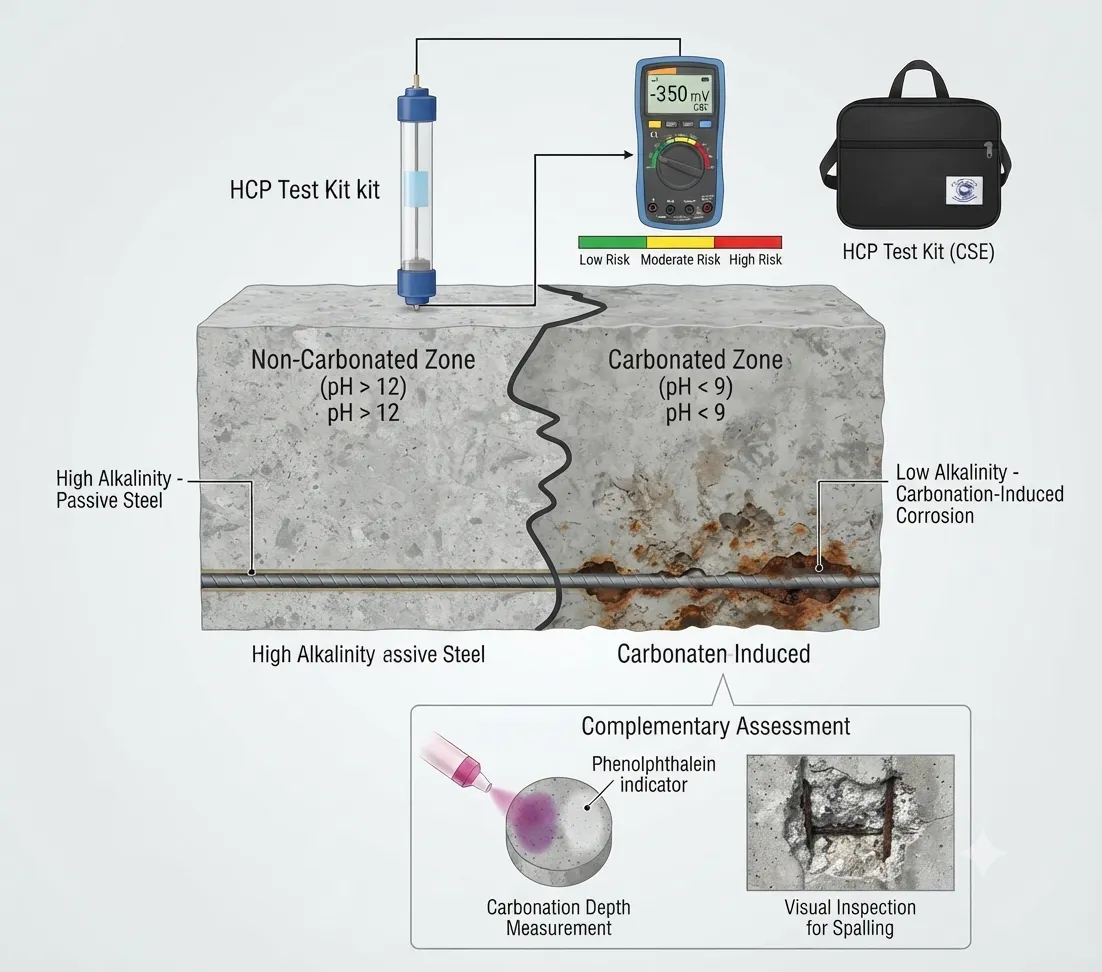
Carbonation is another major factor that affects the durability of reinforced concrete structures. It occurs when carbon dioxide from the atmosphere enters the concrete and reacts with compounds present in the cement paste. This reaction gradually reduces the alkalinity of the concrete.
Under normal conditions, the high alkalinity of concrete provides a protective environment that prevents reinforcement corrosion. However, as carbonation progresses deeper into the concrete cover, the pH level decreases. When the carbonation front reaches the reinforcement, the protective layer surrounding the steel can break down, making the reinforcement vulnerable to corrosion.
The effects of carbonation can influence Half Cell Potential measurements in several ways. Carbonated concrete often exhibits different electrical properties compared to non-carbonated concrete. Changes in moisture movement, conductivity, and corrosion activity can all affect the measured potential values.
One of the challenges during interpretation is that potential values caused by carbonation-induced corrosion may appear similar to those caused by chloride-induced corrosion. As a result, Half Cell Potential testing alone may not always identify the exact cause of deterioration.
For this reason, engineers often combine HCP Tests with carbonation depth measurements, visual inspections, and other durability assessment techniques. This integrated approach helps determine whether the observed corrosion risk is associated with carbonation, chloride contamination, or a combination of both mechanisms.
Keywords