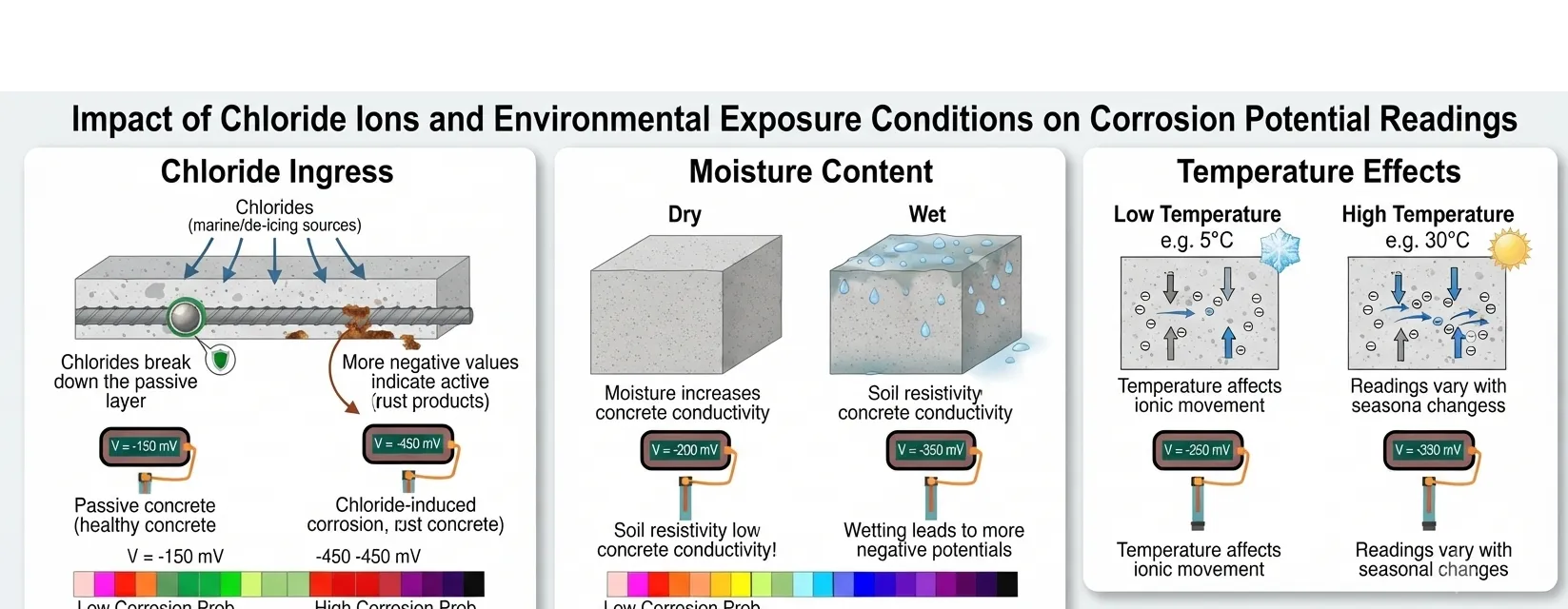
Chloride ingress is one of the primary causes of reinforcement corrosion in concrete structures. Chlorides can enter concrete through marine exposure, de-icing salts, industrial environments, contaminated aggregates, or groundwater. Once chlorides penetrate through the concrete cover and reach the reinforcement, they can destroy the passive protective layer that naturally forms around steel in highly alkaline concrete.
When this protective layer breaks down, active corrosion can begin. As corrosion develops, the electrochemical condition around the reinforcement changes, which is reflected in the Half Cell Potential readings. In general, areas with active corrosion tend to show more negative potential values compared to areas where the reinforcement remains passive.
Environmental exposure conditions also have a major influence on measured potentials. Moisture is particularly important because corrosion is an electrochemical process that requires water to occur. Structures exposed to frequent wetting, rainfall, tidal action, leakage, or high humidity often show different potential distributions compared to dry structures.
Temperature can also affect measurements. Higher temperatures may increase ionic movement within the concrete pore solution, while lower temperatures can reduce conductivity. Similarly, seasonal changes in humidity and moisture content may cause variations in readings taken at different times of the year.
Because of these influences, potential values should never be interpreted without considering the environmental conditions at the time of testing. Half Cell Potential measurements indicate the likelihood of corrosion activity, not the actual corrosion rate or the amount of steel loss. Therefore, understanding the exposure environment is essential for making reliable assessments.
Keywords