The Concrete maturity method plays an important role in predicting the early-age strength of concrete placed at construction sites. Early-age strength means the strength gained by concrete within the first few hours to a few days after casting.
This stage is very important because it controls formwork removal, loading time, and construction safety. The maturity method helps engineers estimate this strength without breaking concrete samples.
Concrete strength develops mainly due to cement hydration. This reaction depends strongly on temperature and time. The maturity method combines both these factors into a single value called the maturity index. Higher temperature or longer time increases maturity, which usually means higher strength.
In real construction conditions, concrete does not cure at a constant temperature. It changes throughout the day. For example, in India, temperatures can vary from about 20°C at night to 40°C during the day. In some mass concrete elements, internal temperature can even go above 60°C due to the heat of hydration. The maturity method uses this changing temperature data to estimate how much hydration has actually taken place inside the concrete.
The method is based on standards such as American Society for Testing and Materials ASTM C1074. This standard explains how to calculate maturity using two main approaches: the Nurse–Saul method and the Arrhenius method. The Nurse–Saul method is more commonly used in field work because it is simpler. It calculates maturity using the formula:
M = Σ (T − T₀) × Δt
where T is concrete temperature, T₀ is a reference (datum) temperature, and Δt is the time interval. This gives a value in degree-hours or degree-days.
To use this method in practice, engineers first create a calibration curve. This is done by testing concrete cubes cured on different days , such as 1, 3, 7, 14 and 28 . The compressive strength of these cubes is measured at different ages. A relationship is then developed between maturity and strength. Once this curve is ready, it can be used on site to predict strength from temperature data.
According to Bureau of Indian Standards IS 456:2000, concrete must reach minimum strength before certain actions are allowed. For example, formwork removal or loading should only be done when concrete has gained enough strength to safely carry loads.
Traditionally, this is checked using 7-day and 28-day cube tests. However, these tests give delayed results and do not show real-time strength. The maturity method solves this problem by giving continuous strength estimation.
One of the biggest advantages of the maturity method is that it allows early decision-making. For example, if a slab reaches the required maturity value corresponding to about 10–15 MPa strength, engineers can safely remove formwork earlier. This improves construction speed and reduces waiting time.
The method is especially useful in fast-track construction projects like high-rise buildings, bridges, and industrial structures. In such projects, time is very important. Even saving one day per floor can significantly reduce total project duration.
Early-age strength prediction is also important for safety. If formwork is removed too early, the concrete may not be strong enough to support its own weight, leading to cracks or even collapse. The maturity method reduces this risk by giving real-time strength estimates instead of assumptions based on time.
However, the accuracy of prediction depends on proper calibration. If the relationship between maturity and strength is not correctly developed, results may be misleading. Different cement types behave differently.
For example, ordinary Portland cement (OPC) gains strength faster in early stages, while Portland Pozzolana Cement (PPC) and Portland Slag Cement (PSC) gain strength more slowly but perform better in long-term durability.
Environmental conditions also affect prediction accuracy. In hot weather, concrete gains strength faster, so maturity increases quickly. In cold weather, strength gain is slower. The method captures this difference, but extreme conditions can still affect reliability if not properly considered.
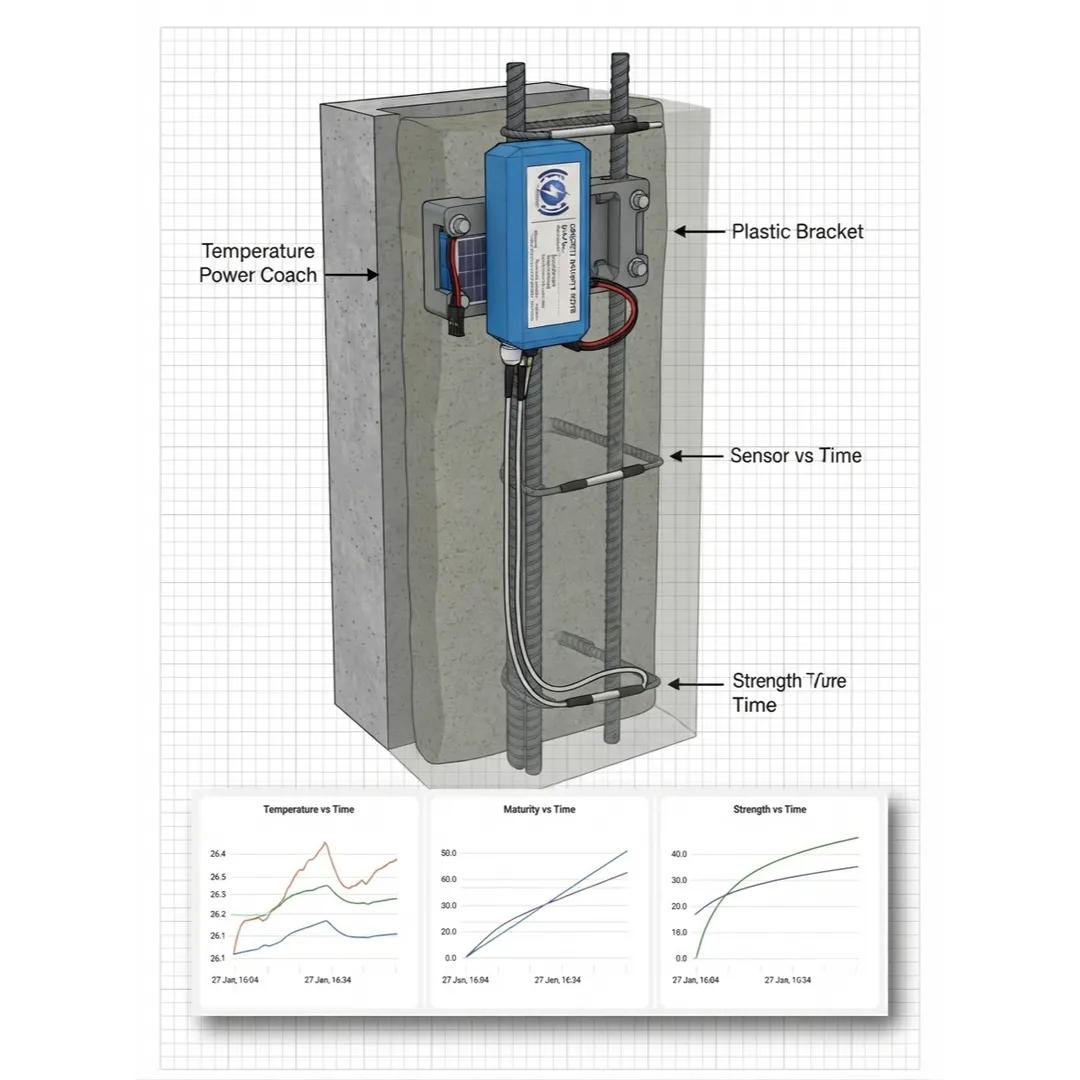
Another important point is sensor placement. Temperature sensors must be properly embedded inside the concrete. If they are placed too close to the surface, they may record lower temperatures than the core. If placed incorrectly, they can give wrong maturity readings and incorrect strength estimates.
Despite these limitations, the maturity method is very useful in modern construction. It reduces dependence on destructive testing and allows continuous monitoring of concrete strength. It also improves planning, scheduling, and quality control.
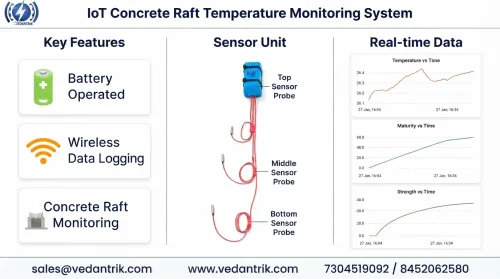
In advanced construction systems, maturity sensors are connected to digital monitoring systems. This allows engineers to check strength development in real time using mobile devices or computers. This is especially useful in large projects where multiple concrete pours happen simultaneously.
In conclusion, the concrete maturity method is a reliable and practical tool for predicting early-age strength of in-situ concrete structures. It uses temperature history to estimate strength development based on standards like ASTM C1074.
When used along with IS 456:2000 requirements and proper calibration, it helps engineers make safe and efficient construction decisions. It improves construction speed, reduces risk, and supports better quality control in modern concrete structures.
Keywords