
The Concrete maturity method is an advanced technique used in modern construction to estimate the early-age strength of concrete based on the combined effect of time and temperature. It is widely applied for optimizing formwork removal time, which is one of the most critical decisions in structural concrete works. Premature removal can cause structural damage, while delayed removal slows down construction and increases cost. The maturity method provides a scientific balance between safety and efficiency by predicting in-place strength in real time.
The basic principle of the maturity method is that concrete strength development depends primarily on the hydration of cement, which is strongly influenced by temperature. The method assumes that equal maturity corresponds to equal strength, regardless of how that maturity was achieved. This is expressed mathematically using the Nurse–Saul or Arrhenius functions, as defined in American Society for Testing and Materials standard ASTM C1074.
In the Nurse–Saul method, maturity is calculated as:
M = Σ (T - T₀) Δt
where M is the maturity index (°C-hours), T is concrete temperature, T₀ is datum temperature (commonly -10°C or 0°C), and Δt is time interval. This method is simple and widely used for field applications. The Arrhenius method, on the other hand, is more accurate because it accounts for the chemical reaction rate of hydration, especially at varying temperatures.
In structural construction, formwork removal decisions are traditionally guided by prescriptive codes. According to the Bureau of Indian Standards IS 456:2000, vertical formwork for walls and columns can generally be removed after 16–24 hours in normal conditions, while slabs and beams require 3–7 days depending on cement type and span. However, these time limits are conservative and do not account for actual temperature variations at site.
In real field conditions, especially in tropical regions like India, concrete temperatures can vary significantly. Daytime temperatures may reach 35–45°C, while nighttime temperatures may drop to 20–25°C. These fluctuations strongly affect hydration rate. In cold conditions, strength gain is slow, and in hot conditions, early strength develops faster. The maturity method captures these variations and converts them into a single parameter representing equivalent curing.
For formwork removal, the critical factor is achieving minimum required in-place strength. For vertical formwork, a strength of approximately 5 MPa is generally considered safe to prevent damage. For slab soffits and beam supports, higher strength levels such as 10–15 MPa may be required depending on structural span and loading conditions. The maturity method allows engineers to continuously monitor whether these strength levels have been reached without waiting for destructive cube tests.
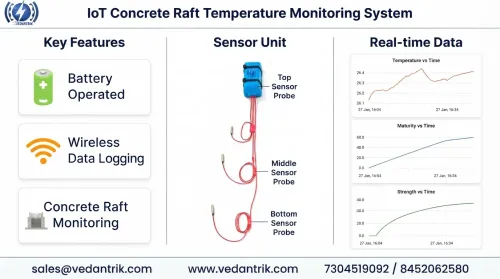
In practice, maturity sensors are embedded in concrete elements during casting. These sensors continuously record internal temperature, which is then used to calculate maturity in real time. A calibration curve is established in the laboratory by testing concrete cubes cured at different days (1, 3, 7, 14, 28 days). The compressive strength is then correlated with maturity index, creating a predictive strength model.
Once installed at site, the system provides real-time strength estimation. For example, if a slab reaches a maturity equivalent to 400–600 °C·hours, it may correspond to approximately 10–15 MPa strength depending on mix design. This allows engineers to safely remove formwork earlier than traditional methods would permit, improving construction speed and project efficiency.
One of the major advantages of using the maturity method is reduction in construction cycle time. In high-rise buildings, even a one-day reduction per floor can significantly reduce total project duration. It also improves resource utilization, as formwork can be reused sooner, reducing equipment idle time.
However, the method requires proper calibration for each specific concrete mix. Factors such as water-cement ratio, cement type (OPC, PPC, PSC), admixtures like accelerators or retarders, and aggregate properties influence strength development. Therefore, a single maturity-strength relationship cannot be universally applied. This is a key requirement emphasized in ASTM C1074.
Another important consideration is curing temperature uniformity. In mass concrete or large structural elements, temperature gradients can develop between core and surface. Core temperatures may exceed 50–60°C due to heat of hydration, while surface temperatures remain lower due to environmental exposure. This can cause differences in maturity readings depending on sensor location, which must be considered during interpretation.
Despite these limitations, the maturity method remains one of the most reliable non-destructive techniques for early-age strength estimation. It reduces dependency on cube testing, improves decision-making speed, and enhances construction safety when properly implemented.
In conclusion, the concrete maturity method provides a scientific and practical approach for optimizing formwork removal time in structural concrete works. It bridges the gap between theoretical curing time and actual in-situ strength development. When combined with standards such as IS 456:2000 and ASTM C1074, it ensures both structural safety and construction efficiency. As modern construction moves toward sensor-based monitoring and smart infrastructure, the maturity method is becoming an essential tool for real-time quality control.
Keywords