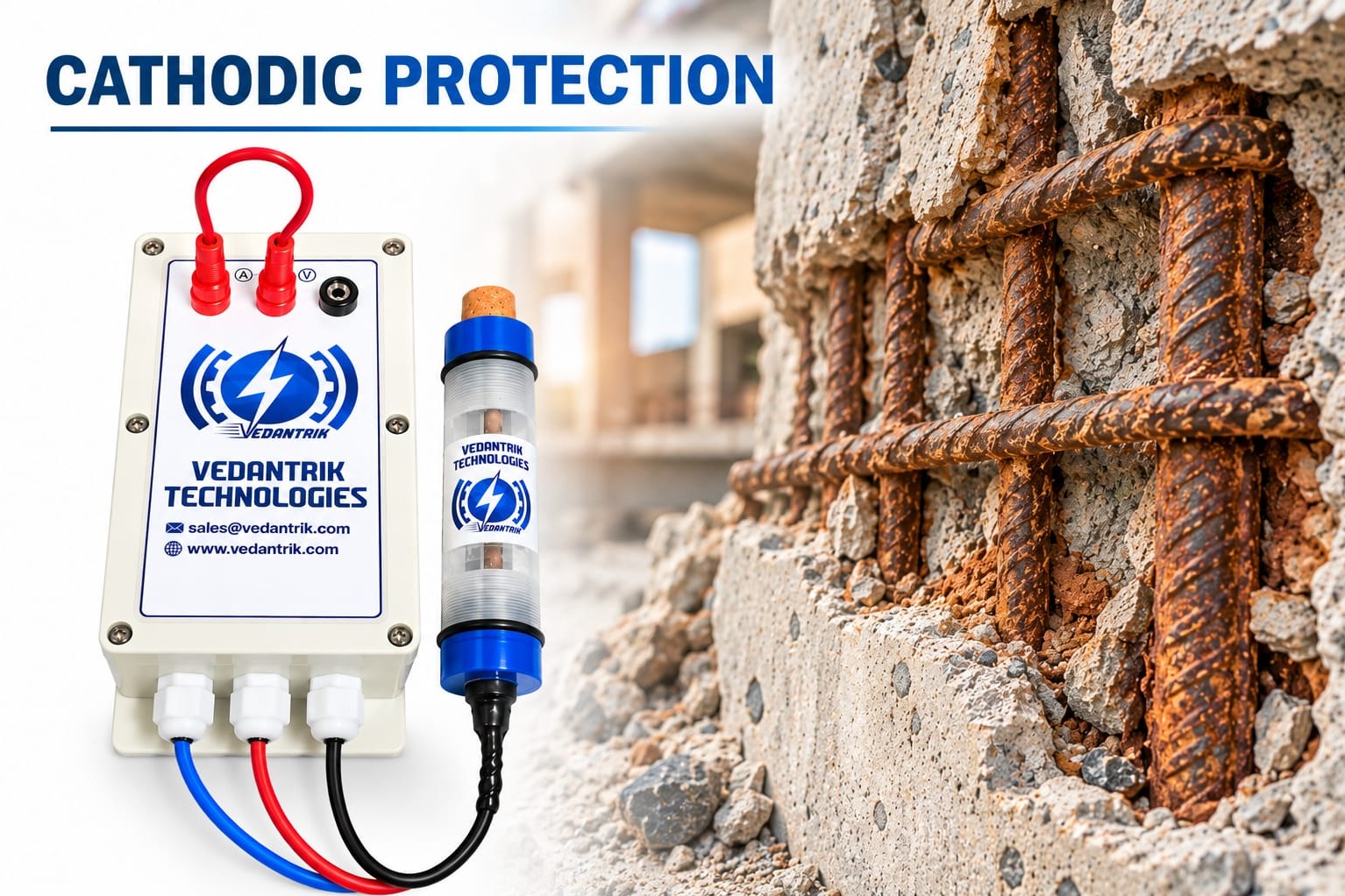
Cathodic protection (CP) systems are designed to prevent corrosion of steel and other metals by making them the cathode of an electrochemical cell. There are two primary types of cathodic protection systems: sacrificial anode systems and current cathodic protection (ICCP) systems.
Each type is suited for specific applications, advantages, and limitations, making it important to implement the correct system depending on the structure and environment.
- Sacrificial Anode Systems:
Sacrificial anode CP, also called galvanic protection, relies on attaching a more electrochemically active metal (anode) to the steel structure. Common anode materials include zinc, magnesium, and aluminum. These metals corrode preferentially, as a sacrificial anode and thereby protecting the steel. This particular is relatively simple to implement and does not require an external power source, making it simple, cost-effective, and low maintenance.
Sacrificial anode systems are widely used in reinforced concrete structures, or pipelines and storage tanks. They are ideal for situations where low protection current is sufficient, and monitoring is minimal. The main limitation is that the protection depends on the anode material and surface area, as the time passes the anode is consumed, requiring replacement.
- Impressed Current Cathodic Protection (ICCP) Systems:
In ICCP an external DC power supply is used as a source to provide electrons to the steel, maintaining it in a cathodic state. In this system, inert anodes such as mixed metal oxides, graphite, or silicon iron are installed, and current is impressed onto the steel. The ICCP system is particularly useful for large structures, pipelines, bridges, marine structures, and reinforced concrete exposed to aggressive environments, such as chlorides or sulfates. ICCP allows precise control of the current, ensuring uniform protection across a larger area of the steel reinforcement. Monitoring is essential to avoid over protection, which can also lead to localized corrosion at areas of high current density.
Comparison and Selection:
The choice between sacrificial anode and ICCP depends on several factors such as the structure size, environment, expected lifespan, maintenance capacity, and protection requirements. Sacrificial anode systems are most commonly used for small scale projects, while ICCP is better suited for large and critical infrastructures which require continuous monitoring of corrosion potential. In some cases, hybrid systems combine both methods to optimize protection and cost.
Other Considerations:
Modern CP designs also consider stray current interference, temperature effects, and concrete resistivity, which can have huge effects on the performance of both systems. Both systems require proper installation, monitoring, and periodic maintenance to ensure effectiveness throughout the structure’s service life. Advances in monitoring technology allow engineers to track steel potential, anode consumption, and current distribution, which helps maintain optimal protection.
In summary, the two main types of cathodic protection sacrificial anode and impressed current offer reliable solutions for preventing corrosion in steel-reinforced structures and pipelines. Understanding their principles, advantages, and limitations is crucial for designing effective CP systems that extend structural durability and minimize maintenance costs.
Keywords