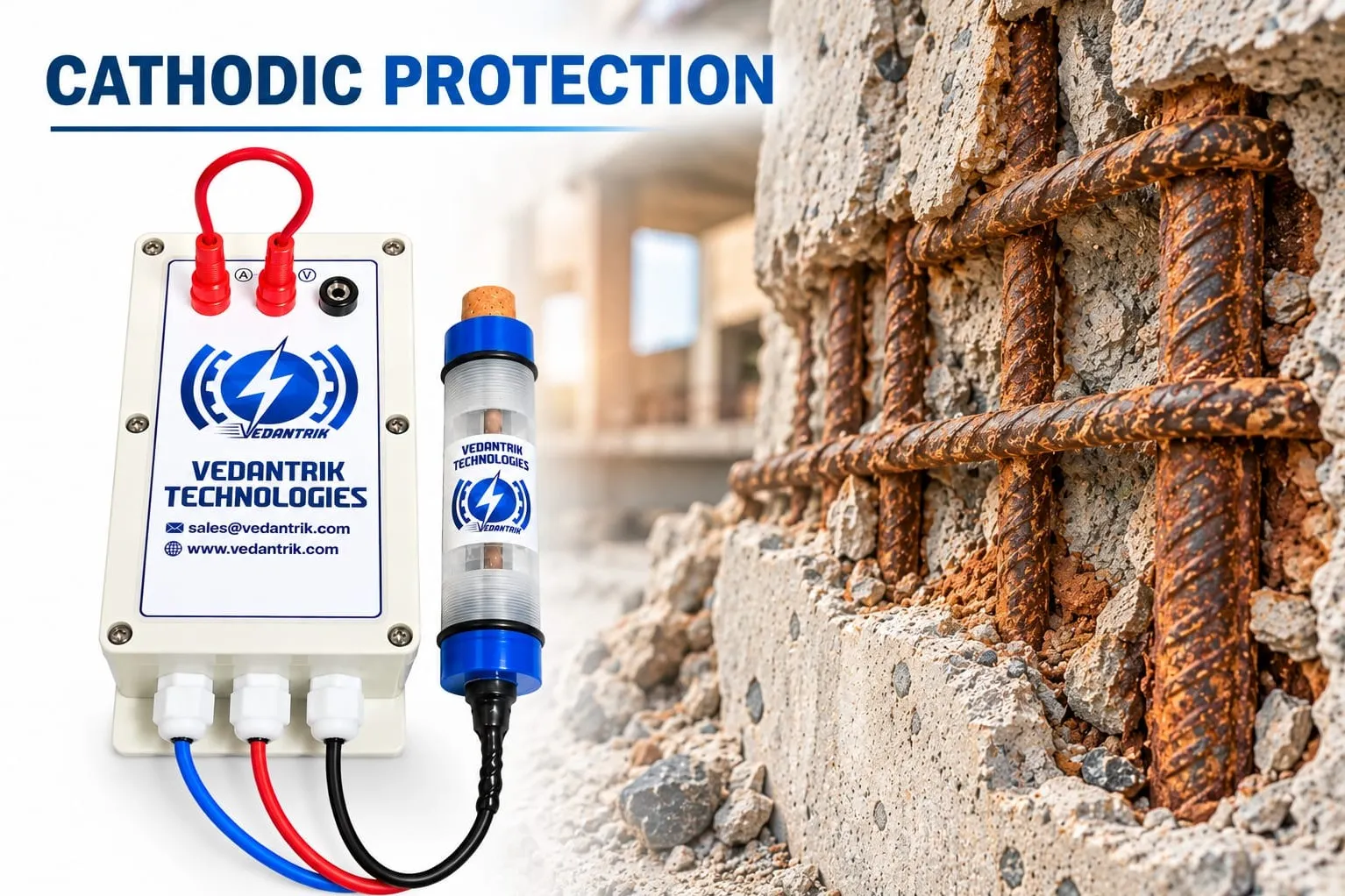
Cathodic protection (CP) is a widely used technique that is generally implemented to prevent or control the corrosion of metal surfaces, like steel reinforcements inside concrete or soil. The main objective behind this technique is to reduce the metal corrosion by making it act as a cathode of an electrochemical cell.
Corrosion occurs when metals, like steel, react with oxygen and moisture, forming rust or other oxides that weaken the structure over time. CP works by interrupting this natural electrochemical reaction.
There are two primary methods of cathodic protection: sacrificial anode systems and impressed current systems. In sacrificial anode CP, metals that are more reactive than steel, such as zinc, magnesium, or aluminum, are attached to the structure.
These anodes preferentially undergo corrosion and thereby protect the steel from corrosion. The principle relies on the electrochemical series, where a more anodic material corrodes instead of the cathodic structure. This method is widely used in reinforced concrete, pipelines, and underground tanks because it is simple, maintenance-free, and effective over time.
The second method which is known as impressed current cathodic protection (ICCP), uses external DC power sources to provide electrons to the steel structure, making it act as cathode. In this system, inert anodes, such as graphite or mixed metal oxides, are installed, and current is applied to maintain the steel in a non-corrosive state.
ICCP is particularly effective for large structures or where high protection current is needed. Unlike sacrificial anode systems,ICCP allows for adjustment of the current output to maintain optimal protection, making it suitable for environments with variable conditions.
CP works based on electrochemical principles. Corrosion of steel involves the flow of electrons from anodic areas (where steel loses metal ions) to cathodic areas (where reduction reactions occur). By providing an external electron source or a more active sacrificial anode, the flow of electrons is redirected, halting the natural corrosion process. Continuous monitoring of voltage and current ensures that the steel remains in a protective cathodic state.
Overall, cathodic protection is an effective technique for extending the service life of the steel reinforced structures, pipelines and storage tanks etc. It is especially important in harsh environments, such as coastal regions or areas with high soil moisture, where conventional methods such as coating may not be sufficient in providing effective protection. Proper design, installation, and maintenance of CP systems are crucial to ensure efficiency, avoid over-protection, and prevent localized corrosion problems.
Keywords