
De-shuttering in mass concrete is one of the most critical stages in construction of raft foundations, pile caps, dams, retaining walls, and other large concrete structures. Removing shuttering at the wrong time can lead to thermal cracking, shrinkage cracks, and durability issues due to sudden temperature changes and uneven cooling.
In mass concrete, de-shuttering should never be decided only based on the number of days. It must always be based on actual temperature monitoring data and the thermal behavior of the concrete.
Correct De-Shuttering Criteria in Mass Concrete
De-shuttering shall be permitted only after all temperature conditions are satisfied. The temperature difference between the core and edge, core and top surface, and the warmest edge and ambient temperature should each be less than 20°C.
This limit is followed as per general mass concrete practices and ACI-based thermal control principles to ensure that the concrete has stabilized thermally and is no longer at risk of developing thermal stresses due to rapid cooling.
Core Temperature Should Start Reducing
Before de-shuttering, it is essential that the core temperature of the mass concrete has already reached its peak and started a steady and continuous downward trend.
This indicates that the heat of hydration has reduced, the concrete has entered the cooling phase, and no further significant temperature rise is expected inside the structure.
If shuttering is removed before the peak temperature cycle is completed, the outer surface may cool quickly while the core remains hot, creating a high temperature gradient which can result in thermal cracking.
Why Early De-Shuttering is Risky
In mass concrete, the shuttering acts as insulation and helps in controlling heat loss from the concrete surface. If shuttering is removed too early, the surface temperature drops suddenly while the core temperature remains high.
This sudden change increases the temperature differential within the concrete, which leads to internal stress development. These stresses can result in surface cracks, internal cracks, and long-term durability problems.
Therefore, early de-shuttering without temperature verification is highly risky in mass concrete works.
Typical De-Shuttering Time in Mass Concrete
In general, de-shuttering in mass concrete is allowed after approximately 15 to 30 days. However, this time period is not fixed and depends on several factors:
- Concrete mix design
- Cement content
- Use of fly ash or GGBS
- Size and thickness of mass concrete
- Ambient weather conditions
- Rate of heat generation
- Cooling rate of concrete
- Consultant/project specifications
Larger and thicker rafts usually require longer insulation and shutter retention periods because heat dissipation takes more time.
Importance of Temperature Monitoring Before De-Shuttering
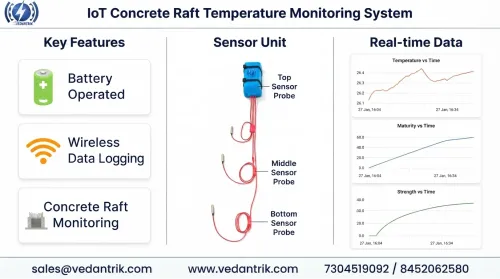
Proper temperature monitoring is essential before taking any de-shuttering decision. Thermocouples should be installed at Top, Middle, and Bottom locations of the mass concrete to accurately capture temperature behavior.
These sensors help monitor core temperature, surface temperature, edge temperature, ambient temperature, and temperature differential trends. This data is used to ensure that the concrete has cooled sufficiently and is safe for shutter removal.
Role of Wireless Temperature Monitoring Systems
Modern Wireless and Battery-Operated Mass Concrete Temperature Monitoring Systems make it easier to track real-time temperature data without dependency on wired systems or external power supply.
Vedantrik Technologies provides advanced wireless monitoring solutions that allow engineers to continuously monitor temperature data on mobile phones, laptops, and tablets. This helps in making accurate and timely decisions regarding safe de-shuttering.
Since the devices are installed directly near the thermocouple sensors, there is minimal risk of cable damage, ensuring uninterrupted and reliable temperature monitoring throughout the curing period.