Steel reinforcement in concrete structure provides additional durability and strength, and extends the service life of the structure. However, the steel reinforcement inside concrete is prone to corrosion as the structure gets older, and can compromise safety and service life.
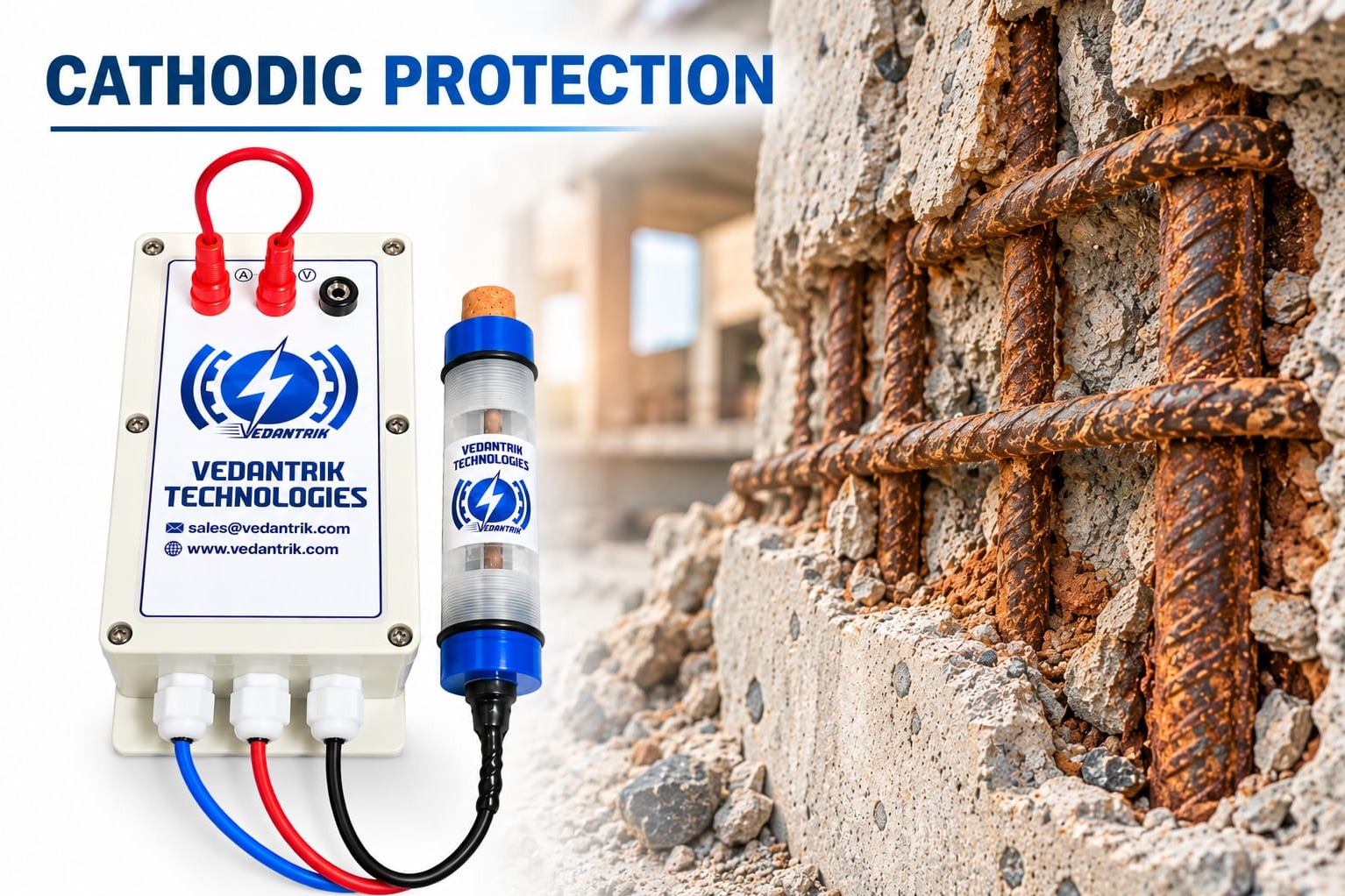
Corrosion of the steel reinforcement is mostly initiated by aggressive agents like chloride ions, carbon dioxide or moisture that penetrate deep inside the concrete and reach the steel. These agents then disintegrate the oxide layer surrounding the rebar which protects it from corrosion.
By-products of corrosion reaction occupy greater volume than steel, leading to cracking, and weakening of the concrete. Cathodic protection (CP) is essential because it resolves the main cause of this deterioration by preventing the steel from corroding, thereby preserving the strength and durability of reinforced concrete structures.
Cathodic protection works by making the steel reinforcement act like a cathodic electrode of an electrochemical cell. In properly installed cathodic protection systems, either using a sacrificial anode or ICCP, provide enough supply of electrons to the steel, to halt or greatly reduce the corrosion process.
Unlike surface coatings or sealants, which wear off or get damaged over time, cathodic protection provides a continuous, even in the presence of cracks or minor concrete defects. This is particularly important in environments with corrosive agents such as marine structures, bridges, parking decks, and industrial facilities where chloride penetration from the environment is common.
Implementing cathodic protection systems early in the structure or even during maintenance assures for long-term protection, minimizing costly repairs. Additionally, CP extends the service life of reinforced concrete structures, which is important for infrastructures such as bridges, tunnels, and piers,where safety is most important.
Another critical reason CP is important is that it allows structures to maintain their structural integrity. Corrosion along with reducing the strength also leads to development of cracks both in the steel reinforcement and concrete. By preventing corrosion, CP ensures that structures remain both safe and its service life remains acceptable over time.
Monitoring systems integrated with CP further enhance its effectiveness by tracking steel potential, current distribution, and anode performance, allowing engineers to adjust the system as needed to maintain optimal protection.
In summary, cathodic protection is a vital technology for reinforced concrete structures. It prevents steel reinforcement corrosion, prolongs service life, reduces repair costs, and maintains both structural integrity and aesthetics. In environments prone to chloride exposure or carbonation, CP often becomes the most reliable solution for long-term durability.
Its effectiveness, combined with proper design, installation, and monitoring, ensures that reinforced concrete structures remain safe and durable throughout their intended lifespan.
Keywords