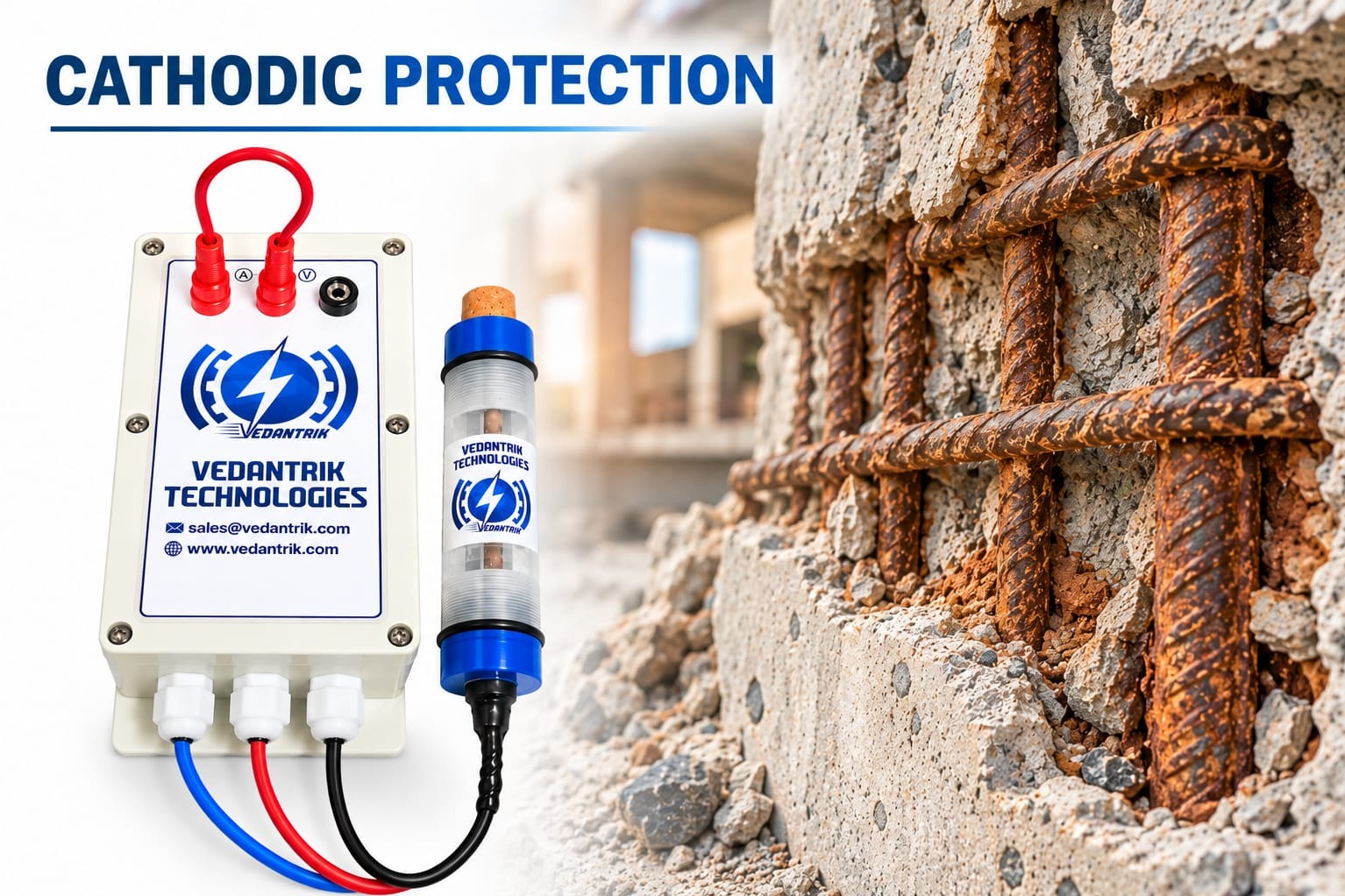
Cathodic protection (CP) is an effective method for preventing corrosion of steel structures, but its success heavily depends on proper design and installation. Even the most advanced CP system can fail if it is poorly designed or incorrectly installed. Ensuring that the system is effective to that specific environment, structure type, and operational conditions is essential for achieving long-term durability, minimizing maintenance costs, and extending the service life of steel-reinforced concrete, pipelines, or marine structures.
1. Importance of System Design:
The design phase determines how effectively the CP system will protect steel over its intended lifespan. Critical design considerations include the type of CP system (sacrificial anode or impressed current), the number and placement of anodes, current density requirements, structural geometry, and environmental factors such as chloride exposure, moisture, and soil resistivity. A poorly designed system may provide uneven protection, leaving some areas of steel exposed to corrosion while overprotecting others, which can lead to cracking in concrete. Accurate design calculations ensure that the system delivers sufficient current to all steel surfaces without causing over protection.
2. Correct Anode Placement and Current Distribution:
Effective CP requires uniform current distribution to all parts of the steel structure. Improper anode placement or spacing can result in localized corrosion at areas with insufficient protection. In reinforced concrete, for example, remote steel elements deep within thick sections may be efficiently protected if anodes are not correctly positioned. Similarly, in pipelines, improper anode spacing or inadequate cabling can leave long sections vulnerable. Careful design ensures that all steel surfaces receive appropriate current levels and that potential differences are minimized.
3. Installation Quality and Materials:
Even a well-designed CP system can fail if installation is substandard. Proper electrical connections, secure anode attachment, proper insulation, and reliable power supply (for impressed current systems) are crucial. Poor-quality materials, loose connections, or incorrect placement can result in current loss, system malfunctions, or short-circuiting. In sacrificial anode systems, selecting the correct anode type and size is critical to match the structure’s corrosion demands and environmental conditions.
4. Adaptation to Environmental Conditions:
Environmental factors, such as soil resistivity, moisture, temperature, and chloride concentration, significantly affect CP efficiency. The design must consider these variables to ensure that the system operates effectively under all conditions. For example, in marine environments with high chloride levels, CP current requirements are higher, and anode consumption rates are faster. Properly accounting for these factors during design ensures long-term protection.
5. Monitoring and Maintenance Considerations:
A well-designed and correctly installed CP system facilitates monitoring and maintenance. Incorporating reference electrodes, inspection ports, and accessible wiring allows engineers to measure steel potential, current output, and anode performance, enabling timely adjustments and preventing failures.
In summary, proper design and installation are critical to the long-term performance of cathodic protection systems. They ensure uniform protection, prevent localized corrosion or over protection, and accommodate environmental challenges. Quality materials, precise installation, and integration of monitoring features make the system reliable and durable, safeguarding steel structures against corrosion for decades and reducing costly repairs or structural failures.
Keywords