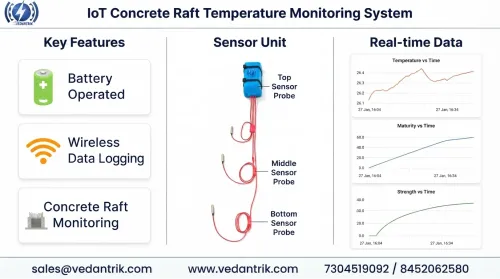

Concrete curing is a crucial process because it directly influences the natural progression of cement hydration, which is highly sensitive to temperature variations.
Fluctuations in curing tank temperature affect the rate of cement hydration and, in turn, influence early-age strength development in concrete.
Since cement hydration is an exothermic reaction that releases heat, improper control can lead to heat accumulation, which increases the internal temperature of the concrete.
Higher temperatures accelerate hydration but may also result in improper microstructure development, altering the pore structure and overall hardness of the concrete cube.
On the other hand, if the temperature is too low, the hydration process slows down, delaying early-age strength gain.
Therefore, continuous temperature regulation in curing tanks is necessary to maintain optimal curing conditions for concrete.
As per IS 516, the recommended temperature range for proper curing is 27 ± 2°C. Any deviation from this standard range can significantly influence the hydration process.
For both laboratory and field applications, curing tank temperature monitoring is essential to ensure that concrete curing is carried out under controlled conditions in compliance with standards.
Proper curing ensures that strength tests performed on cubes or cylinders are accurate and reliable. It also ensures that durability tests such as RCPT and RCMT are not affected by improper curing conditions.
Since inadequate curing can alter microstructure development, it may increase the porosity of concrete and consequently raise its permeability to chloride ions. This can lead to inaccurate RCPT or RCMT results and incorrect interpretation of concrete mix performance.
By continuously monitoring temperature, engineers and laboratory personnel can identify deviations, evaluate the risk of thermal cracking, and take timely corrective actions such as adjusting curing tank water temperature, ensuring water circulation for uniformity, or modifying environmental controls in curing rooms.
In addition to achieving optimum strength and durability, maintaining ideal curing temperatures also supports concrete mix design optimization by allowing observation of hydration behavior with different admixtures and supplementary cementitious materials (SCMs), which influence hydration kinetics.
In simple terms, a curing tank with continuous temperature monitoring ensures consistent curing conditions, which is essential for evaluating mix designs, meeting standards, and researching new cement-based materials.
Continuous monitoring makes the curing process controlled and reliable, reduces errors, improves consistency, and helps preserve the long-term quality of concrete.
Keywords