Concrete resistivity is a non-destructive testing method for concrete durability assessment, by measuring the electrical resistance of the concrete under an applied current.
The electrical resistance of the concrete directly reflects ionic permeability, porosity, and micro-structure network of the concrete, which allows engineers to evaluate the durability and service life of the concrete.
Concrete is inherently porous, and may contain large networks of capillaries, micro-cracks, coarser structure, that form pathways for movement of different ions which can initiate the corrosion of the steel reinforcement.
The pore solution of the concrete which naturally holds different anions along with water can establish potential difference between the steel reinforcement and concrete which makes the concrete highly conductive.
However the conductivity is mainly dependent on the internal micro structure of the concrete that either resists or allows passage of such ions through its porous structure.
Hence, concrete resistivity allows one to evaluate how well the concrete structure is able to resist the movement of aggressive agents, particularly chloride ions which destabilize the oxide layer around the steel, exposing it to the moisture, which causes the corrosion.
The higher the resistivity, the more difficult it is for ions to move through the pore network, meaning lower corrosion probability. Conversely, low resistivity indicates that concrete structure is conductive and prone to corrosion risk.
Because of these clear correlations, resistivity testing is now widely used by engineers, researchers, and contractors for quality control, service-life prediction, and maintenance planning.
The two most common methods used to perform the concrete resistivity test are surface resistivity testing also known as Wenner probe method and Bulk resistivity method.
Although both the methods measure the electrical resistance of the concrete, their procedures and application make them different, making it important to understand which method should be used.
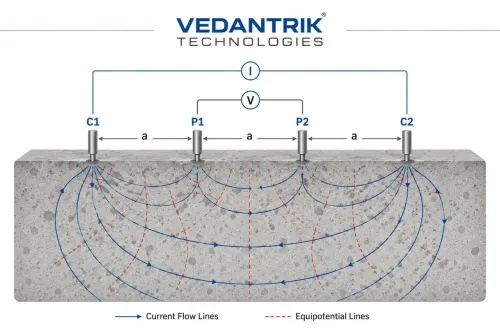
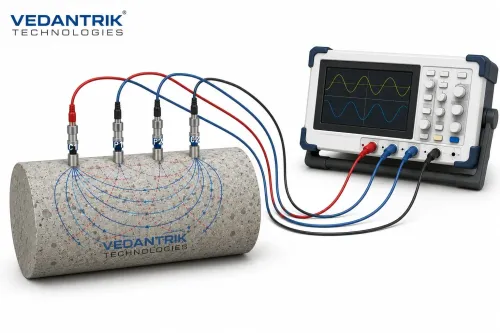
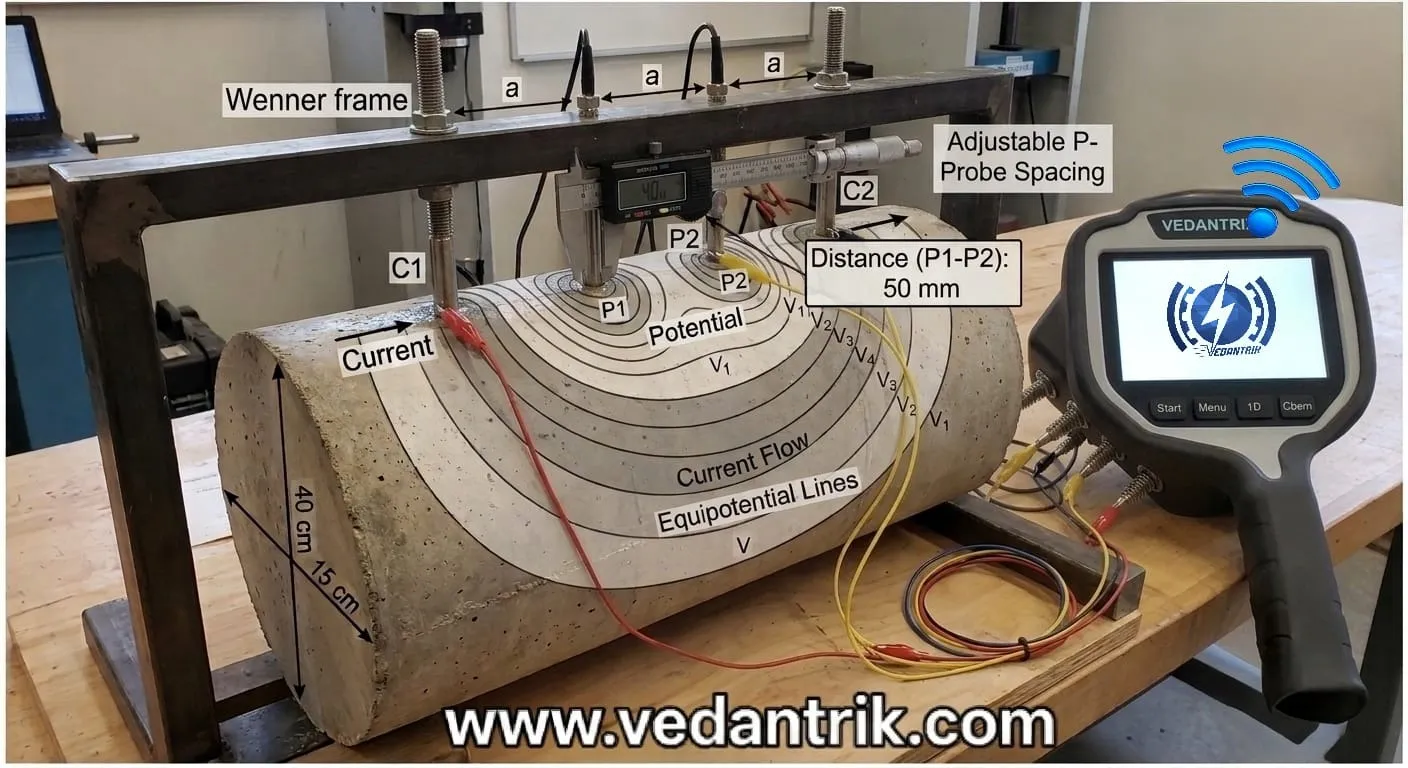
Surface resistivity testing involves placing a four-point Wenner probe on the concrete surface, applying an electric current, and measuring the resulting potential difference.
This technique is a fast, non-destructive method suitable for field applications. It allows testing of concrete structures without the need of removing the core.
However, surface conditions such as moisture gradients, surface roughness, and carbonation can influence the measurements.
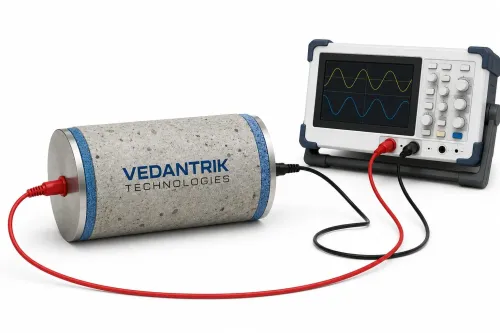
Bulk resistivity testing, on the other hand, involves measurement of electrical resistance across the entire volume of a concrete cylinder or cube. This test is typically conducted in a laboratory environment using a water saturated concrete core or cylinder.
Since the entire concrete sample is used to measure the electrical conductance, this method is sensitive to the moisture condition of the surface and provides a more accurate representation of the concrete’s internal pore structure.
This makes it particularly suitable for research studies, mix optimization, and comparative evaluation of new materials or admixtures.
The decision to use surface or bulk resistivity totally depends on the testing objective. For quality control of fresh or recently cast concrete, bulk resistivity is valuable because samples can be tested under controlled moisture conditions.
For inspection of new structures, surface resistivity is more preferable due to its non-destructive nature.
In many projects, both tests are used together: bulk resistivity helps establish baseline mix performance, while surface resistivity supports ongoing structural assessment.
One of the main reasons engineers rely heavily on resistivity testing is its strong correlation with chloride permeability. High resistivity typically indicates a dense micro-structure with low diffusion rates.
Many service-life models and design standards now use resistivity values to classify durability performance.
In summary, concrete resistivity tests offer significant benefits, providing reliable, non-destructive insight into corrosion potential and permeability.
Keywords