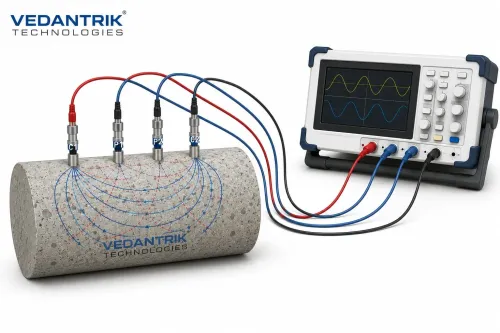

Water curing is commonly used in normal concrete works, but in mass concrete it is generally avoided or used very carefully. This is because mass concrete behaves differently due to high heat generation inside the structure. Raft foundations, pile caps, dams, and other thick concrete elements require controlled temperature management rather than direct water cooling.
a. Sudden Temperature Drop Causes Thermal Shock
Mass concrete has high internal heat due to cement hydration. If cold water is directly applied on the surface, it causes sudden cooling of the outer layer while the core remains hot. This creates a large temperature difference, which can lead to thermal stress and cracking.
b. Increases Temperature Gradient
Water curing cools the surface quickly, but the inside temperature reduces slowly. This increases the temperature gradient between core and surface. If this difference becomes too high, it can lead to:
- Thermal cracks
- Surface cracking
- Internal stress development
In mass concrete, controlling temperature difference is more important than rapid cooling.
c. Risk of Surface Cracking
Due to fast cooling of the outer layer, the surface contracts faster than the core. This uneven contraction creates tensile stress on the surface, which may result in early-age cracks.
d. Disturbs Heat of Hydration Balance
Mass concrete requires gradual and controlled dissipation of heat. Water curing disturbs this natural cooling process by forcing rapid heat loss from the surface, which affects overall temperature balance in the structure.
e. Moisture vs Temperature Conflict
While curing is needed to maintain moisture, mass concrete already retains moisture due to its large volume. The main issue is not moisture loss but temperature control. In such cases, insulation curing is more important than water curing.
f. Importance of Temperature Monitoring
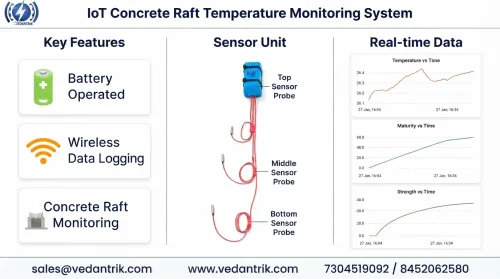
In mass concrete, curing decisions should be based on temperature monitoring rather than traditional methods. Sensors installed at top, middle, and bottom help track:
- Core temperature
- Surface temperature
- Temperature differential
This ensures curing method does not damage the concrete
Water curing is generally avoided in mass concrete because it causes rapid surface cooling, increases temperature gradient, and creates thermal stress. Instead of water curing, insulation-based curing methods are preferred to control heat loss and maintain uniform temperature. Proper temperature monitoring is essential to ensure safe curing and prevent cracking in mass concrete structures.
Keywords