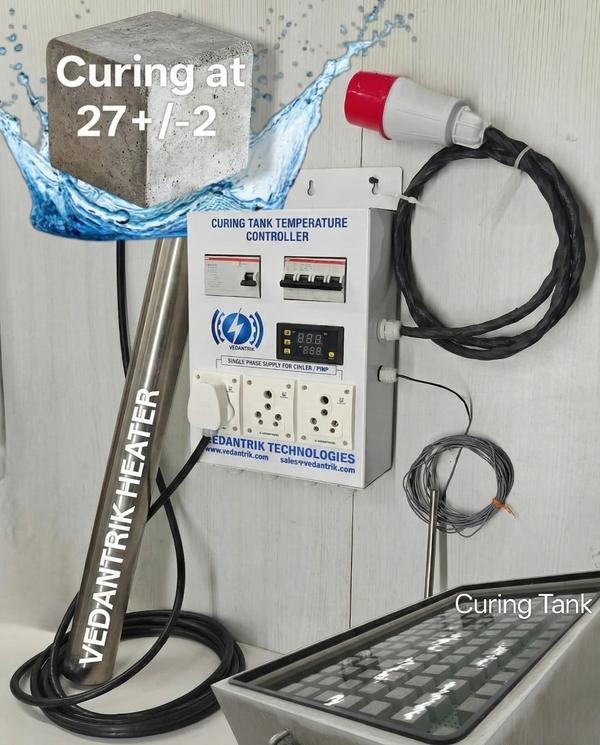
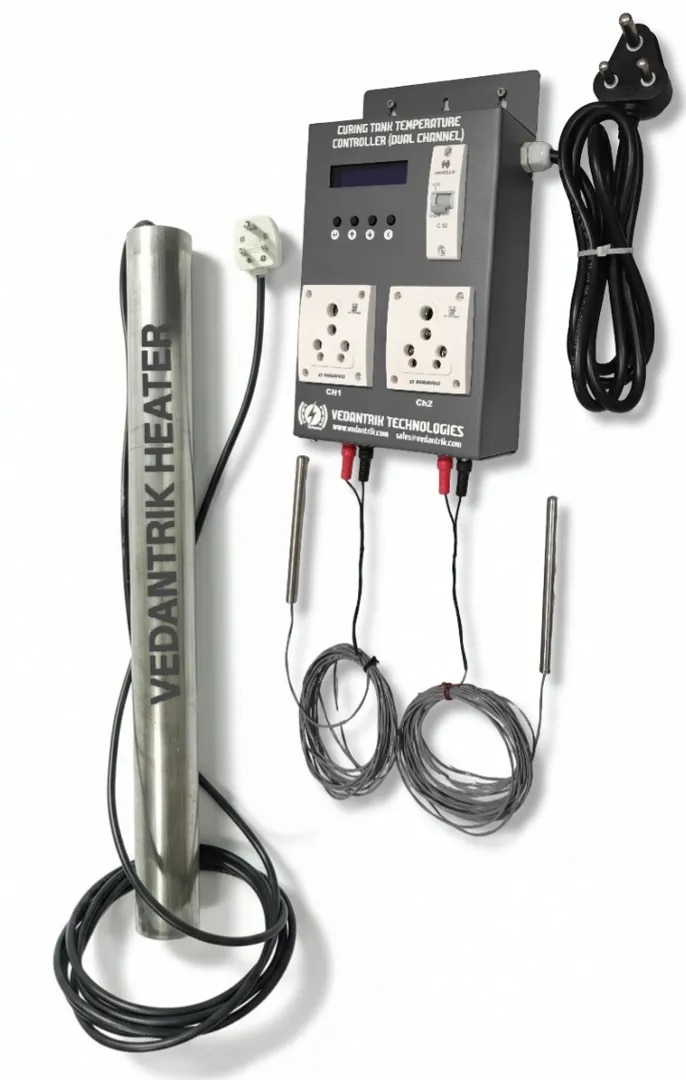
Curing Tank Temperature Controller & Heater
Description
Curing Tank Temperature Controller to Maintain 27 +/-2 with immersion Heater & Chiller:
Automatic curing tank temperature controller developed by Vedantrik technologies will help to maintain 27 +/- 2 degree Celsius, in the curing tank where concrete cubes are kept for the curing .
When it comes to larger infrastructure projects and construction sites, the concrete cubes are casted on site in large numbers, then the curing tanks have limitation of size hence there is a need of onsite concrete curing tanks where concrete cubes are kept for curing.
the large number of cubes that require proper water curing to ensure strength and durability. A critical aspect of proper curing is maintaining a consistent water temperature of 27 ± 2 degree C (I.e., between 25 to 29 degree C), which becomes increasingly difficult in an uncontrolled environment.
To tackle this issue, the main controller is equipped with a 2 and 4 channel temperature controller, paired with a waterproof and shockproof stainless steel heater, specifically designed for immersion in curing tanks.
The main unit also comes with waterproof temperature sensors that continuously monitor the curing tank temperature and provide real-time feedback to the controller. The automatic controller ensures that the heater is turned ON when the temperature in the tank falls below 25 degree C and OFF when it exceeds 29 degree C, thus maintaining the optimal temperature for curing, without the need for manual intervention.
The stainless steel immersion heater has a temperature handling capacity ranging from 0 to 100°C, making it suitable for a variety of environments and use cases. The system's automatic ON/OFF control mechanism ensures energy efficiency, safety, and consistent temperature regulation, which is vital for maintaining the integrity of concrete test specimens.
Its shock proof and protection against shock and earth leakage makes it very useful for onsite applications.
Key features:
1. Precise Temperature Control (25°C to 29°C Range): The controller is designed to maintain water temperature within the optimal curing range of 27 ± 2°C, as specified in IS 516. It automatically activates the heater when the temperature drops below 25°C and cuts it off once it exceeds 29°C. This ensures consistent curing conditions crucial for accurate concrete strength testing.
2. Multi Channel Operation: The system features a Multi channel controller, allowing it to manage the multiple heater and temperature sensor simultaneously. This Multi channel setup enhances reliability, especially useful for larger curing tanks or setups with varying thermal loads or two different channels can be used for two different tanks if the water capacity is within range.
3. Waterproof and Shockproof Design: all the immersion heater and temperature sensor are designed to be fully waterproof and shockproof, ensuring safe operation in wet environments. This is especially important for construction sites where durability and safety are top priorities.
4. Stainless Steel Immersion Heater: The heater is made from high-grade stainless steel, offering resistance to corrosion and extended durability. It supports a wide operating temperature range (0°C to 100°C ± 1°C) and is suitable for long-term immersion in curing tanks without degrading.
5. Automatic On/Off Mechanism: The controller uses an automated switching system that turns the heater on or off based on real-time temperature feedback. This not only simplifies operation but also improves energy efficiency and prevents overheating or under-curing of concrete specimens.
6. High-Capacity Support: The controller supports immersion heaters up to 3000 Watts (3 kW), making it ideal for large curing tanks that require faster and more efficient heating.
A curing tank temperature controller is an essential component in maintaining the ideal temperature environment required for curing of concrete samples. The device ensures that the curing takes place under controlled thermal conditions, which is essential for achieving optimal material properties like strength , durability, and structural integrity over time. As mentioned by IS 516 code, the ideal temperature for concrete curing is 27 ± 2 degree C, at which the concrete achieves optimal development. Hence, the controllers are specifically designed to regulate and stabilise the water’s temperature within the curing tank, maintaining it around 27 ± 2 degree C as per the standard requirement.
Unlike general purpose thermostats, curing tank temperature controllers are specifically designed for laboratory and industrial settings where minor temperature fluctuations can significantly affect the curing process. The temperature controller continuously monitors the water temperature using highly temperature sensors, typically thermocouples or resistance temperature detectors (RTDs) which provide real-time feedback. This temperature value is used to dynamically adjust the heater placed in the curing tank, to ensure that the temperature remains within the tolerance range.
Additionally, some construction materials are particularly sensitive to curing conditions. The hydration reaction of the cement, which is fundamental to the development of strength and integrity in concrete, is exothermic and highly influenced by surrounding temperature. Too low temperature can slow down the reaction and result in underdeveloped mechanical properties, while excessive heat may lead to rapid evaporation, shrinkage or micro-cracking. Therefore the role of curing tank temperature becomes pivotal in preserving the homogeneity and reproducibility of curing conditions, especially in quality control laboratories, research institutions, and construction testing facilities.
Purpose of curing tank temperature controller:
1. Essential for maintaining a constant temperature to ensure curing water stays at a stable temperature (27 ± 20C) for consistent curing.
2. Ensures proper cement hydration, providing ideal conditions for the hydration of cement, leading to proper strength development in concrete specimens.
3. To prevent over-heating or under-heating or any temperature fluctuations that can negatively affect the curing process and compromise concrete quality.
4. Enables automatic temperature regulation and continuous monitoring, reducing the need for manual intervention.
Principle of Curing:
The effectiveness of concrete curing is fundamentally governed by the physicochemical and thermodynamic conditions to which the cementitious matrix is exposed during the early stages of hydration. The curing environment particularly in immersion based systems such as curing tanks plays a pivotal role in regulating the moisture availability, temperature equilibrium, ionic mobility, and phase development within the hydrated cement paste. At the core, curing tank functionality is primarily important to sustain a saturated aqueous environment that ensures uninterrupted progression of cement hydration reaction. Concrete strength gain is intrinsically linked to the kinetics of cement hydration, a complex exothermic reaction between water and cementitious materials such as tricalcium silicate, dicalcium silicate, tricalcium aluminate, and tetracalcium aluminoferrite , which requires continuous availability of water. In the absence of adequate moisture, endogenous shrinkage may halt the hydration process prematurely that may lead sub-optimal development of calcium-silicate-hydrate (C-S-H) gel and other reaction products that contribute materials structural integrity.
However, the immersion curing via a water tank mitigates this risk by establishing a thermodynamically stable water-rich boundary at the concrete surface. This condition then eliminates formation of moisture gradient and suppressive evaporation, thereby preserving the internal humidity at 95% , which is critical for advancements of later-stage hydration. Additionally, water also provides a medium for heat dissipation of heat and ionic species, which in turn maintains the thermal homogeneity and equilibrium phase distribution across the concrete mix. Therefore, temperature regulation within the curing tank is equally important, as the rate and the extent of hydration is temperature-sensitive. At temperatures below the optimal range the rate of hydration process is significantly lower, resulting in reduced early-stage strength, and potential issues with delayed ettringite formation (DEF). Conversely, curing at elevated temperatures can accelerate the early hydration, promoting rapid calcium-silicate-hydrate (C-S-H) gel precipitation near the cement surface. This can lead to formation of diffusion limiting shells, which impedes inward diffusion of water and ions, thereby disturbing the long-term strength development in concrete.
As per IS 516, the standard temperature for curing recommended is 27 ± 2 degree C, as this range provides an optimal balance between kinetics and structural integrity of the hydration products. This is particularly critical in the formation of porosity, high durability matrix. The solubility equilibrium of calcium hydroxide (Ca(OH)2), which is one of the major byproducts of hydration, is also temperature dependent. Higher temperatures can decrease the solubility of Ca(OH)2, which may lead to supersaturation and premature precipitation, which then influences the availability of calcium ions, necessary for polymerisation of silicate chains in C-H-S. Therefore the role of curing tank temperature becomes significantly important in preserving the homogeneity and micro-structural integrity of concrete mix during the curing process.
Formula to find the Power, Heat, Time required to maintain the temperature of Water 27+/-2 degree celsius in a Curing Tank
Step1:
Calculate the mass of water by calculating the volume of your tank.
For example the Tank Size is 3x2x0.6 meter
Volume of water if tank is fully filled = 3x2x0.6 = 3.6 (Meter Cube)
Mass of water = density of water * Volume of water= 1000*3.6= 3600Kg
Step2:
Calculate the heat required
Formula : Q= m*Cp*(t2-t1)
Q= heat Required in Joules . (J)
m= Mass of Water in kg
Cp= Specific capacity of heat for water (4184 j/kg.k rounded to 4200)
t2= The final temperature which need to be achieved
t1= Lower temperature or ambient temperature
Let’s consider temperature of your city or ambient temperature is 20 degree Celsius and temperature required to maintain is minimum 25 degree Celsius.
Q= m*Cp*(t2-t1) = 3600*4200*(25-20)= 75,600,000 Joules or 75,600 KJ
So if we consider to supply 75,600KJ of heat Per second then that becomes a power as power is P=(Q/T) hence P= 75,600KW
In practicality the available heaters are of 3KW which mean heater will supply 3KJ of heat per second, hence to supply 75,600 KJ of Heat using a heater of capacity 3KW it will require (75600/3)=25200 seconds , Means 7 hours (assuming No Heat Loss) will be required which is high response time, hence the Number of heater need to be increased based on the required response time or the size of tank.
For the above case if we use 4 Heaters of 3KW capacity, it will take 1 hour and 45minutes to raise the temperature of water from 20 to 25 degree celsius, with the given tank size and assuming no heat loss and the tank is fully filled.
Key Considerations
1. Consistency of Units:Ensure your units are consistent. If using Celsius for ΔT, use the specific heat capacity for J/kg·°C or J/kg·K.
2. Heating Time: Be specific about how quickly you need the water to reach the target temperature. A shorter time requires more power.
3. Heat Losses: These calculations provide a minimum theoretical power. In reality, some heat will be lost to the surroundings, so you may need to account for that
Main components of curing tank temperature controller:
1. Temperature Controller Unit: To continuously monitor and regulate the temperature condition during the curing process.
2. Temperature sensors: RTD or thermocouples that measure the water temperature inside the curing tank.
3. Heater: An electric immersion heater to raise the water temperature as needed. Typically activated by the controller to maintain the desired curing temperature.
4. Display interface: Allows the to set and monitor temperature in real-time.
5. Chiller: Required in summer
Standard Procedure: Overview
1. Filling the Tank with Water
Fill the tank with clean, preferably distilled or potable water to the required level. The water should cover specimens completely during curing. Impurities in water can affect all sensor performance and specimen quality.
2. Installing the Temperature Probe or Sensor
The temperature probe or sensor should be securely placed inside the tank, typically at mid-depth, to monitor the water temperature accurately. It must be fully submerged and away from the heating or cooling element to avoid false readings. Ensure that the sensor cable is routed safely to avoid kinks, tension, or contact with hot surfaces.
3. Connecting Heater
Place and connect the heater (and cooling system, if applicable), after immersing the heater should be positioned low in the tank, fully submerged, and spaced away from the tank walls and sensors. Improper installation can lead to inconsistent temperature or damage to the components.
4. Connecting the Controller
Connect the controller to the sensor and heating/cooling system. Use appropriate terminals and ensure secure electrical connections. Plug into a grounded power source and power on the system to begin monitoring temperature.
Factors Influencing Curing Tank Temperature Controller
a) Ambient Temperature
External environmental conditions can significantly impact the tank’s internal temperature. High ambient temperatures can cause overheating, while low surroundings may strain the controller to maintain the desired range.
b) Thermostat Sensitivity
The responsiveness and calibration of the thermostat directly affect temperature accuracy. Poorly calibrated thermostats may lead to under- or over-heating of the curing water.
c) Water Circulation
Inadequate or uneven water circulation can lead to temperature stratification, where some parts of the tank are hotter or cooler than others. Proper circulation ensures uniform curing.
d) Heater Efficiency
The efficiency and capacity of the heater to determine how quickly and evenly the water reaches and maintains the set temperature. Aging or faulty heaters may lead to slow or inconsistent heating.
e) Insulation Quality
Good insulation helps maintain a stable internal temperature by reducing heat loss to the environment. Poor insulation increases energy use and makes the system more prone to fluctuations.
Proper curing is essential to achieve the intended strength and durability of concrete. The Curing Tank Temperature Controller ensures that curing tanks maintain precise temperature levels for specimen preparation and testing.
Vedantrik Technologies manufactures reliable curing tank temperature controllers and heaters that comply with testing standards. In Mumbai, where construction labs handle large numbers of samples daily, these devices help maintain consistent curing conditions, ensuring accuracy in strength tests.
By using advanced temperature controllers, engineers can eliminate variations that compromise test results. This leads to more dependable data, ultimately supporting better material selection and structural performance.
For efficient curing tank temperature controllers, contact Vedantrik Technologies and ensure consistent accuracy in your concrete testing process.
Technical Specifications:
Unit A: Controller
1. Universal Power: 230V AC, Single Phase. For 2 channel system
2. Three Phase AC For 4 channel system
3. Max Current Handling Capacity 32Amps
Unit B: Temperature Sensor
1. Temperature Range 0 - 100 degree celcius.
2. Wirelength 5meters
Unit C: Heater
1.Single Phase for two channel system
2. Three Phase for Four channel system
3. Capacity Per Heater 3KW
As a best Curing Tank Temperature Controller system Manufacturer in India we have supplied in Mumbai, Pune, Nashik, Aurangabad, Surat, Vadodara, Ahmedabad, Indore, Bhopal, Nagpur, Jaipur, Ludhiana, Ghaziabad, Delhi, Lucknow, Kanpur, Prayagraj, Patna, Ranchi, Dhanbad, Bengaluru, Hyderabad, Chennai, Coimbatore, Madurai, Visakhapatnam, Kolkata, and Srinagar.
Also we have supplied a range of products in Dubai, Abu Dhabi, the United Arab Emirates, Oman, Saudi Arabia, Kuwait, and Iran. We also serve clients in Singapore, Indonesia, Thailand, and other international locations.