
Thank you for writing to us. One of our executive will reach back to you through your submitted medium. In case there’s an urgency, feel free to connect over WhatsApp for faster response.
Prefer calling? Dial +918043694111 (International callers) or 08043694111 (Indian callers).
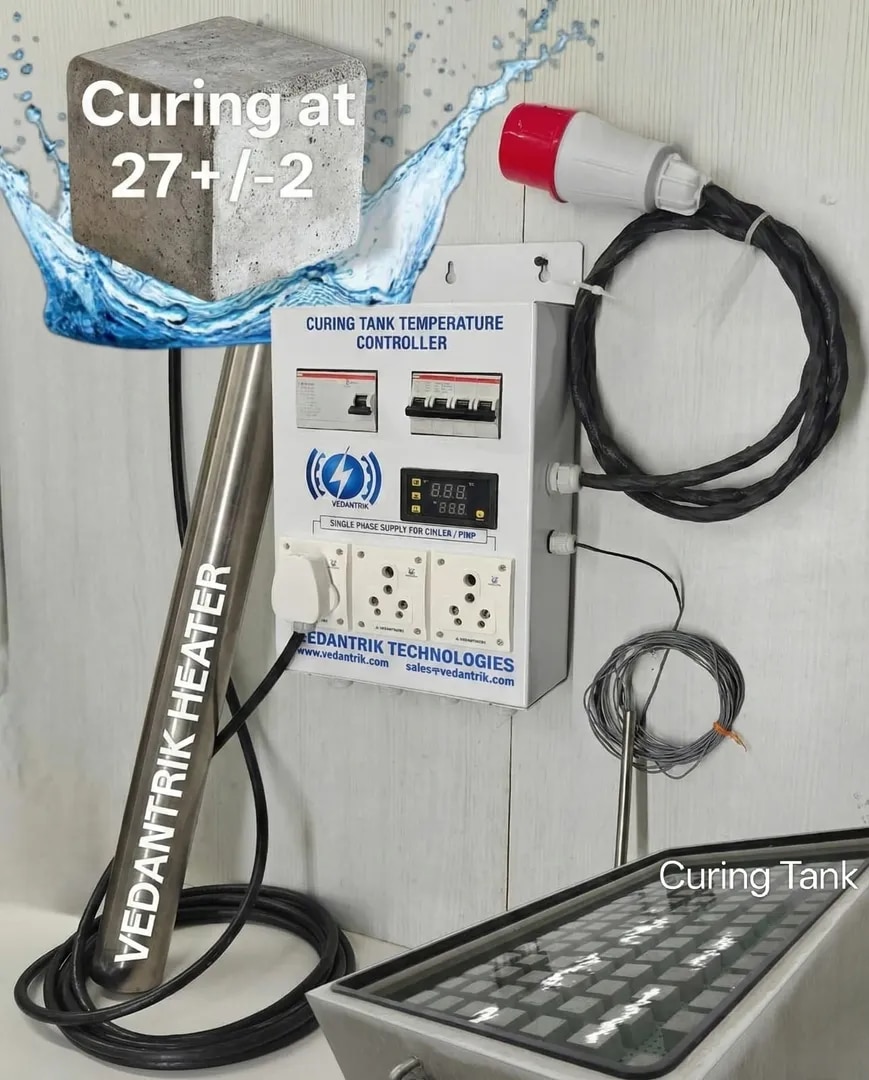
Curing Tank Temperature Controller for Concrete Cubes
NABL Calibrated | Single & Three Phase | Waterproof & Shockproof | Heater, Chiller & Pump Ready
Vedantrik Technologies presents an advanced curing tank temperature controller designed specifically for concrete cube curing tanks used in NABL-accredited laboratories, RMC plants, construction site labs, and infrastructure projects.
The system accurately maintains the standard curing temperature of 27 ± 2 °C, as prescribed by IS and NABL guidelines. Equipped with an intelligent temperature controller, SS316 waterproof immersion heaters, and built-in electrical safety protections, this solution eliminates manual temperature monitoring and ensures consistent, audit-compliant curing conditions.
Each system can be supplied with an NABL-traceable calibration certificate, making it suitable for laboratory audits and quality assurance processes.
Concrete Curing Tank Temperature Control System
This plug-and-play curing tank controller manages heating during winter and cooling during summer, ensuring uninterrupted and uniform curing of concrete test specimens.
The controller supports both single phase and three phase power supplies, allowing it to work seamlessly with different tank sizes and heater configurations without any modification.
Ideal Applications
Concrete cube curing tanks
NABL civil engineering laboratories
Construction site testing laboratories
RMC plants and QA/QC departments
Infrastructure and government projects
Technical Specifications – Curing Tank Controller
Power Supply: Single Phase / Three Phase AC, 230 V
Maximum Current Capacity: 32 Amps
Temperature Set Point: 27 ± 2 °C
Temperature Accuracy: ±1 °C
Controller Power Cord Length: 2 meters
Temperature Sensor Cable Length: 5 meters
Plug & Play Connections
Heater connection
Chiller connection
Water circulation pump connection
Temperature sensor connection
No skilled installation required.
Key Features of Curing Tank Temperature Controller
Compatible with single phase and three phase heaters
Dedicated socket for chiller (summer curing)
Dedicated socket for circulation pump
Built-in short circuit and over-current protection
Integrated MCB and RCCB for complete electrical safety
Rugged design suitable for laboratory and onsite conditions
Smart Heating & Cooling Logic (Energy Efficient)
Heating Control – Winter Operation
Heater switches OFF above 27 °C
Heater switches ON below 25 °C
Prevents overheating and reduces power consumption
Chiller Control – Summer Operation
Chiller switches ON above 29 °C
Chiller switches OFF below 25 °C
Maintains curing temperature as per NABL and IS standards
Heater Selection Based on Curing Tank Volume
Below 2000 liters: Single phase heater recommended
Above 2000 liters: Three phase heater recommended
The controller supports both heater types without any modification.
Electrical Load Capacity of Controller
Three Phase Heater Load
Heater Rating: 4 kW per unit
Minimum Load: 1 × 4 kW
Maximum Load: 4 × 4 kW (Total 16 kW)
Single Phase Heater Load
Heater Rating: Up to 2 kW per unit
Minimum Load: 1 heater
Maximum Load: 3 heaters (Total 6 kW)
Note:
Single phase heaters draw higher current; therefore, lower total power is recommended. For large curing tanks, three phase heaters provide better efficiency and stability.
SS316 Waterproof & Shockproof Immersion Heaters
Three Phase Immersion Heater
Power Rating: 4 kW
Cable Length: 5 meters
Cable Type: 5-core
Heater Material: SS316
Protection: Waterproof & shockproof
Single Phase Immersion Heater
Power Rating: 2 kW
Cable Length: 5 meters
Cable Type: 3-core
Heater Material: SS316
Protection: Waterproof & shockproof
Recommended Heater Configuration for Curing Tanks
Single Phase System (Small & Medium Tanks)
2000 liters: 1 × 2 kW heater
4000 liters: 2 × 2 kW heaters
6000 liters: 3 × 2 kW heaters
Maintains 27 ± 2 °C curing temperature.
Three Phase System (Large Tanks)
Up to 2500 liters: 1 × 4 kW heater
Up to 5000 liters: 2 × 4 kW heaters (8 kW)
Up to 7500 liters: 3 × 4 kW heaters (12 kW)
Up to 10,000 liters: 4 × 4 kW heaters (16 kW)
Best Practices for Uniform Concrete Curing
Interconnect multiple curing tanks using a water circulation pump
For identical tanks in the same environment, one temperature sensor is sufficient
For different tank sizes, place the sensor in the largest tank
Use multiple controllers for independent temperature control
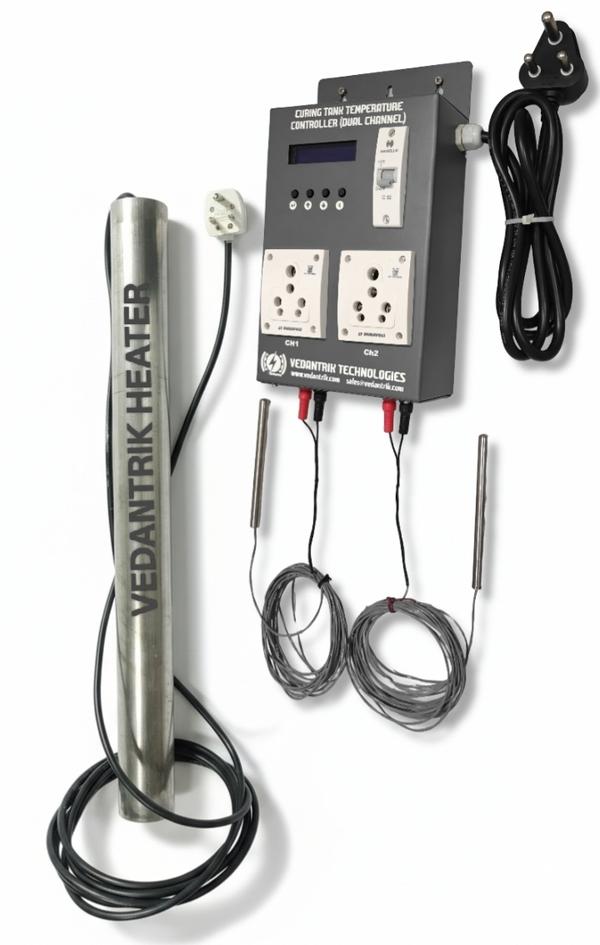
Multichannel curing tank controller available for economical multi-tank operation
NABL Compliance & Custom Solutions
NABL-traceable temperature calibration certificate available
Multichannel and customized curing tank controllers
Designed for NABL labs, RMC plants, infrastructure projects, and site laboratories
Contact for Pricing & Technical Support
📞 8452062580
📧 sales@vedantrik.com
Topic covered above
Curing tank temperature controller
Concrete cube curing tank controller
NABL curing tank temperature controller
Concrete curing tank heater
SS316 immersion heater for curing tank
Single phase curing tank heater
Three phase curing tank heater
Concrete laboratory curing equipment
Curing tank temperature control system
Best Digital Rebound Hammer Hammer manufacturer in India Vedantrik Technologies,
Digital Rebound Hammer for direct Compressive strength, a quick non-destructive testing and assessment of concrete quality, uniformity, and indicative compressive strength without damaging the structure.
Benefits of Vedantrik Digital Rebound Hammer
Direct Compressive strength without referring to the graph
Wireless connectivity with Laptop/PC for seamless data transfer
Automatic storage of test readings, eliminating manual data entry
Instant report generation for improved productivity
Laboratory-developed strength correlation curves for enhanced reliability
Selection of testing orientation including:
* Vertical Upward
* Vertical Downward
* Horizontal
* Inclined Upward
* Inclined Downward
Customized correction factors developed and validated by experienced engineers in the laboratory
Improved accuracy and consistency in concrete strength estimation
Digital database creation for quality control and audit traceability
Reduced testing time and enhanced operational efficiency
Engineered for Modern Concrete Testing
The intelligent software allows users to select the testing direction before measurement, automatically applying the appropriate correction factors and correlation curves. This significantly reduces human intervention and ensures more reliable strength estimation compared to conventional manual methods.
As the construction industry increasingly adopts digital technologies, testing equipment must evolve beyond manual data collection. The Vedantrik Digital Rebound Hammer represents a step forward in the digital transformation of concrete testing, quality assurance, and structural condition assessment.
Vedantrik Wireless Thermocouple Sensors provide an advanced and reliable solution for temperature monitoring in mass concrete structures. The system is specially designed to measure the internal temperature of concrete during the hydration process, helping engineers control thermal gradients and prevent thermal cracking in large concrete elements.
Mass concrete structures such as raft foundations, pile caps, piles, dams, footings, and large foundations generate significant heat during cement hydration. If the temperature difference between the concrete core and surface becomes excessive, it may lead to thermal stress and cracking.
Using Vedantrik wireless thermocouple sensors, engineers can continuously monitor concrete temperature in real time without the complexity of long cables or external power supply.
Thermocouple Installation in Concrete
For accurate concrete temperature monitoring, thermocouple sensors are installed inside the reinforcement cage before concrete pouring.
At a typical monitoring location, 3–4 thermocouple sensors are installed at different depths when the concrete thickness is around 1.8–2.0 meters.
The sensors are generally positioned at:
Top layer of concrete
Middle or core zone
Bottom layer
Each sensor is securely fixed to the reinforcement bars using cable ties or binding wire to ensure stable positioning during concrete pouring and vibration.
Advantages of Vedantrik Wireless Thermocouple Sensors
The Vedantrik wireless monitoring system eliminates traditional wiring and simplifies temperature monitoring on construction sites.
Key advantages include
Completely Wireless Concrete Temperature Monitoring
Battery Operated Thermocouple Sensors
No Long Cable Installation Required
Quick and Easy Site Installation
Continuous Real-Time Concrete Temperature Monitoring
Suitable for Mass Concrete Structures
This system reduces installation complexity while providing accurate temperature data throughout the concrete curing period.
Concrete Temperature Monitoring Duration
Concrete temperature is typically monitored for 7 to 14 days after casting, depending on project specifications.
The collected temperature data helps engineers evaluate:
Peak hydration temperature
Core vs surface temperature difference
Thermal cracking risk in mass concrete
Concrete maturity and strength development
These measurements are critical for quality control, structural durability, and compliance with thermal control plans in infrastructure projects.
Applications
Vedantrik Wireless Thermocouple Sensors are widely used in:
Mass Concrete Temperature Monitoring
Raft Foundation Monitoring
Pile and Pile Cap Monitoring
Bridge Foundations
Dam Construction Projects
Large Industrial Foundations
Why Choose Vedantrik Wireless Thermocouple Sensors
Vedantrik offers a cost-effective, reliable, and easy-to-install concrete temperature monitoring system that helps contractors, consultants, and project engineers maintain proper thermal control in mass concrete construction.
The wireless design eliminates cable management issues, reduces installation time, and ensures continuous temperature monitoring during the most critical curing period.
Wireless thermocouple sensors
Battery operated – No external power required
No long cable runs
Real-time temperature monitoring of concrete core
Maturity & strength estimation possible
Ideal for raft foundations, piles, footings and mass concrete
Wireless Mass Concrete Temperature Monitoring & Maturity Sensor – VedaLite by Vedantrik Technologies
For Temperature controlled concrete and other concrete members.
Mass concrete elements such as rafts of High rise buildings, dams, thick foundations, piers, piles, and hot-block castings generate significant internal heat due to the exothermic hydration of cement. If this heat is not properly monitored, thermal gradients develop between the core and surface, leading to thermal stresses, micro-cracking, reduced durability, and long-term structural risks.
International standards such as ASTM C1074 (Concrete Maturity Method) explain how temperature history can be used to calculate maturity and strength development using scientific models like the Nurse–Saul and Arrhenius equations. This method allows engineers to predict real-time strength, optimize curing, and make informed decisions about formwork removal and prestressing operations.
Introducing VedaLite – Wireless Concrete Temperature & Maturity Sensor
VedaLite by Vedantrik Technologies (Mumbai, India) is an advanced wireless concrete temperature monitoring and maturity system designed for mass concrete, high-rise buildings, infrastructure, and precast applications worldwide.
This innovative single wireless module is capable of measuring temperature at four critical locations simultaneously and also gives the Idea of thermal gradient:
- Ambient temperature
- Top of the concrete
- Middle of the concrete
- Bottom of the concrete
This multi-point sensing approach ensures accurate thermal profiling of rafts, dams, foundations, piers, piles, and thick structural elements.
Why Wireless Monitoring is Superior
Traditional wired temperature monitoring systems face multiple challenges:
- Signal errors due to long wire lengths
- Wire damage during reinforcement and concreting
- Data loss or inaccurate readings
- Complex installation and maintenance
VedaLite wireless technology eliminates these problems by:
- Removing long wire runs
- Preventing damage during casting
- Ensuring reliable, uninterrupted data
- Reducing installation time and labour costs
Economical Single-Module Multi-Point Monitoring
Unlike conventional systems that require multiple sensors and cables, VedaLite uses a single compact module to monitor four critical points.
This makes it:
- More economical
- Faster to deploy
- Easier to manage on large sites
- Ideal for high-rise rafts, dams, and infrastructure projects
Battery-Operated – No 24/7 Power Dependency
VedaLite operates on a long-lasting battery for up to 60 days, which:
- Eliminates the need for continuous power supply
- Reduces site dependency on generators
- Ensures uninterrupted monitoring even in remote locations
Real-Time Data, Memory & Graphical Analysis
The system features:
- Inbuilt memory for continuous data logging
- Temperature vs. time graphical representation
- Wireless connectivity with mobile phones and laptops
- Real-time monitoring from anywhere on site
This allows engineers to:
- Track temperature rise and fall
- Control thermal gradients
- Prevent cracking
- Make informed construction decisions
Sacrificial and Reusable System Options
Vedantrik offers flexible solutions:
- Low-cost sacrificial wirless Concrete temperature multi-point sensing modules for single-use projects (mostly prefferd as No huge investment or high upfront cost involved)
- Reusable transmitter modules where only the sensors are sacrificial and transmitter is Re-Usable with extra cost.
This provides cost-effective solutions for both large infrastructure and repetitive construction projects.
Maturity & Strength Monitoring for Structural Concrete
When used in:
- Columns
- Beams
- Slabs
- Precast elements
- In-situ structures
- PT slabs
The same module can provide:
- Concrete maturity values
- Real-time strength estimation
- Reduced dependence on cube testing
- Accurate formwork removal timing
- Safer prestressing operations
As per ASTM C1074, a maturity-strength correlation is established for the specific mix design, enabling reliable strength predictions from day one.
Applications
- High-rise raft foundations
- Mass concrete structures
- Dams and spillways
- Bridge piers and pile caps
- Deep foundations and piles
- Hot-weather concrete
- Precast plants
- PT slabs and structural elements
Why Choose Vedantrik Technologies
- Wireless, cable-free monitoring
- Economical multi-point sensing
- Up to 60-day battery operation
- Real-time mobile and laptop connectivity
- Inbuilt data memory and graphs
- Sacrificial and reusable options
- Suitable for mass and structural concrete
- Developed and deployed in major infrastructure projects
Vedantrik Technologies – Mumbai, India
Delivering advanced wireless concrete monitoring solutions for projects across India and worldwide.
Concrete Maturity meter
product-detail-entry-exit
311, Sagar Industrial Estate, Western Express Hwy, opp. Dahisar toll Naka, Diamond Industrial Estate, Dahisar East, Mumbai, Maharashtra 400068, India