Thank you for writing to us. One of our executive will reach back to you through your submitted medium. In case there’s an urgency, feel free to connect over WhatsApp for faster response.
Prefer calling? Dial +917304519092 (International callers) or +917304519092 (Indian callers).
Wireless Mass Concrete Temperature Monitoring & Maturity Sensor – VedaLite by Vedantrik Technologies
For Temperature controlled concrete and other concrete members.
Mass concrete elements such as rafts of High rise buildings, dams, thick foundations, piers, piles, and hot-block castings generate significant internal heat due to the exothermic hydration of cement. If this heat is not properly monitored, thermal gradients develop between the core and surface, leading to thermal stresses, micro-cracking, reduced durability, and long-term structural risks.
International standards such as ASTM C1074 (Concrete Maturity Method) explain how temperature history can be used to calculate maturity and strength development using scientific models like the Nurse–Saul and Arrhenius equations. This method allows engineers to predict real-time strength, optimize curing, and make informed decisions about formwork removal and prestressing operations.
Introducing VedaLite – Wireless Concrete Temperature & Maturity Sensor
VedaLite by Vedantrik Technologies (Mumbai, India) is an advanced wireless concrete temperature monitoring and maturity system designed for mass concrete, high-rise buildings, infrastructure, and precast applications worldwide.
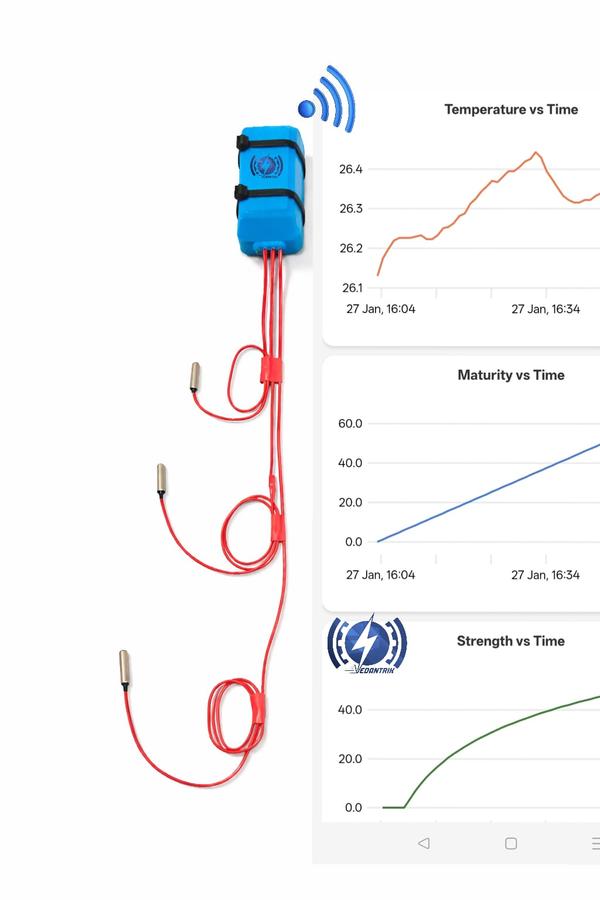
This innovative single wireless module is capable of measuring temperature at four critical locations simultaneously and also gives the Idea of thermal gradient:
- Ambient temperature
- Top of the concrete
- Middle of the concrete
- Bottom of the concrete
This multi-point sensing approach ensures accurate thermal profiling of rafts, dams, foundations, piers, piles, and thick structural elements.
Why Wireless Monitoring is Superior
Traditional wired temperature monitoring systems face multiple challenges:
- Signal errors due to long wire lengths
- Wire damage during reinforcement and concreting
- Data loss or inaccurate readings
- Complex installation and maintenance
VedaLite wireless technology eliminates these problems by:
- Removing long wire runs
- Preventing damage during casting
- Ensuring reliable, uninterrupted data
- Reducing installation time and labour costs
Economical Single-Module Multi-Point Monitoring
Unlike conventional systems that require multiple sensors and cables, VedaLite uses a single compact module to monitor four critical points.
This makes it:
- More economical
- Faster to deploy
- Easier to manage on large sites
- Ideal for high-rise rafts, dams, and infrastructure projects
Battery-Operated – No 24/7 Power Dependency
VedaLite operates on a long-lasting battery for up to 60 days, which:
- Eliminates the need for continuous power supply
- Reduces site dependency on generators
- Ensures uninterrupted monitoring even in remote locations
Real-Time Data, Memory & Graphical Analysis
The system features:
- Inbuilt memory for continuous data logging
- Temperature vs. time graphical representation
- Wireless connectivity with mobile phones and laptops
- Real-time monitoring from anywhere on site
This allows engineers to:
- Track temperature rise and fall
- Control thermal gradients
- Prevent cracking
- Make informed construction decisions
Sacrificial and Reusable System Options
Vedantrik offers flexible solutions:
- Low-cost sacrificial wirless Concrete temperature multi-point sensing modules for single-use projects (mostly prefferd as No huge investment or high upfront cost involved)
- Reusable transmitter modules where only the sensors are sacrificial and transmitter is Re-Usable with extra cost.
This provides cost-effective solutions for both large infrastructure and repetitive construction projects.
Maturity & Strength Monitoring for Structural Concrete
When used in:
- Columns
- Beams
- Slabs
- Precast elements
- In-situ structures
- PT slabs
The same module can provide:
- Concrete maturity values
- Real-time strength estimation
- Reduced dependence on cube testing
- Accurate formwork removal timing
- Safer prestressing operations
As per ASTM C1074, a maturity-strength correlation is established for the specific mix design, enabling reliable strength predictions from day one.
Applications
- High-rise raft foundations
- Mass concrete structures
- Dams and spillways
- Bridge piers and pile caps
- Deep foundations and piles
- Hot-weather concrete
- Precast plants
- PT slabs and structural elements
Why Choose Vedantrik Technologies
- Wireless, cable-free monitoring
- Economical multi-point sensing
- Up to 60-day battery operation
- Real-time mobile and laptop connectivity
- Inbuilt data memory and graphs
- Sacrificial and reusable options
- Suitable for mass and structural concrete
- Developed and deployed in major infrastructure projects
Vedantrik Technologies – Mumbai, India
Delivering advanced wireless concrete monitoring solutions for projects across India and worldwide.
Vedantrik Technologies is first in India to develop and manufacture Sacrificial type Wireless Concrete Maturity Meter, which monitors temperature, maturity, and strength. Using Vedantrik Maturity Meter Per Point testing is 7-10 times Cheaper compared to any Imported or Re-usable type Maturity Meter
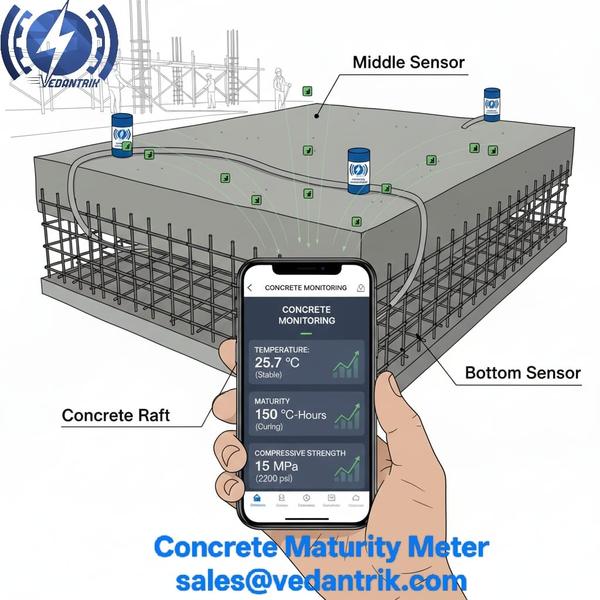
Multi-Channel Sensing : Monitor Top, Middle, and Bottom concrete temperatures using a single Maturity Meter.
Wireless Type: No cable routing, Seamlessly connect with mobile phones or laptops.
On-Board Data Storage: Temperature, maturity, and strength data stored in inbuilt memory—download anytime.
In-Built Battery Powered: No 24×7 external power supply required.
No Expensive Reader Required: Your smartphone becomes the reader and monitor.
✔ True 3-in-1 Monitoring
Temperature • Maturity • Strength — in one device.
Sacrificial & Damage-Proof: Designed to be embedded—no special handling or protection needed.
Lowest Cost per Point: More economical than reusable maturity meters.
Low Capital Investment: Eliminates high upfront cost of reusable wired systems.
Ideal for Multi-Location Projects: Deploy multiple sensors across sites without wiring or complexity.
Smart sensing. Lower cost. Scalable deployment.
Concrete Maturity meter is a device inserted in concrete structure while casting, to monitor the concrete maturity and strength of the actual concrete by measuring temperature variations within the concrete, the device calculates the maturity value to develop a co-relation between maturity and strength, enabling real-time strength monitoring of both precast and cast-in-place concrete and also useful for determining the correct time for foam work or shuttering removal and to decide when to stretch the tendons in PT Slabs.
Vedantrik Technologies has developed India’s first Wireless type Concrete Maturity meter and installed it in India’s first bullet train Project at BKC.
Concrete Maturity meter is available in various models like wireless and wired type, Sacrificial and Reusable type concrete maturity meter where only the sensor will be sacrificed and the transmitter part can be reused as per the different different application, concrete maturity meter for Concrete Road and infrastructure Projects, residential project and mass concrete temperature monitoring, temperature differential and for thermal gradient monitoring is also available.
The temperature sensors are embedded into the concrete at the construction site to measure temperature continuously. The maturity value is then calculated based on the recorded temperature data and correlated with the concrete strength. This correlation must be established for the specific concrete mix design As per ASTM C1074 standards and remains valid as long as the mix design does not change.
to Know more write on sales@vedantrik.com or Whatsapp 8452062580
Principle behind Concrete Maturity Measurement Method:
The concrete maturity method is an empirical technique employed to predict the development of strength in concrete as a function of its temperature-time history. The fundamental principle underlying this method is that the rate of cement hydration process, along with the consequential strength gain, is not only influenced by the age of the concrete since the time of casting, but primarily by the combined effect of time and temperature. In essence the maturity method is useful in quantifying the degree of hydration by integrating temperature over time, thereby allowing to estimate the strength of in-situ concrete with great accuracy, especially during the early stages of curing.
Concrete strength gain is intrinsically linked to the kinetics of cement hydration, a complex exothermic reaction between water and cementitious materials such as tricalcium silicate, dicalcium silicate, tricalcium aluminate, and tetracalcium aluminoferrite that leads to formation of calcium-silicate-hydrate (C-S-H) gel and other reaction products that contribute materials structural integrity. The rate of these hydration reactions are temperature dependent, so elevation in temperature increases the rate, mainly because of reduced activation energy barrier, while lower temperatures affect it in the opposite manner. However, this same hydration process can result in excessive heat generation that has a direct effect on the morphology and distribution of the hydration products. Hence, it can lead to temperature induced changes in the micro-structures, porosity and micro-cracking due to differential thermal gradients, especially in mass concrete.
Furthermore elevated temperature can also affect the natural evolution of the micro-structures in the concrete, thereby affecting the structural and mechanical properties beyond that could be assessed by the maturity method.
Nurse-Saul Method:
The common approach for estimation of concrete’s strength from its maturity, utilizes the Nurse-Saul method, which assumes that there is a linear relationship between temperature and the rate of hydration. The general formula proposed is expressed in the form given below:
M(t) = ∑ (Ta - T0) * Δt
Where :
M(t) = the temperature-time factor at age t, degree-days or degree-hours, Δt = a time interval, days or hours, Ta = average concrete temperature during time interval, Δt, °C, and To = datum temperature, °C.
Arrhenius Method:
The hydration process can halt altogether if the concrete remains below datum temperature, as it can be assumed that datum temperature sets a critical temperature threshold limit.
Crossing this limit creates a condition where maturity is no longer linear and cannot be predicted until other supplementary cementitious mixtures (SCM) such as accelerators are added into the mix.
In such cases where ambient temperature goes below datum temperature (0°C for India) the Arrhenius method gives a more accurate and reliable result. The Arrhenius method is based on activation energy that captures nonlinear temperature effects more accurately, especially under extreme hot or cold conditions.The general formula proposed is expressed in the form given below:
te = ∑e-Q(1/Ta - 1/Ts) * Δt
Where:
te = equivalent age at a specified temperature Ts, days or h, Q = activation energy divided by the gas constant, K, Ta = average temperature of concrete during time interval Dt, K, Ts = specified temperature, K, and Δt = time interval, days or h.
Measurement of Maturity and strength:
Nurse-Saul function is the widely used method, which assumes that there is a linear relationship between temperature and the rate of hydration. The general formula is expressed in the form given below:
M(t) = ∑ (Ta - T0) * Δt
Where :
M(t) = the temperature-time factor at age t, degree-days or degree-hours,
Δt = time interval, days or hours,
Ta = average concrete temperature during time interval, Δt, °C, and
To = datum temperature, °C.
After calculating the maturity values for each of the specified curing days and determining the corresponding compressive strengths from the CTM (Compression Testing Machine) results, plot a graph of maturity index versus compressive strength. Fit a trend-line to the data to identify the best-fit relationship, typically a logarithmic regression provides a good representation of the strength development in relation to maturity.
Fc = a + b * log10 (M)
Components of Concrete Maturity Method:
Temperature Monitoring Equipment - Devices to measure and record concrete temperature over time.
Concrete Strength Testing - Standard strength tests (e.g., ASTM C39 – Compressive strength of cylindrical concrete specimens).
Reference Temperature - A specific temperature used in maturity calculations. For Nurse–Saul, the typical reference is 0°C (32°F) unless otherwise specified.
Concrete Mix Design Information - The maturity method is mix-specific; a separate calibration curve is required for each mix.
Data Collection and Analysis Tools - Software or spreadsheets to calculate maturity and estimate strength. Ensures real-time tracking and reporting.
Components of Concrete Maturity Method:
Temperature Monitoring Equipment - Devices to measure and record concrete temperature over time.
Concrete Strength Testing - Standard strength tests (e.g., ASTM C39 – Compressive strength of cylindrical concrete specimens).
Reference Temperature - A specific temperature used in maturity calculations. For Nurse–Saul, the typical reference is 0°C (32°F) unless otherwise specified.
Concrete Mix Design Information - The maturity method is mix-specific; a separate calibration curve is required for each mix.
Data Collection and Analysis Tools - Software or spreadsheets to calculate maturity and estimate strength. Ensures real-time tracking and reporting.
Standard procedure: Overview (as per ASTM C1074)
1. Objective of Maturity Method Calibration (Co-Relation Establishment)
The primary objective of the calibration process in ASTM C1074 is to establish a reliable relationship between concrete maturity and its compressive strength for a specific concrete mix. This relationship—called the strength–maturity curve—enables users to estimate in-place concrete strength based on temperature history rather than destructive testing. Since the maturity method is mix-specific, each unique concrete mixture requires its own calibration.
2. Selection and Preparation of Concrete Mix
The calibration begins by selecting the specific concrete mix that will be used in the field. This includes confirming the materials, proportions, and mixing procedure. Fresh concrete from this mix is then used to cast a set of standard specimens depending on the project requirements, which will be cured and tested over time to develop the strength–maturity relationship.
3. Temperature Monitoring of Specimens
To track the maturity development, thermocouples or temperature sensors are embedded in at least two of the cylinders immediately after casting. These sensors record the internal temperature of the specimens continuously over time. The temperature data is used to calculate the maturity index using either the Nurse–Saul function or the Arrhenius function, as specified in ASTM C1074.
4. Curing and Strength Testing Schedule
The concrete specimens are cured under standard laboratory conditions, and are tested for compressive strength at multiple time intervals; for example, at 1, 3, 7, 14, and 28 days. The specific times should span the range of expected strengths during field monitoring. At each test age, the corresponding maturity index is calculated based on the recorded temperature history.
5. Developing the Strength–Maturity Relationship
After collecting the strength and maturity data at each age, the results are plotted with concrete strength on the y-axis and maturity index on the x-axis. A best-fit curve (usually exponential or logarithmic) is applied to the data points to define the strength–maturity relationship for the given concrete mix. This curve becomes the foundation for estimating in-place strength based on measured maturity in the field.
Result Interpretation of Concrete Maturity Method:
Result interpretation in the maturity method involves comparing the maturity index (°C·hours or °C·days) calculated from the in-situ concrete to a previously developed calibration curve that relates maturity to compressive strength. By identifying the maturity value measured in the field and locating that point on the calibration curve, the corresponding compressive strength can be estimated. This allows for a reliable prediction of the in-place concrete strength at any given time, provided the conditions match those used during calibration.
When maturity and strength relation established becomes invalid
If Mix design changes. (Cement/Admixture/Chemicals/etc) calibration becomes invalid ,This can be considered as advantage instead of disadvantage, like if mix design changes, maturity vs time response will vary.
Co-relation established in winter will not be valid in summer or vice versa.
Ambient condition (do not insert concrete cube in curing Tank at the time of co-relation establishment as the actual concrete structure can not be immersed in curing tank)
Small concrete used during Co-relation establishment, hence this co-relation will not be valid for Mass-Concrete due to Thermal-Gradient
Topics Covered above: Concrete Maturity, Concrete Maturity Method, Concrete Maturity Meter, Concrete Maturity Testing, Maturity Method Concrete Strength, Maturity Sensor for Concrete, Concrete Strength Maturity Curve, Nurse-Saul Maturity Formula, Temperature & Time Factor Method Concrete Maturity, Strength vs Maturity Relationship, How To Calibrate Concrete Maturity, Weighted Maturity Function Concrete, ASTM C1074 Maturity Method, Datum Temperature Concrete Maturity, Concrete Maturity Monitoring System, Temperature Sensor in Concrete Maturity, Real Time Concrete Maturity Monitoring, Maturity In Mass Concrete, Concrete Strength Monitoring using concrete maturity meter