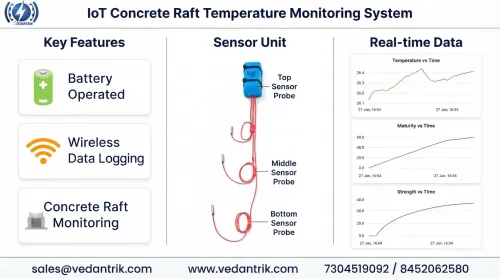

Temperature plays a crucial role in determining the maturity development of freshly placed concrete. Once concrete is poured, its internal temperature begins to rise mainly due to the heat generated from cement hydration, and this heat continues to build as the reaction progresses.
The initial temperature of the concrete mix significantly influences early-age strength gain. Higher temperatures accelerate the hydration process, resulting in faster strength development at early stages. However, this rapid heat evolution can also increase the risk of shrinkage and cracking due to thermal gradients forming within the concrete mass.
On the other hand, lower temperatures slow down hydration, delaying setting time and early strength gain, which can extend construction schedules.
Since hydration does not occur at a constant rate, temperature variations over time cause fluctuations in maturity development. Short-term temperature spikes, caused either by environmental conditions or exothermic heat release, can temporarily increase maturity values. If not properly accounted for, this may lead to an overestimation of long-term strength.
To accurately monitor these changes, temperature is recorded at regular intervals using embedded sensors within the concrete. These readings help engineers track thermal behaviour and establish a reliable relationship between temperature history and strength development using the Nurse–Saul maturity method.
In practical applications, controlling curing temperature is essential to achieve consistent and predictable strength gain. Maintaining uniform temperature conditions helps minimize thermal gradients, which can otherwise lead to uneven maturity within the same structural element and complicate strength predictions.
Ultimately, temperature governs the rate of cement hydration and directly controls strength development in concrete. A clear understanding of its effects under both stable and fluctuating conditions is essential for accurate maturity-based strength estimation.
Keywords