Concrete durability refers to the concrete’s ability to resist deformation due to chemical attacks, weathering, and abrasion during its service life. Concrete durability has now become a topic of concern for modern infrastructure projects, particularly for structures exposed to aggressive environments.
The most important parameter for evaluating durability is the measurement of concrete’s permeability against various chemical agents, gases, water etc.
One of the primary reasons for deformation is the corrosion of steel reinforcements induced by chloride ions. Chloride ions penetrate the concrete over time, breaking down the passive oxide layer around reinforcing steel and initiating corrosion.
This can compromise the durability and reduce the service life significantly. Hence assessing the resistivity of concrete mix against Chloride ion migration, prior to its field application becomes crucial.
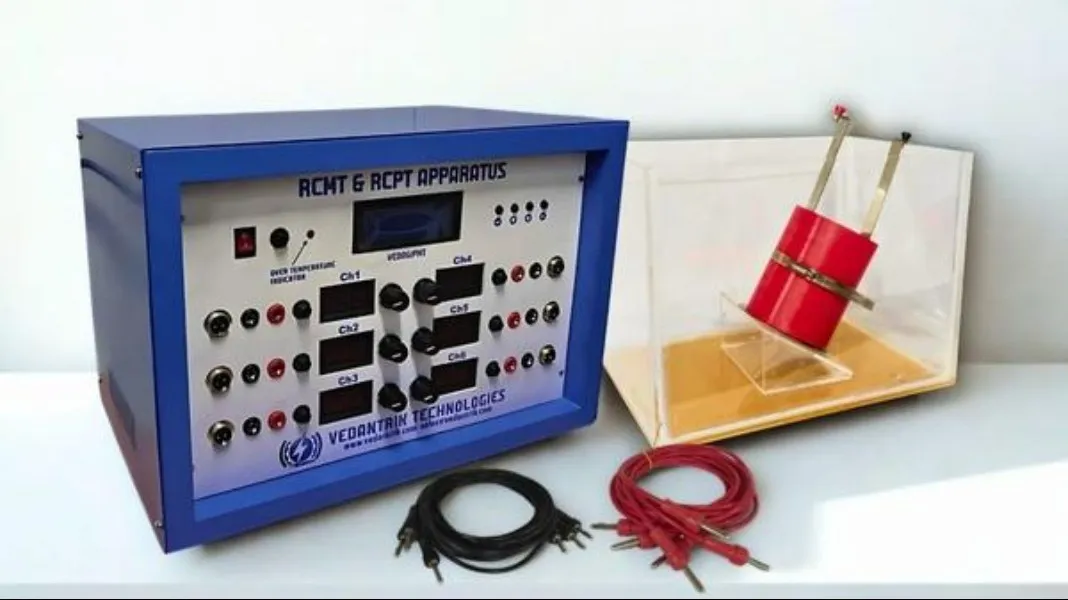
The Rapid Chloride Migration Test (RCMT), standardized as NT Build 492, has emerged as one of the most reliable and widely adopted methods for evaluating chloride penetrability.
The RCMT measures the non-steady-state migration coefficient, which is an indicator of how quickly chloride ions move through the concrete matrix under an applied electrical potential.
Being a rapid test, RCMT allows evaluation of concrete’s long term durability within hours, and enables engineers, researchers, and quality-control personnel to make timely decisions about mixture proportions, supplementary cementitious materials, curing practices, and overall durability performance.
Keywords