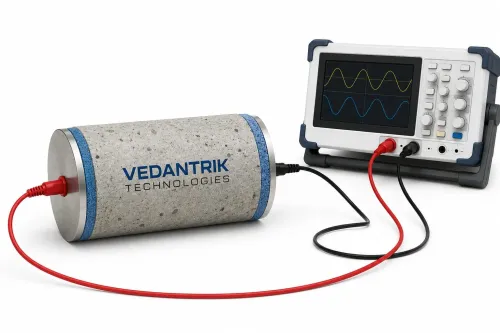
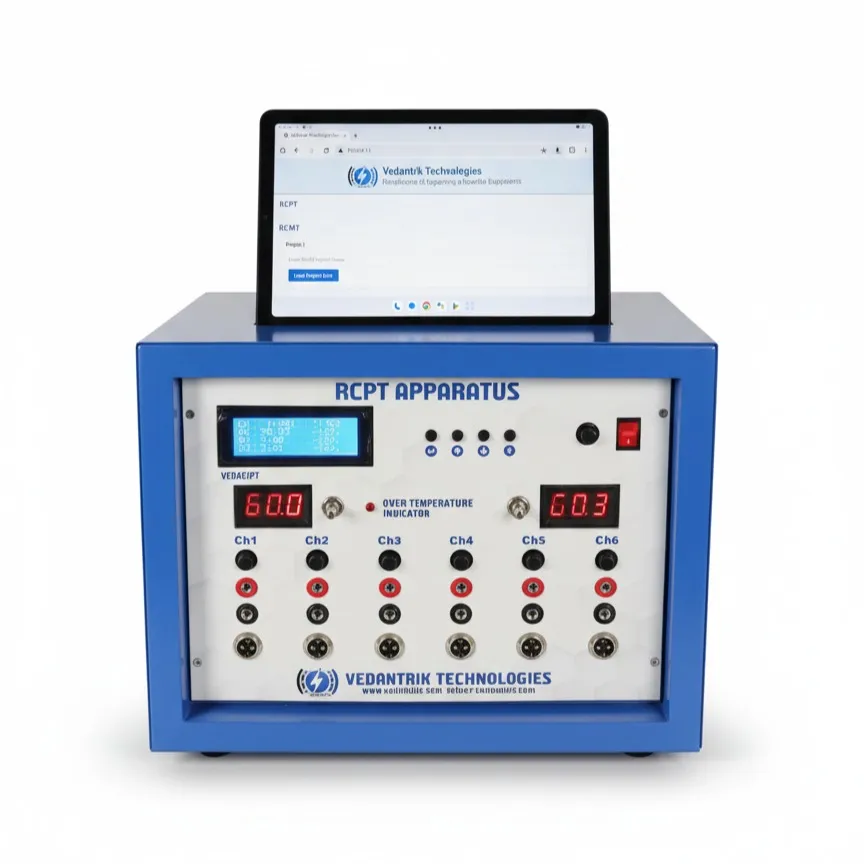
The Rapid Chloride Penetration Test (RCPT), as per ASTM C1202, is a laboratory test used to evaluate the chloride ion penetrability of concrete by measuring its electrical conductance.
The test determines the ability of concrete to resist chloride ion ingress, which is critical because chloride ions can reach reinforcing steel, break the passive oxide layer, and initiate corrosion, leading to cracking and durability loss in reinforced concrete structures exposed to marine or de-icing environments.
In RCPT, a concrete disc specimen of 100 mm diameter and 50 mm thickness is placed between two cells. One cell contains 3% sodium chloride (NaCl) solution and the other contains 0.3 N sodium hydroxide (NaOH) solution. A constant 60 V DC voltage is applied for 6 hours.
The electrical current is measured at 30-minute intervals, giving 13 readings over the test duration. The total charge passed is calculated by integrating current over time and is reported in coulombs.
The test is based on the principle that higher charge passed indicates higher ionic permeability, due to a more connected pore structure. This is commonly associated with higher water–cement ratio, poor compaction, or inadequate curing.
Concrete with a dense and refined pore structure shows lower ionic movement and lower charge passed, indicating improved resistance to chloride penetration.
RCPT is used for quality control, mix design comparison, and evaluation of supplementary cementitious materials such as fly ash, silica fume, and slag, which typically reduce permeability by refining pore structure.
The test is widely used due to its simplicity, repeatability, and standard interpretation under ASTM C1202.
Keywords