Ultrasonic Pulse Velocity (UPV) testing is classified under non-destructive testing, which allows engineers to evaluate the internal conditions on the concrete. Modern infrastructure projects often demand higher durability, safety, and performance standards.
UPV enables engineers to assess the concrete without damaging the structure, which makes it ideal for quality assurance in new construction and condition assessment in old concrete structures.
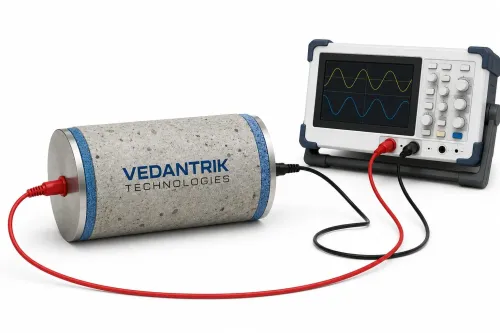
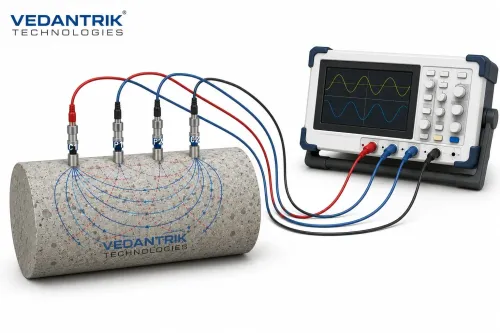
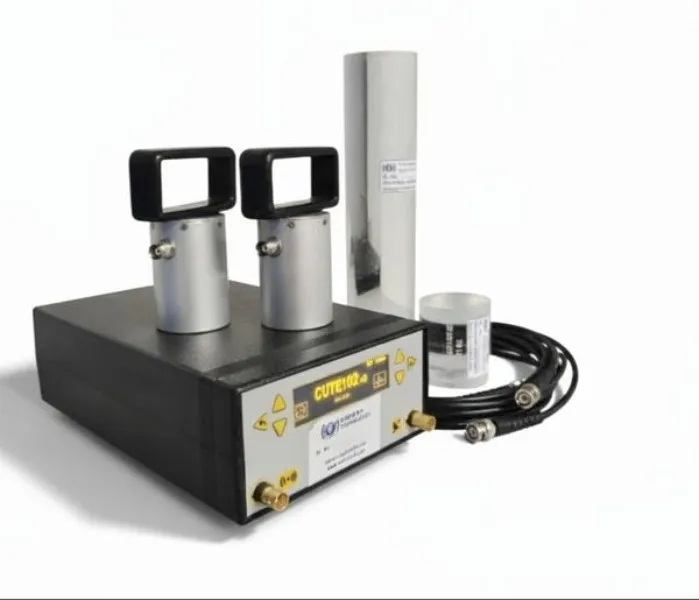
UPV test involves transmission of high frequency sound pulses that travel through the concrete, and measuring the time taken by the wave to reach the receiving transducer.
The basic principle behind the test is that sound waves travel faster in dense, elastic, and defect-free concrete, while their velocity decreases in areas with cracks, voids, or deterioration.
Since the velocity of the waves is directly influenced by concrete’s properties such as density, uniformity, elasticity, and homogeneity, UPV provides a direct evaluation of these properties without the requirement of any destructive methods.
Interpreting the UPV result involves comparing the calculated velocity with the standard reference values provided by IS 516 (Part 5/Sec 1): 2018 and ASTM C597.
UPV testing is widely employed for detecting internal defects such as voids, cracks, honeycombing, delamination, and weak zones.
UPV is commonly used on bridges, dams, pavements, buildings, tunnels, and precast concrete elements. In addition to locating flaws, it helps evaluate concrete homogeneity, monitor deterioration over time.
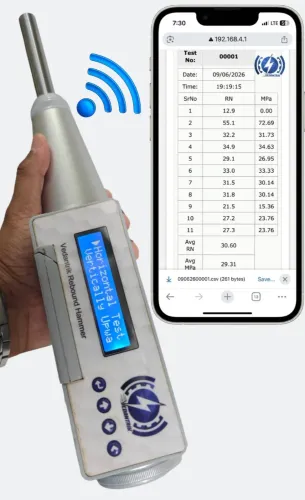
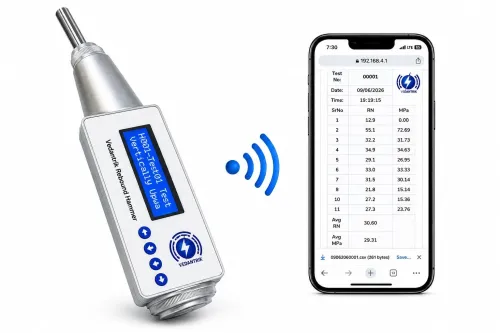
Engineers can integrate UPV with complementary techniques such as rebound hammer testing, Half cell potential test, cut and pull out method to improve the accuracy.
Keywords