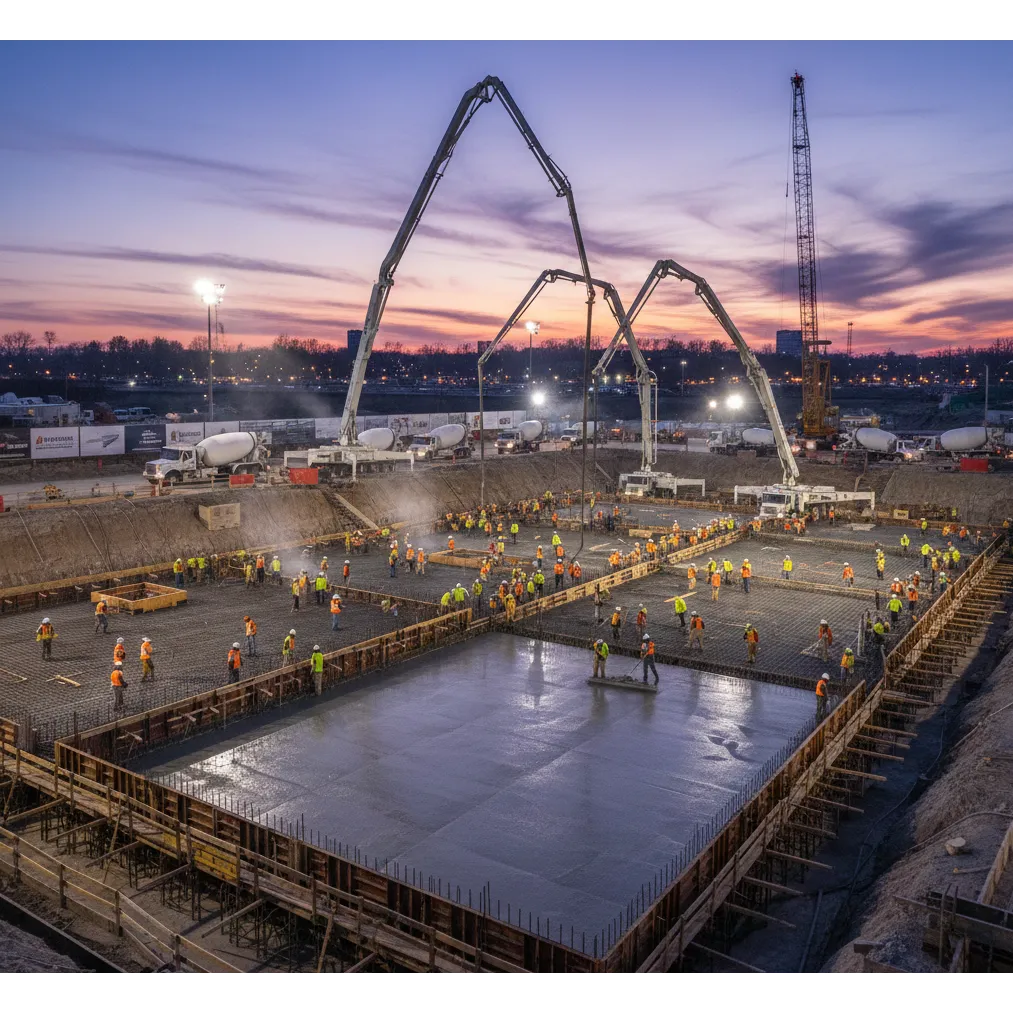
Mass concrete refers to large volumes of concrete where heat generated from cement hydration followed by the temperature rise and volume change must be managed carefully to avoid development of thermal stress and cracking.
According to ACI, mass concrete is defined as “any volume of concrete with dimensions large enough to require that measures be taken to cope with generation of heat from hydration and attendant volume change to minimise cracking.”
Applications of mass concrete generally include large foundations such as mat slabs, retaining walls, thick bridge piers or columns, dams, and heavy footings essentially any structural component whose section size, volume -surface ratio, or geometry could lead to slow heat dissipation and internal heat buildup.
Hence identifying and understanding that a particular pour qualifies as mass concrete is the first step in regulating the thermal behaviour, it also signals that standard curing and monitoring methods may not be sufficient to prevent any possible thermal gradient formation, and special measures such as temperature monitoring, cooling pipes, insulation, or staged pours must be necessary implications.
In Mumbai’s climate, with varying temperatures and humidity levels, monitoring concrete temperature becomes vital. Vedantrik Technologies provides advanced monitoring systems that record accurate data, helping project managers maintain curing consistency.
By tracking temperature variations, contractors prevent issues such as thermal cracking, improper hydration, or delayed strength gain. These devices support better decision-making and improve the long-term durability of structures.
Mass Concrete temperature Monitoring system
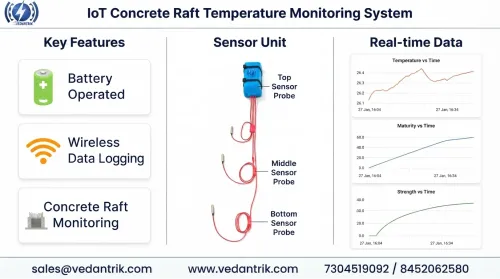
Mass concrete temperature monitoring device developed by vedantrik technologies is an advanced temperature monitoring and data logging system specifically designed for mass concrete applications like raft, foundations, hot blocks and other mass concretes to prevent thermal stresses and micro cracking.
Wirelength Challenges in Mass Concrete Temperature Monitoring
In Mass Concrete applications, temperature sensors are typically embedded at multiple levels the top, middle, and bottom of the pour — to accurately monitor temperature differentials during curing. However, in high-rise building foundations, the raft thickness can reach up to 3 meters or more, creating significant wirelength challenges.
As the sensors are placed deeper within the concrete, the distance between the sensors and the data loggers (which are usually installed at a controlled, accessible location) can exceed 5 meters. This extended wirelength can lead to inaccurate or higher temperature readings.
The commonly used RTD (Resistance Temperature Detector) thermocouples in concrete temperature monitoring are typically accurate only up to a cable length of approximately 5 meters. Beyond this distance, the increase in lead resistance can result in elevated or higher temperature readings. This is particularly problematic because the lead resistance is non-linear and not directly proportional to the cable length, making it difficult to apply standardized correction factors. Consequently, extended cable lengths introduce a significant source of error in temperature measurements.
But the device developed by vedantrik technologies for mass concrete temperature monitoring can give accurate temperature readings even if wirelengths are above 100 meters with accuracy of +/- 1 degree celsius.
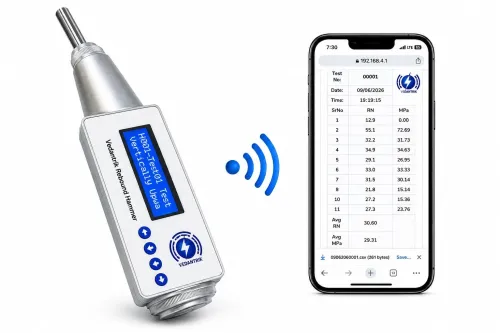
The device logs temperature data at user-defined intervals, with a standard recording interval of 30 minutes. The system utilizes high accuracy sensors, which are embedded in the concrete, during casting and remain in place throughout the curing process. These sensors feed temperature data to the device’s internal storage, which can be accessed later wirelessly using mobile phone or laptop via wifi, the device supports Wi-Fi connectivity, allowing users to access and monitor data in real time through a PC, laptop, or mobile device. By providing accurate and timely temperature data, the system supports informed decisions regarding concrete strength development, enabling optimized construction schedules, timely formwork removal, and improved quality control in mass concrete applications.
Keywords