
Concrete Maturity Meter
Description
Concrete Maturity Meter:
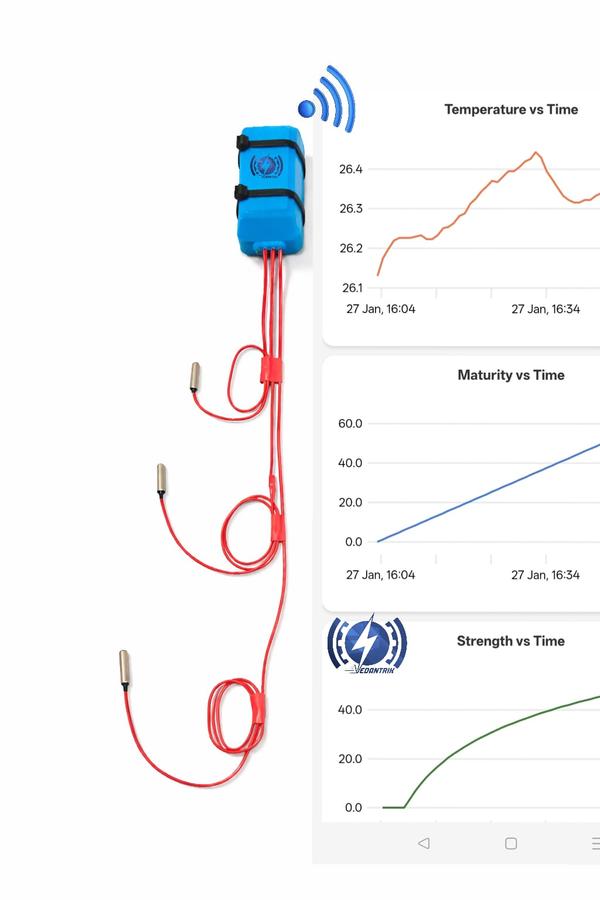
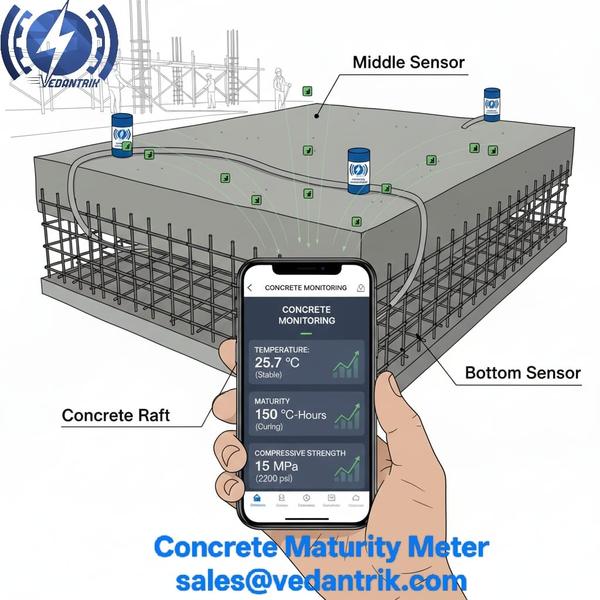
VedaConMat14 by Vedantrik Technologies is a device designed to accurately estimate the maturity of concrete using highly sensitive and precise temperature sensors. By measuring temperature variations within the concrete, the device calculates the maturity value, which is then correlated with strength to develop a reliable maturity index. This index is used to determine the in-situ compressive strength of concrete, enabling real-time monitoring of both precast and cast-in-place concrete.
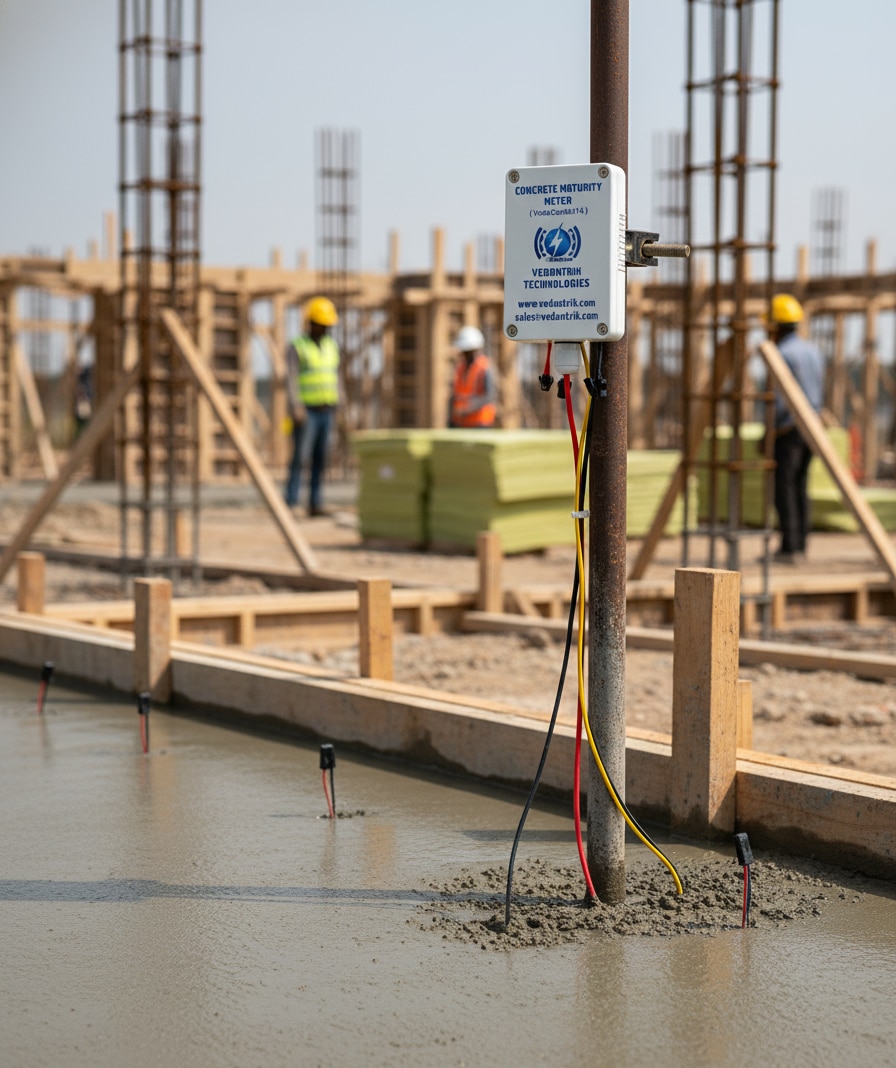
The device is equipped with four sensor ports, allowing connection of four temperature sensors simultaneously. These sensors are embedded into the concrete at the construction site to measure temperature continuously. The maturity value is then calculated based on the recorded temperature data and correlated with the concrete strength. This correlation must be established for the specific concrete mix design following ASTM C1074 standards and remains valid as long as the mix design does not change.
VedaConMat14 logs temperature data every 30 minutes, averaging 60 individual readings collected at 30-second intervals to provide precise and stable temperature values over time. This continuous monitoring ensures a detailed temperature profile throughout the curing process.
For seamless connectivity, VedaConMat14 features a built-in Wi-Fi Hotspot, allowing wireless connection from laptops, PCs, or mobile devices. Its web-based software interface provides real-time visualization of temperature, maturity, and strength data directly from the device. Furthermore, when connected to an office Wi-Fi network and synced with Google Drive, all logged data is automatically uploaded to the cloud. This allows remote access to the concrete maturity and strength information from anywhere in the world via Google Drive.
Key features of Concrete Maturity Meter : VedConMat14
1. Temperature Sensing Range: 0 to 100°C with ±1°C Accuracy:
VedaConMat14 can measure temperatures from freezing point (0°C) up to 100°C, covering the entire typical range for concrete curing. The sensors provide highly accurate readings, with a small possible error margin of just plus or minus one degree Celsius, ensuring reliable temperature data for maturity calculations.
2. Low-Cost Sacrificial Sensors, Reusable Measuring Unit:
The temperature sensors used are designed to be low-cost and sacrificial, meaning they can be embedded directly into the concrete and disposed of after use. However, the main measuring unit, which collects and processes data from these sensors, is reusable for multiple projects, reducing overall costs.
3. Automatic Data Logging with User-Defined Intervals:
The device automatically records temperature data at intervals set by the user. This flexibility allows adjusting the frequency of measurements based on project requirements—whether data is needed every few minutes or hours—making monitoring efficient and tailored.
4. Available in Multiple Channel Options
VedaConMat14 supports different versions with varying numbers of sensor ports (channels). This allows monitoring temperature at multiple points within the concrete, which is especially useful for large pours where temperature can vary across the mass.
5. Web-Based Software for Data Logging and Report Download
The system comes with easy-to-use web-based software accessible through any device connected to the VedaConMat14 Hotspot. This software allows viewing real-time data, managing logged data, and downloading detailed reports for record-keeping and analysis.
6. Graphical Representation
The software provides clear graphical charts that plot temperature changes over time, Maturity vs. Time, Maturity vs. strength. These graphs help visualize the curing process, showing how temperature rises and falls during hydration. Such visual data assists engineers in quickly assessing whether concrete is curing done properly and supports making informed decisions about strength development and construction scheduling.
Monitoring the strength development of concrete during early curing is essential for safe construction scheduling. The Concrete Maturity Meter provides real-time data on temperature history to estimate in-place strength, making it a crucial tool for project managers.
In Mumbai’s high-rise and infrastructure projects, where deadlines are tight, maturity meters allow engineers to determine the right time for formwork removal, post-tensioning, or opening structures to service. Vedantrik Technologies offers advanced maturity meters that are easy to deploy and deliver accurate strength estimations.
By using this device, contractors avoid unnecessary delays while ensuring safety. It reduces reliance on time-based curing estimates and instead relies on actual strength data, leading to better efficiency and reduced costs.
For high-performance concrete maturity meters in Mumbai, connect with Vedantrik Technologies and achieve safer, smarter, and faster construction results.
Concrete Maturity method is a fundamental concept that is used to estimate the early-strength development of concrete based on its time & temperature history. It follows the principle that the strength development of the concrete is directly influenced by both time and temperature. The maturity method as defined by ASTM C1074 provides a reliable, non-destructive way to assess the in-situ concrete strength development over time. This standard is widely used in structural monitoring, quality control, and construction scheduling where early-age strength prediction is critical.
Concrete maturity refers to the cumulative effect of both temperature and time on strength development in concrete. The main objective behind the maturity method is that concrete does not gain strength based on age but rather how temperature has influenced its hydration process over time. The process of hydration is temperature dependent, where higher temperature accelerates the reaction and, in turn, the strength gain, while lower temperatures show an opposite effect. Hence maturity is also defined as a time-temperature factor or function. By integrating temperature over time, maturity index can be established, which is typically expressed in °C·hours or °C·days, that correlates with strength development.
The co-relation between maturity and strength is empirical and must be established for each specific concrete design, as it is generally accepted that concrete of a specific mix design will develop the same compressive strength if it reaches the same maturity index, for example if a concrete mix (A) is achieving the maturity index of value Z 0C.hrs in X days at Y 0C , and there is a concrete mix (B) is also achieving the same maturity index that is of value Z 0C.hrs in P days at Q 0C still both will develop same compressive strength as the maturity indexes are same. This assumption enables project teams to assess strength development in real time, improving the quality control without the need of frequent destruction.
Purpose of Concrete maturity method:
1. To determine in-situ concrete strength using the time-temperature history of the structure, in accordance with ASTM C1074.
2. Provides a non-destructive alternative to traditional testing methods.
3. Helps in improving the structural safety by ensuring that critical construction activities are performed only after the concrete has reached the required strength.
4. Enhance control over curing conditions by allowing for assessment of temperature related-effects on strength development.
Supports mix design optimisation by allowing the study of variables like admixtures, cement types, or curing conditions effect on strength development.
5. Facilitate compliance with standards through data-driven, quantifiable verification of strength development.
Principle behind Concrete Maturity Measurement Method:
The concrete maturity method is an empirical technique employed to predict the development of strength in concrete as a function of its temperature-time history. The fundamental principle underlying this method is that the rate of cement hydration process, along with the consequential strength gain, is not only influenced by the age of the concrete since the time of casting, but primarily by the combined effect of time and temperature. In essence the maturity method is useful in quantifying the degree of hydration by integrating temperature over time, thereby allowing to estimate the strength of in-situ concrete with great accuracy, especially during the early stages of curing.
Concrete strength gain is intrinsically linked to the kinetics of cement hydration, a complex exothermic reaction between water and cementitious materials such as tricalcium silicate, dicalcium silicate, tricalcium aluminate, and tetracalcium aluminoferrite that leads to formation of calcium-silicate-hydrate (C-S-H) gel and other reaction products that contribute materials structural integrity. The rate of these hydration reactions are temperature dependent, so elevation in temperature increases the rate, mainly because of reduced activation energy barrier, while lower temperatures affect it in the opposite manner. However, this same hydration process can result in excessive heat generation that has a direct effect on the morphology and distribution of the hydration products. Hence, it can lead to temperature induced changes in the micro-structures, porosity and micro-cracking due to differential thermal gradients, especially in mass concrete. Furthermore elevated temperature can also affect the natural evolution of the micro-structures in the concrete, thereby affecting the structural and mechanical properties beyond that could be assessed by the maturity method.
Measurement of Maturity and strength:
Nurse-Saul function is the widely used method, which assumes that there is a linear relationship between temperature and the rate of hydration. The general formula is expressed in the form given below:
M(t) = ∑ (Ta - T0) * Δt
Where :
M(t) = the temperature-time factor at age t, degree-days or degree-hours,
Δt = time interval, days or hours,
Ta = average concrete temperature during time interval, Δt, °C, and
To = datum temperature, °C.
After calculating the maturity values for each of the specified curing days and determining the corresponding compressive strengths from the CTM (Compression Testing Machine) results, plot a graph of maturity index versus compressive strength. Fit a trend-line to the data to identify the best-fit relationship, typically a logarithmic regression provides a good representation of the strength development in relation to maturity.
Fc = a + b * log10 (M)
Components of Concrete Maturity Method:
1. Temperature Monitoring Equipment - Devices to measure and record concrete temperature over time.
2. Concrete Strength Testing - Standard strength tests (e.g., ASTM C39 – Compressive strength of cylindrical concrete specimens).
3. Reference Temperature - A specific temperature used in maturity calculations. For Nurse–Saul, the typical reference is 0°C (32°F) unless otherwise specified.
4. Concrete Mix Design Information - The maturity method is mix-specific; a separate calibration curve is required for each mix.
5. Data Collection and Analysis Tools - Software or spreadsheets to calculate maturity and estimate strength. Ensures real-time tracking and reporting.
Standard procedure: Overview (as per ASTM C1074)
1. Objective of Maturity Method Calibration
The primary objective of the calibration process in ASTM C1074 is to establish a reliable relationship between concrete maturity and its compressive strength for a specific concrete mix. This relationship—called the strength–maturity curve—enables users to estimate in-place concrete strength based on temperature history rather than destructive testing. Since the maturity method is mix-specific, each unique concrete mixture requires its own calibration.
2. Selection and Preparation of Concrete Mix
The calibration begins by selecting the specific concrete mix that will be used in the field. This includes confirming the materials, proportions, and mixing procedure. Fresh concrete from this mix is then used to cast a set of standard specimens depending on the project requirements, which will be cured and tested over time to develop the strength–maturity relationship.
3. Temperature Monitoring of Specimens
To track the maturity development, thermocouples or temperature sensors are embedded in at least two of the cylinders immediately after casting. These sensors record the internal temperature of the specimens continuously over time. The temperature data is used to calculate the maturity index using either the Nurse–Saul function or the Arrhenius function, as specified in ASTM C1074.
4. Curing and Strength Testing Schedule
The concrete specimens are cured under standard laboratory conditions, and are tested for compressive strength at multiple time intervals; for example, at 1, 3, 7, 14, and 28 days. The specific times should span the range of expected strengths during field monitoring. At each test age, the corresponding maturity index is calculated based on the recorded temperature history.
5. Developing the Strength–Maturity Relationship
After collecting the strength and maturity data at each age, the results are plotted with concrete strength on the y-axis and maturity index on the x-axis. A best-fit curve (usually exponential or logarithmic) is applied to the data points to define the strength–maturity relationship for the given concrete mix. This curve becomes the foundation for estimating in-place strength based on measured maturity in the field.
Result Interpretation of Concrete Maturity Method:
Result interpretation in the maturity method involves comparing the maturity index (°C·hours or °C·days) calculated from the in-situ concrete to a previously developed calibration curve that relates maturity to compressive strength. By identifying the maturity value measured in the field and locating that point on the calibration curve, the corresponding compressive strength can be estimated. This allows for a reliable prediction of the in-place concrete strength at any given time, provided the conditions match those used during calibration.
Factor influencing Concrete Maturity Method:
1. Temperature Measurement Accuracy: Proper placement and calibration of temperature sensors are crucial. Incorrect readings due to poor installation or equipment issues can lead to inaccurate maturity and strength estimates.
2. Calibration Curve Quality: The maturity-strength relationship must be based on accurate, consistent lab testing. Any errors in sample preparation, curing, or testing can compromise the validity of field results.
3. Mix Design Consistency: Variations in concrete mix (e.g., cement type, water content, admixtures) between the lab and field can affect strength development, making maturity estimates unreliable if not properly accounted for.
4. Curing and Environmental Conditions: While temperature is monitored, factors like moisture loss and poor curing practices can slow strength gain, leading to overestimated strength if maturity is used alone.
5. Data Recording Frequency: Infrequent or interrupted temperature logging can distort the maturity calculation. ASTM recommends frequent intervals (e.g., every 30 minutes) for accurate tracking.
6. Thermal Gradients in Large Sections: In large pours or mass concrete, different parts of the element may heat and cool at different rates. A single sensor may not represent the entire structure, leading to localised over- or underestimation of strength.
As a best Concrete Maturity Meter Manufacturer in India we have supplied in Mumbai, Pune, Nashik, Aurangabad, Surat, Vadodara, Ahmedabad, Indore, Bhopal, Nagpur, Jaipur, Ludhiana, Ghaziabad, Delhi, Lucknow, Kanpur, Prayagraj, Patna, Ranchi, Dhanbad, Bengaluru, Hyderabad, Chennai, Coimbatore, Madurai, Visakhapatnam, Kolkata, and Srinagar.
Also we have supplied a range of products in Dubai, Abu Dhabi, the United Arab Emirates, Oman, Saudi Arabia, Kuwait, and Iran. We also serve clients in Singapore, Indonesia, Thailand, and other international locations.