Mumbai
08043694111
+917304519092

concrete curing data logger

6814772a5d263414004dd4a4 Card 2

product image
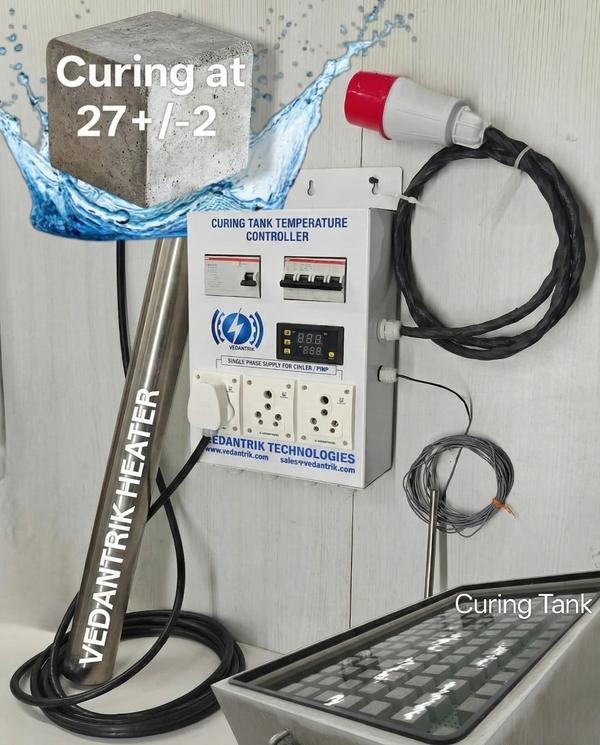
Curing Tank Temperature Controller

Curing Tank Temperature Controller for Concrete Cubes NABL Calibrated | Single & Three Phase | Waterproof & Shockproof | Heater, Chiller & Pump Ready Vedantrik Technologies presents an advanced curing tank temperature controller designed specifically for concrete cube curing tanks used in NABL-accredited laboratories, RMC plants, construction site labs, and infrastructure projects. The system accurately maintains the standard curing temperature of 27 ± 2 °C, as prescribed by IS and NABL guidelines. Equipped with an intelligent temperature controller, SS316 waterproof immersion heaters, and built-in electrical safety protections, this solution eliminates manual temperature monitoring and ensures consistent, audit-compliant curing conditions. Each system can be supplied with an NABL-traceable calibration certificate, making it suitable for laboratory audits and quality assurance processes. Concrete Curing Tank Temperature Control System This plug-and-play curing tank controller manages heating during winter and cooling during summer, ensuring uninterrupted and uniform curing of concrete test specimens. The controller supports both single phase and three phase power supplies, allowing it to work seamlessly with different tank sizes and heater configurations without any modification. Ideal Applications Concrete cube curing tanks NABL civil engineering laboratories Construction site testing laboratories RMC plants and QA/QC departments Infrastructure and government projects Technical Specifications – Curing Tank Controller Power Supply: Single Phase / Three Phase AC, 230 V Maximum Current Capacity: 32 Amps Temperature Set Point: 27 ± 2 °C Temperature Accuracy: ±1 °C Controller Power Cord Length: 2 meters Temperature Sensor Cable Length: 5 meters Plug & Play Connections Heater connection Chiller connection Water circulation pump connection Temperature sensor connection No skilled installation required. Key Features of Curing Tank Temperature Controller Compatible with single phase and three phase heaters Dedicated socket for chiller (summer curing) Dedicated socket for circulation pump Built-in short circuit and over-current protection Integrated MCB and RCCB for complete electrical safety Rugged design suitable for laboratory and onsite conditions Smart Heating & Cooling Logic (Energy Efficient) Heating Control – Winter Operation Heater switches OFF above 27 °C Heater switches ON below 25 °C Prevents overheating and reduces power consumption Chiller Control – Summer Operation Chiller switches ON above 29 °C Chiller switches OFF below 25 °C Maintains curing temperature as per NABL and IS standards Heater Selection Based on Curing Tank Volume Below 2000 liters: Single phase heater recommended Above 2000 liters: Three phase heater recommended The controller supports both heater types without any modification. Electrical Load Capacity of Controller Three Phase Heater Load Heater Rating: 4 kW per unit Minimum Load: 1 × 4 kW Maximum Load: 4 × 4 kW (Total 16 kW) Single Phase Heater Load Heater Rating: Up to 2 kW per unit Minimum Load: 1 heater Maximum Load: 3 heaters (Total 6 kW) Note: Single phase heaters draw higher current; therefore, lower total power is recommended. For large curing tanks, three phase heaters provide better efficiency and stability. SS316 Waterproof & Shockproof Immersion Heaters Three Phase Immersion Heater Power Rating: 4 kW Cable Length: 5 meters Cable Type: 5-core Heater Material: SS316 Protection: Waterproof & shockproof Single Phase Immersion Heater Power Rating: 2 kW Cable Length: 5 meters Cable Type: 3-core Heater Material: SS316 Protection: Waterproof & shockproof Recommended Heater Configuration for Curing Tanks Single Phase System (Small & Medium Tanks) 2000 liters: 1 × 2 kW heater 4000 liters: 2 × 2 kW heaters 6000 liters: 3 × 2 kW heaters Maintains 27 ± 2 °C curing temperature. Three Phase System (Large Tanks) Up to 2500 liters: 1 × 4 kW heater Up to 5000 liters: 2 × 4 kW heaters (8 kW) Up to 7500 liters: 3 × 4 kW heaters (12 kW) Up to 10,000 liters: 4 × 4 kW heaters (16 kW) Best Practices for Uniform Concrete Curing Interconnect multiple curing tanks using a water circulation pump For identical tanks in the same environment, one temperature sensor is sufficient For different tank sizes, place the sensor in the largest tank Use multiple controllers for independent temperature control Multichannel curing tank controller available for economical multi-tank operation NABL Compliance & Custom Solutions NABL-traceable temperature calibration certificate available Multichannel and customized curing tank controllers Designed for NABL labs, RMC plants, infrastructure projects, and site laboratories Contact for Pricing & Technical Support 📞 8452062580 📧 sales@vedantrik.com Topic covered above Curing tank temperature controller Concrete cube curing tank controller NABL curing tank temperature controller Concrete curing tank heater SS316 immersion heater for curing tank Single phase curing tank heater Three phase curing tank heater Concrete laboratory curing equipment Curing tank temperature control system

6814772a5d263414004dd4a4 Card 2

product image
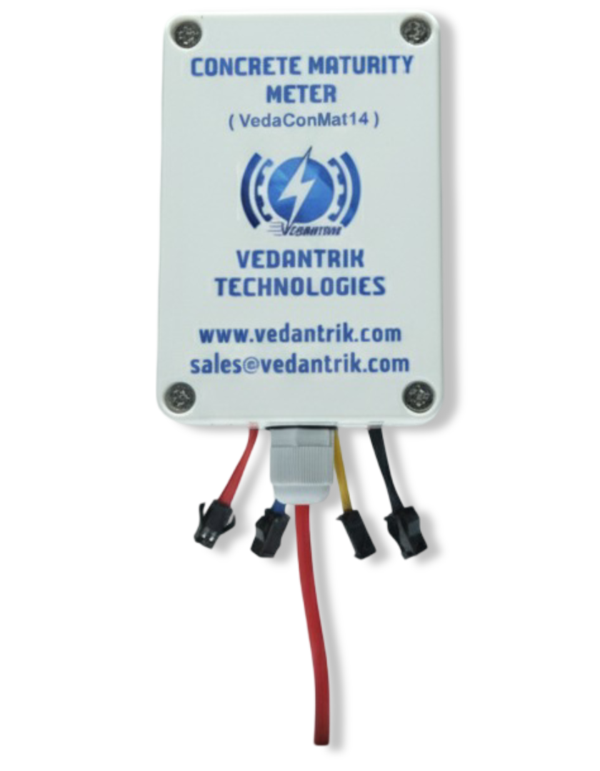
Concrete Maturity meter

Concrete Maturity Meter: VedaConMat14 by Vedantrik Technologies is a device designed to accurately estimate the maturity of concrete using highly sensitive and precise temperature sensors. By measuring temperature variations within the concrete, the device calculates the maturity value, which is then correlated with strength to develop a reliable maturity index. This index is used to determine the in-situ compressive strength of concrete, enabling real-time monitoring of both precast and cast-in-place concrete. The device is equipped with four sensor ports, allowing connection of four temperature sensors simultaneously. These sensors are embedded into the concrete at the construction site to measure temperature continuously. The maturity value is then calculated based on the recorded temperature data and correlated with the concrete strength. This correlation must be established for the specific concrete mix design following ASTM C1074 standards and remains valid as long as the mix design does not change. VedaConMat14 logs temperature data every 30 minutes, averaging 60 individual readings collected at 30-second intervals to provide precise and stable temperature values over time. This continuous monitoring ensures a detailed temperature profile throughout the curing process. For seamless connectivity, VedaConMat14 features a built-in Wi-Fi Hotspot, allowing wireless connection from laptops, PCs, or mobile devices. Its web-based software interface provides real-time visualization of temperature, maturity, and strength data directly from the device. Furthermore, when connected to an office Wi-Fi network and synced with Google Drive, all logged data is automatically uploaded to the cloud. This allows remote access to the concrete maturity and strength information from anywhere in the world via Google Drive. Key features of Concrete Maturity Meter : VedConMat14 1. Temperature Sensing Range: 0 to 100°C with ±1°C Accuracy: VedaConMat14 can measure temperatures from freezing point (0°C) up to 100°C, covering the entire typical range for concrete curing. The sensors provide highly accurate readings, with a small possible error margin of just plus or minus one degree Celsius, ensuring reliable temperature data for maturity calculations. 2. Low-Cost Sacrificial Sensors, Reusable Measuring Unit: The temperature sensors used are designed to be low-cost and sacrificial, meaning they can be embedded directly into the concrete and disposed of after use. However, the main measuring unit, which collects and processes data from these sensors, is reusable for multiple projects, reducing overall costs. 3. Automatic Data Logging with User-Defined Intervals: The device automatically records temperature data at intervals set by the user. This flexibility allows adjusting the frequency of measurements based on project requirements—whether data is needed every few minutes or hours—making monitoring efficient and tailored. 4. Available in Multiple Channel Options VedaConMat14 supports different versions with varying numbers of sensor ports (channels). This allows monitoring temperature at multiple points within the concrete, which is especially useful for large pours where temperature can vary across the mass. 5. Web-Based Software for Data Logging and Report Download The system comes with easy-to-use web-based software accessible through any device connected to the VedaConMat14 Hotspot. This software allows viewing real-time data, managing logged data, and downloading detailed reports for record-keeping and analysis. 6. Graphical Representation The software provides clear graphical charts that plot temperature changes over time, Maturity vs. Time, Maturity vs. strength. These graphs help visualize the curing process, showing how temperature rises and falls during hydration. Such visual data assists engineers in quickly assessing whether concrete is curing done properly and supports making informed decisions about strength development and construction scheduling. Monitoring the strength development of concrete during early curing is essential for safe construction scheduling. The Concrete Maturity Meter provides real-time data on temperature history to estimate in-place strength, making it a crucial tool for project managers. In Mumbai’s high-rise and infrastructure projects, where deadlines are tight, maturity meters allow engineers to determine the right time for formwork removal, post-tensioning, or opening structures to service. Vedantrik Technologies offers advanced maturity meters that are easy to deploy and deliver accurate strength estimations. By using this device, contractors avoid unnecessary delays while ensuring safety. It reduces reliance on time-based curing estimates and instead relies on actual strength data, leading to better efficiency and reduced costs. For high-performance concrete maturity meters in Mumbai, connect with Vedantrik Technologies and achieve safer, smarter, and faster construction results. Concrete Maturity method is a fundamental concept that is used to estimate the early-strength development of concrete based on its time & temperature history. It follows the principle that the strength development of the concrete is directly influenced by both time and temperature. The maturity method as defined by ASTM C1074 provides a reliable, non-destructive way to assess the in-situ concrete strength development over time. This standard is widely used in structural monitoring, quality control, and construction scheduling where early-age strength prediction is critical. Concrete maturity refers to the cumulative effect of both temperature and time on strength development in concrete. The main objective behind the maturity method is that concrete does not gain strength based on age but rather how temperature has influenced its hydration process over time. The process of hydration is temperature dependent, where higher temperature accelerates the reaction and, in turn, the strength gain, while lower temperatures show an opposite effect. Hence maturity is also defined as a time-temperature factor or function. By integrating temperature over time, maturity index can be established, which is typically expressed in °C·hours or °C·days, that correlates with strength development. The co-relation between maturity and strength is empirical and must be established for each specific concrete design, as it is generally accepted that concrete of a specific mix design will develop the same compressive strength if it reaches the same maturity index, for example if a concrete mix (A) is achieving the maturity index of value Z 0C.hrs in X days at Y 0C , and there is a concrete mix (B) is also achieving the same maturity index that is of value Z 0C.hrs in P days at Q 0C still both will develop same compressive strength as the maturity indexes are same. This assumption enables project teams to assess strength development in real time, improving the quality control without the need of frequent destruction. Purpose of Concrete maturity method: 1. To determine in-situ concrete strength using the time-temperature history of the structure, in accordance with ASTM C1074. 2. Provides a non-destructive alternative to traditional testing methods. 3. Helps in improving the structural safety by ensuring that critical construction activities are performed only after the concrete has reached the required strength. 4. Enhance control over curing conditions by allowing for assessment of temperature related-effects on strength development. Supports mix design optimisation by allowing the study of variables like admixtures, cement types, or curing conditions effect on strength development. 5. Facilitate compliance with standards through data-driven, quantifiable verification of strength development. Principle behind Concrete Maturity Measurement Method: The concrete maturity method is an empirical technique employed to predict the development of strength in concrete as a function of its temperature-time history. The fundamental principle underlying this method is that the rate of cement hydration process, along with the consequential strength gain, is not only influenced by the age of the concrete since the time of casting, but primarily by the combined effect of time and temperature. In essence the maturity method is useful in quantifying the degree of hydration by integrating temperature over time, thereby allowing to estimate the strength of in-situ concrete with great accuracy, especially during the early stages of curing. Concrete strength gain is intrinsically linked to the kinetics of cement hydration, a complex exothermic reaction between water and cementitious materials such as tricalcium silicate, dicalcium silicate, tricalcium aluminate, and tetracalcium aluminoferrite that leads to formation of calcium-silicate-hydrate (C-S-H) gel and other reaction products that contribute materials structural integrity. The rate of these hydration reactions are temperature dependent, so elevation in temperature increases the rate, mainly because of reduced activation energy barrier, while lower temperatures affect it in the opposite manner. However, this same hydration process can result in excessive heat generation that has a direct effect on the morphology and distribution of the hydration products. Hence, it can lead to temperature induced changes in the micro-structures, porosity and micro-cracking due to differential thermal gradients, especially in mass concrete. Furthermore elevated temperature can also affect the natural evolution of the micro-structures in the concrete, thereby affecting the structural and mechanical properties beyond that could be assessed by the maturity method. Measurement of Maturity and strength: Nurse-Saul function is the widely used method, which assumes that there is a linear relationship between temperature and the rate of hydration. The general formula is expressed in the form given below: M(t) = ∑ (Ta - T0) * Δt Where : M(t) = the temperature-time factor at age t, degree-days or degree-hours, Δt = time interval, days or hours, Ta = average concrete temperature during time interval, Δt, °C, and To = datum temperature, °C. After calculating the maturity values for each of the specified curing days and determining the corresponding compressive strengths from the CTM (Compression Testing Machine) results, plot a graph of maturity index versus compressive strength. Fit a trend-line to the data to identify the best-fit relationship, typically a logarithmic regression provides a good representation of the strength development in relation to maturity. Fc = a + b * log10 (M) Components of Concrete Maturity Method: 1. Temperature Monitoring Equipment - Devices to measure and record concrete temperature over time. 2. Concrete Strength Testing - Standard strength tests (e.g., ASTM C39 – Compressive strength of cylindrical concrete specimens). 3. Reference Temperature - A specific temperature used in maturity calculations. For Nurse–Saul, the typical reference is 0°C (32°F) unless otherwise specified. 4. Concrete Mix Design Information - The maturity method is mix-specific; a separate calibration curve is required for each mix. 5. Data Collection and Analysis Tools - Software or spreadsheets to calculate maturity and estimate strength. Ensures real-time tracking and reporting. Standard procedure: Overview (as per ASTM C1074) 1. Objective of Maturity Method Calibration The primary objective of the calibration process in ASTM C1074 is to establish a reliable relationship between concrete maturity and its compressive strength for a specific concrete mix. This relationship—called the strength–maturity curve—enables users to estimate in-place concrete strength based on temperature history rather than destructive testing. Since the maturity method is mix-specific, each unique concrete mixture requires its own calibration. 2. Selection and Preparation of Concrete Mix The calibration begins by selecting the specific concrete mix that will be used in the field. This includes confirming the materials, proportions, and mixing procedure. Fresh concrete from this mix is then used to cast a set of standard specimens depending on the project requirements, which will be cured and tested over time to develop the strength–maturity relationship. 3. Temperature Monitoring of Specimens To track the maturity development, thermocouples or temperature sensors are embedded in at least two of the cylinders immediately after casting. These sensors record the internal temperature of the specimens continuously over time. The temperature data is used to calculate the maturity index using either the Nurse–Saul function or the Arrhenius function, as specified in ASTM C1074. 4. Curing and Strength Testing Schedule The concrete specimens are cured under standard laboratory conditions, and are tested for compressive strength at multiple time intervals; for example, at 1, 3, 7, 14, and 28 days. The specific times should span the range of expected strengths during field monitoring. At each test age, the corresponding maturity index is calculated based on the recorded temperature history. 5. Developing the Strength–Maturity Relationship After collecting the strength and maturity data at each age, the results are plotted with concrete strength on the y-axis and maturity index on the x-axis. A best-fit curve (usually exponential or logarithmic) is applied to the data points to define the strength–maturity relationship for the given concrete mix. This curve becomes the foundation for estimating in-place strength based on measured maturity in the field. Result Interpretation of Concrete Maturity Method: Result interpretation in the maturity method involves comparing the maturity index (°C·hours or °C·days) calculated from the in-situ concrete to a previously developed calibration curve that relates maturity to compressive strength. By identifying the maturity value measured in the field and locating that point on the calibration curve, the corresponding compressive strength can be estimated. This allows for a reliable prediction of the in-place concrete strength at any given time, provided the conditions match those used during calibration. Factor influencing Concrete Maturity Method: 1. Temperature Measurement Accuracy: Proper placement and calibration of temperature sensors are crucial. Incorrect readings due to poor installation or equipment issues can lead to inaccurate maturity and strength estimates. 2. Calibration Curve Quality: The maturity-strength relationship must be based on accurate, consistent lab testing. Any errors in sample preparation, curing, or testing can compromise the validity of field results. 3. Mix Design Consistency: Variations in concrete mix (e.g., cement type, water content, admixtures) between the lab and field can affect strength development, making maturity estimates unreliable if not properly accounted for. 4. Curing and Environmental Conditions: While temperature is monitored, factors like moisture loss and poor curing practices can slow strength gain, leading to overestimated strength if maturity is used alone. 5. Data Recording Frequency: Infrequent or interrupted temperature logging can distort the maturity calculation. ASTM recommends frequent intervals (e.g., every 30 minutes) for accurate tracking. 6. Thermal Gradients in Large Sections: In large pours or mass concrete, different parts of the element may heat and cool at different rates. A single sensor may not represent the entire structure, leading to localised over- or underestimation of strength. As a best Concrete Maturity Meter Manufacturer in India we have supplied in Mumbai, Pune, Nashik, Aurangabad, Surat, Vadodara, Ahmedabad, Indore, Bhopal, Nagpur, Jaipur, Ludhiana, Ghaziabad, Delhi, Lucknow, Kanpur, Prayagraj, Patna, Ranchi, Dhanbad, Bengaluru, Hyderabad, Chennai, Coimbatore, Madurai, Visakhapatnam, Kolkata, and Srinagar. Also we have supplied a range of products in Dubai, Abu Dhabi, the United Arab Emirates, Oman, Saudi Arabia, Kuwait, and Iran. We also serve clients in Singapore, Indonesia, Thailand, and other international locations.

6814772a5d263414004dd4a4 Card 2

product image
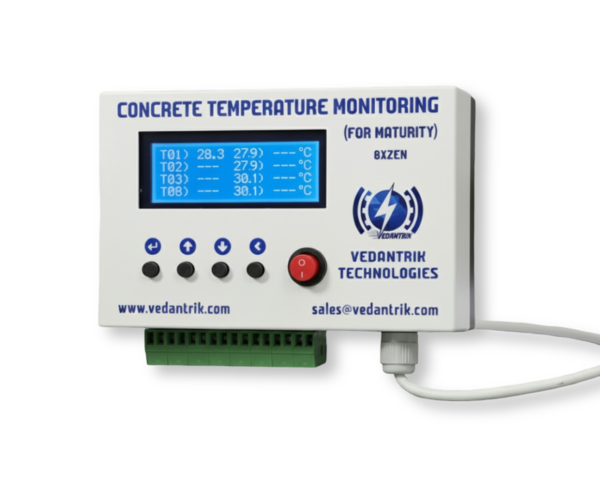
Mass Concrete Temperature monitoring

Mass Concrete temperature Monitoring system Mass concrete temperature monitoring device developed by Vedantrik technologies is an advanced temperature monitoring and data logging system specifically designed for mass concrete applications like raft, foundations, hot blocks and other mass concretes to prevent thermal stresses and micro cracking. Wire-length Challenges in Mass Concrete Temperature Monitoring In mass concrete applications, temperature sensors are typically embedded at multiple levels — the top, middle, and bottom of the pour — to accurately monitor temperature differentials during curing. However, in high-rise building foundations, the raft thickness can reach up to 3 meters or more, creating significant wire-length challenges. As the sensors are placed deeper within the concrete, the distance between the sensors and the data loggers (which are usually installed at a controlled, accessible location) can exceed 5 meters. This extended wire-length can lead to inaccurate or higher temperature readings. The commonly used RTD (Resistance Temperature Detector) thermocouples in concrete temperature monitoring are typically accurate only up to a cable length of approximately 5 meters. Beyond this distance, the increase in lead resistance can result in elevated or higher temperature readings. This is particularly problematic because the lead resistance is non-linear and not directly proportional to the cable length, making it difficult to apply standardised correction factors. Consequently, extended cable lengths introduce a significant source of error in temperature measurements. But the device developed by Vedantrik technologies for mass concrete temperature monitoring can give accurate temperature readings even if wire-lengths are above 100 meters with accuracy of +/- 1 degree Celsius. The device logs temperature data at user-defined intervals, with a standard recording interval of 30 minutes. The system utilises high accuracy sensors, which are embedded in the concrete, during casting and remain in place throughout the curing process. These sensors feed temperature data to the device’s internal storage, which can be accessed later wirelessly using mobile phone or laptop via wifi, the device supports Wi-Fi connectivity, allowing users to access and monitor data in real time through a PC, laptop, or mobile device. By providing accurate and timely temperature data, the system supports informed decisions regarding concrete strength development, enabling optimised construction schedules, timely formwork removal, and improved quality control in mass concrete applications. Key Features: 1. Wide Temperature Sensing Range with High Accuracy The device is equipped with high-precision sensors capable of measuring temperatures from the time of concrete casting through the entire curing period. The system accurately captures internal temperatures during the critical heat of hydration phase, providing essential data for quality control and structural safety. The sensors offer reliable performance, ensuring accurate temperature readings necessary for maturity-based strength estimation. 2. Automatic Logging with 30-Minute Interval (User-Defined Options) The device records temperature data automatically at regular intervals, by default set to 30 minutes that can be configured to suit specific project requirements. This flexibility allows engineers to tailor the data collection frequency based on the concrete mix, ambient conditions, and structure type, optimising both storage and monitoring needs.. 3. Multiple Sensor Channel Options for Mass Concrete The device comes with 16 channels, each can be connected to a different temperature sensor, allowing temperature monitoring at several points within a single pour. This is especially beneficial in mass concrete applications, where thermal gradients and differential heating can impact structural performance and cracking risk. 4. Onboard Storage and Wireless Data Access Temperature data is stored locally on the device and can be retrieved via memory card. In addition, this device features built-in Wi-Fi connectivity, enabling users to connect through laptops, PCs, or smartphones to view real-time data, manage sensor inputs, and download detailed reports for documentation and compliance. Concrete temperature directly affects hydration, setting, and strength development. Concrete Temperature Monitoring Devices help engineers track temperature changes during curing, ensuring optimal conditions are maintained. In Mumbai’s climate, with varying temperatures and humidity levels, monitoring concrete temperature becomes vital. Vedantrik Technologies provides advanced monitoring systems that record accurate data, helping project managers maintain curing consistency. By tracking temperature variations, contractors prevent issues such as thermal cracking, improper hydration, or delayed strength gain. These devices support better decision-making and improve the long-term durability of structures. For precision concrete temperature monitoring devices in Mumbai, trust Vedantrik Technologies and enhance the quality of your construction projects. Concrete temperature monitoring is a critical process in ensuring the structural integrity and long term durability of large concrete placements. Mass concrete refers to large volumes of concrete that require specific measures to deal with the excessive generation of heat from hydration and change in volume associated to minimise micro-cracking due to thermal stress. In large scale projects continuous temperature monitoring becomes essential at the early stages after the placement, where thermal gradient and excessive heat can alter the development of micro-structures in concrete causing thermal cracks which are detrimental to the structural integrity of the concrete. In the evolution of concrete from different phases, an exothermic reaction occurs between the cement and water which results in generation of heat called as heat of hydration. The amount of heat generated primarily depends on the composition of the concrete mix design. In mass concrete, this heat is not able to dissipate quickly due to low surface area- to -volume ratio, resulting in the significant increase in internal temperature, sometimes exceeding 70°C. This can become concerning because the difference in between the hot internal and cooler external surface can create a thermal gradient that can induce tensile stresses, potentially leading to thermal crack development. Monitoring the temperature during these initial phases of development is crucial for quality control and compliance with various regulatory codes. As per the guidelines of ACI 301 and ACI 207.1R, the maximum temperature limit allowance ranges from 65°C to 70°C for internal temperatures and the difference between the ambient and internal temperature must not exceed or be less than 20°C. For continuous temperature monitoring, temperature sensors or thermocouples are embedded at different depths and locations within the concrete. The data is logged into a temperature monitoring device which allows the engineers to take immediate necessary actions if the temperature exceeds the safe limit. In addition the maturity method, as defined in ASTM C1074, can be used in parallel with temperature monitoring to estimate in-place strength gain. Since strength development is temperature-dependent, combining maturity and temperature data offers a comprehensive view of both thermal and structural performance. In extreme cases or during hot weather concreting, pre-cooling (cooling the materials before mixing), post-cooling (using embedded cooling pipes through which chilled water is circulated), and surface insulation are employed to manage temperature rise. These methods aim to control the rate of temperature development and limit differential temperatures between the core and surface, thereby reducing thermal stresses. Purpose of temperature monitoring in mass concrete: 1. Monitoring ensures concrete cures within the ideal temperature range. Too cold slows hydration, delaying strength gain; too hot accelerates it, reducing final strength and durability. 2. Temperature data helps estimate how quickly concrete is gaining strength. This guides safe timing for formwork removal, loading, or post-tensioning. 3. In mass pours, temperature differences between the core and surface can cause cracking. Monitoring helps manage cooling rates to reduce this risk. 4. In low temperatures, monitoring ensures concrete doesn't freeze before setting. It supports the use of heating or insulation when needed. 5. High heat can cause rapid moisture loss and shrinkage cracks. Monitoring allows for cooling methods or mix adjustments to maintain quality. 6. Real-time temperature data supports timely decision-making, helping avoid delays while ensuring the concrete has reached required strength. Principle of Concrete temperature monitoring: The thermal behaviour of mass concrete is governed by the exothermic hydration reaction, low thermal diffusion, low surface area-to-mass ratio, which in conjunction can lead to thermal cracking and long-term durability impairment, if not regulated with great concern. Temperature monitoring in mass concrete, therefore, becomes the base on understanding the thermal gradient induced during the hydration process, in conjunction with thermal & structural interaction that occurs due to differential thermal strain in between internal and external zones of the concrete mass. The primary heat generation is derived from the exothermic hydration of portland cement phases, primarily tricalcium silicate, dicalcium silicate, since their heat evolution profiles are temporally variant and sensitive to mixture proportions, ambient temperatures, and presences of cementitious materials. The volumetric heat generation within the matrix leads to progressive elevation of internal temperature, which can rise beyond 65°C to 70°C in high cement contents while the outer exposed surface dissipates heat more efficiently via conduction, convection and by radiation, resulting in formation of a thermal gradient. The resulting thermal gradient then induces differential change within the concrete mass. Internally, the concrete goes under thermal expansion during the peak hydration, whereas the outer surface being cooler, may undergo regional contraction, this creates difference in the hardness at various points in concrete. Upon the subsequent cooling, the core begins to shrink, but the surrounding hardened shell resists this contraction, preventing the volumetric movement, thereby imparting tensile stresses in the interior zone. These internal tensile stresses can significantly lower the development of compressive strength, leading to the formation of thermal induced cracks. The concrete's natural low diffusivity contributes to slow temperature equalisation across the cross-section, thus sustaining high temperature differentials over extended duration. Another critical aspect for temperature monitoring is the time-dependent nature of materials in concrete. Since the thermal strains are governed by both temperature changes and time-dependent mechanical properties, the process of temperature monitoring becomes essential in understanding the viscoelastic nature of the concrete. Accurate temperature data, therefore, becomes essential to capture the real-time behaviour of the concrete to predict its stress-strain response under thermal loading. Furthermore, especially in mass concrete systems incorporating additives such as fly ash, slag, or silica fumes, kinetics of the hydration often get modified, contributing to prolonged heat evolution. Temperature monitoring in such systems must account for the synergistic thermal contribution of secondary reactions. Hence, concrete temperature monitoring becomes an important tool in the process of concrete strength development throughout the curing phase. Components of Concrete temperature monitoring 1. Temperature Sensors: Embedded in the concrete to measure internal temperatures during curing. Common types include thermocouples, and digital sensors, all designed to withstand harsh construction environments. 2. Data Loggers: Records the temperature readings from sensors at regular intervals and logs the data in internal memory. 3. Wireless connectivity: System can connect with Mobile phone laptop PC using Wifi. Standard procedure: Overview 1. Sensor Installation Sensors are securely positioned within the reinforcement cage or attached to the formwork at pre-identified locations. Proper spacing and orientation are ensured to prevent sensor displacement during concrete placement. All wiring is routed through protective conduits or sleeves to safeguard against mechanical damage, moisture ingress, or interference during pouring and compaction operations. The integrity of the sensor installation is verified prior to the pour. 2. Concrete Placement and Monitoring Activation Once the concrete is placed, the monitoring system is activated. Data loggers or wireless transmitters begin recording temperature at set intervals. The initial temperature readings immediately after placement help establish baseline values for curing analysis and thermal control. 3. Real-Time or Periodic Data Collection Depending on the monitoring system employed, temperature data is downloaded wirelessly . 4. Data Analysis and Interpretation Engineers interpret the temperature data in accordance with project-specific thermal control plans, ACI guidelines (e.g., ACI 301 for mass concrete), or maturity method standards (e.g., ASTM C1074). Data is evaluated to ensure curing temperatures remain within acceptable limits. If deviations are identified such as excessive thermal gradients or temperature peaks, corrective measures (e.g., insulating blankets, surface cooling, delayed formwork removal) are implemented. Result Interpretation of Concrete Temperature Monitoring The interpretation of concrete temperature monitoring data is critical to ensuring the structural integrity, durability, and safety of a concrete element, particularly in applications involving mass concrete, cold weather concreting, or accelerated construction schedules. The data obtained from embedded sensors must be systematically analysed to assess compliance with design and curing requirements. Below are the key aspects considered during result interpretation: 1. Peak Temperature Evaluation The maximum internal temperature recorded within the concrete mass is reviewed to ensure it remains within allowable limits, typically not exceeding 70°C (158°F) for most mixes, unless specifically engineered otherwise. Excessive peak temperatures may lead to deleterious effects such as Delayed Ettringite Formation (DEF), which can compromise long-term durability, and accelerated hydration, increasing the risk of early-age thermal cracking. 2. Temperature Differential Assessment The temperature gradient between the core and surface of the concrete element is analysed to identify the potential for thermal cracking. A commonly accepted threshold is a differential of 20°C (36°F); however, project-specific limits may vary based on structural geometry, restraint conditions, and material properties 3. Minimum Temperature Verification Minimum recorded temperatures are reviewed to ensure they meet the threshold for proper cement hydration, especially in cold weather concreting. Typically, concrete must be maintained above 5°C (41°F) for standard mixes, unless modified with accelerators or heated curing methods. Temperatures below this threshold may cause delayed strength development, or result in incomplete hydration , compromising final performance. 4. Time-Temperature Curve Analysis Time-temperature curves are plotted to visualise temperature evolution over time. These curves help determine the curing trends, such as rate of temperature rise and fall,timing of exothermic peak, which typically occurs within 24–48 hours, and the rate of cooling, which should be controlled to avoid thermal stress buildup. Analysis of these curves supports engineering decisions regarding the timing of further construction operations. 5. Compliance Verification All interpreted results are compared against the project’s thermal control plan or governing specifications (e.g., ACI 301, ACI 207.1R, CSA A23.1). Any deviations from specified temperature ranges or curing conditions must be documented, and appropriate corrective actions should be recommended and implemented. Factors Influencing Concrete Temperature Monitoring Several variables influence the accuracy, reliability, and interpretation of concrete temperature monitoring. Understanding these factors is essential for implementing an effective monitoring system and ensuring valid data collection during the curing process. a. Mix Design Characteristics : The type of cement, water-to-cement ratio, use of supplementary cementitious materials (SCMs), and presence of chemical admixtures significantly affect the rate and magnitude of temperature development in concrete. High-performance or mass concrete mixes, in particular, exhibit elevated heat of hydration, which requires close thermal management. b. Ambient and Weather Conditions : External temperature, wind, and humidity influence both the surface and internal temperatures of concrete. In cold weather, the risk of freezing during early curing stages is critical, while in hot weather, rapid surface drying or heat accumulation can lead to thermal gradients and cracking. c. Element Size and Geometry: Larger or thicker concrete sections (e.g., footings, piers, or mat foundations) retain more heat due to lower surface-to-volume ratios, which results in slower heat dissipation and higher internal temperatures. Conversely, thin sections cool more rapidly, increasing the risk of thermal differentials. d. Sensor Type and Quality: The accuracy and sensitivity of the sensors used (e.g., thermocouples, fiber-optic sensors, or wireless maturity sensors) influence the precision of temperature readings. e. Sensor Placement and Depth: Improper placement of sensors can lead to unrepresentative or misleading data. Sensors must be strategically installed at different depths (core vs. surface) and locations within the structure to capture thermal gradients and localized heating. Inconsistent or shallow placement may fail to reflect internal thermal conditions. f. Insulation and Formwork Conditions: The presence of insulation materials, thermal blankets, or sealed formwork can slow down heat loss from the concrete, affecting its thermal profile. These protective measures are especially relevant in extreme weather but must be considered when interpreting the resulting temperature curves. Technical Specifications: a) Temperature Sensing range: 0 °C to 100 °C b) Temperature Accuracy: ± 1 °C c) Number of Channels: Up to 16 channels, allowing multiple sensor connections. d) Maximum Sensor Lead Length: more than 100 meters with accurate readings. e) Report Generation: Automatic reports with temperature logs; download/export into your device. f) Sensor : High-precision Temperature sensor for long-cable applications. As a best Mass concrete temperature monitoring system Manufacturer in India we have supplied in Mumbai, Pune, Nashik, Aurangabad, Surat, Vadodara, Ahmedabad, Indore, Bhopal, Nagpur, Jaipur, Ludhiana, Ghaziabad, Delhi, Lucknow, Kanpur, Prayagraj, Patna, Ranchi, Dhanbad, Bengaluru, Hyderabad, Chennai, Coimbatore, Madurai, Visakhapatnam, Kolkata, and Srinagar. Also we have supplied our Mass concrete temperature monitoring system including Dubai, Abu Dhabi, the United Arab Emirates, Oman, Saudi Arabia, Kuwait, and Iran. We also serve clients in Singapore, Indonesia, Thailand, and other international locations.

Subcategory Tags

Anvil For Rebound Hammer Calibration in India Anvil For Rebound Hammer Calibration Manufacturer in India Anvil For Rebound Hammer Calibration Manufacturer in Mumbai Half-Cell Corrosion Potential Meter Manufacturer in India Half-Cell Corrosion Potential Meter manufacturer in Mumbai Half Cell Corrosion Potentiomete Concrete Half Cell Corrosion Tester Concrete Corrosion Potentiometer Half Cell Potential Tester Concrete Corrosion Measurement Device Concrete Rebar Corrosion Tester Concrete Corrosion Monitoring Equipment Concrete Corrosion Testing Instrument Copper Sulfate Half Cell Electrode Concrete Corrosion Potential Meter Concrete Durability Tester Concrete Corrosion Detection Device Reinforcement Corrosion Tester Concrete Half Cell Testing Equipment Concrete Corrosion Monitoring System Concrete Corrosion Analyzer Concrete Rebar Corrosion Measurement Equipment Concrete Structure Corrosion Tester Concrete Corrosion Evaluation Device Concrete Half Cell Potential Tester Concrete Rebar Potential Measurement Device Half Cell Potential Measurement Instrument Concrete Corrosion Analysis Equipment Concrete Durability Testing Equipment Concrete Half Cell Measurement System Concrete Potential Measurement Device Concrete Electrochemical Testing Equipment Concrete Steel Corrosion Tester Concrete Half Cell Electrode Tester Concrete Rebar Corrosion Analyzer Concrete Corrosion Inspection Instrument Reinforcement Corrosion Monitoring Equipment Concrete Surface Potential Measurement Device Concrete Corrosion Detection Instrument Concrete Corrosion Monitoring Device Half Cell Corrosion Measurement Kit Concrete Half Cell Potential Measurement System Concrete Rebar Corrosion Mapping Equipment Concrete Corrosion Evaluation Instrument Concrete Rebar Corrosion Detection Tester Concrete Corrosion Mapping Device Concrete Structure Corrosion Analyzer Concrete Electrical Potential Tester Half Cell Potential Measurement Device Concrete Rebar Potential Mapping Instrument Concrete Non Destructive Corrosion Tester Concrete Corrosion Control Equipment Concrete Half Cell Reference Electrode Concrete Rebar Corrosion Assessment Device Concrete Corrosion Measurement System Rapid Chloride Migration Test (RCMT) Apparatus Manufacturer in India Rapid Chloride Migration Test (RCMT) Apparatus Manufacturer in Mumbai Rapid Chloride Migration Test Chloride Ion Penetration Tester Concrete Chloride Tester Chloride Diffusion Test Concrete Ion Migration Tester Chloride Ion Migration Analyzer Concrete Chloride Analyzer Concrete Chloride Diffusion Tester Concrete Chloride Permeability Meter Chloride Ion Diffusion Test Equipment Concrete Durability Analyzer Rapid Chloride Diffusion Test Concrete Permeability Analyzer Chloride Ion Test Machine Concrete Ion Transport Tester Concrete Resistance Tester Concrete Electrical Conductivity Tester Concrete Durability Measurement Chloride Ion Penetration Analyzer Rapid Chloride Test Machine Concrete Ion Migration Analyzer Concrete Resistance Measurement Device Concrete Durability Evaluation System Concrete Permeability Measuring Instrument Chloride Penetration Measurement Device Concrete Diffusion Analyzer Concrete Durability Test Apparatus Cement Durability Testing Equipment Chloride Ion Resistance Tester Concrete Transport Property Tester Chloride Ion Diffusion Analyzer Concrete Durability Evaluation Tester Concrete Electrical Resistivity Tester Rapid Chloride Analyzer Chloride Ion Migration Measurement Concrete Permeability Measurement Device Cement Chloride Analyzer Concrete Ion Transport Analyzer Concrete Chloride Penetration Test Rapid Chloride Penetration Test (RCPT) Apparatus Manufacturer in India RCPT Apparatus Concrete Durability RCPT test Procedure RCPT Manufacturer RCPT calibration services RCPT result interpretation RCPT testing charges RCPT testing Services Concrete Resistivity meter RCPT manufacturer in Mumbai rcpt manual rcpt limit Rapid Chloride Penetration Test RCPT Test Equipment Concrete Chloride Penetration Tester Concrete Permeability Tester Chloride Ion Diffusion Test Concrete Ion Penetration Analyzer Chloride Permeability Test Equipment Rapid Chloride Permeability Tester Concrete Durability Testing Machine Concrete Electrical Resistance Tester Concrete Resistivity Tester Concrete Durability Measurement Device Concrete Corrosion Resistance Tester Concrete Durability Evaluation Equipment Chloride Ion Migration Test Concrete Penetration Resistance Tester Concrete Permeability Measurement Concrete Diffusion Test Apparatus Concrete Electrical Conductivity Meter Concrete Durability Test Machine RCPT Testing Apparatus Concrete Permeability Test Apparatus Concrete Durability Test Equipment Chloride Ion Diffusion Measurement Concrete Permeability Measurement System Concrete Durability Testing Instrument Concrete Chloride Resistance Tester Concrete Ion Diffusion Tester Concrete Temperature monitoring for Concrete Maturity meter Manufacturer in India Concrete Temperature monitoring for Concrete Maturity meter Manufacturer in Mumbai Mass concrete temperature Monitoring services ACI 305 Concrete curing—Cure concrete in accordance with ACI 308.1. Protection period Acceptable protection materials to prevent excessive temperature drop Maximum allowable concrete temperature Limit the maximum allowable fresh concrete temperature to 35 °C (95 °F) concrete mixture Mass Concrete Temperature Monitoring Concrete Temperature Sensor Concrete Temperature Monitoring System Concrete Curing Temperature Sensor Concrete Temperature Logger Concrete Temperature Data Logger Concrete Thermal Monitoring System Concrete Temperature Recorder Mass Concrete Temperature Sensor Concrete Curing Temperature Logger Concrete Thermal Sensor Concrete Temperature Measurement Device Concrete Temperature Monitoring Device Wireless Concrete Temperature Sensor Smart Concrete Temperature Sensor Concrete Pour Temperature Monitoring Concrete Temperature Monitoring Equipment Concrete Curing Monitoring System Concrete Internal Temperature Sensor Concrete Structure Temperature Sensor Concrete Thermal Monitoring Device Concrete Temperature Testing Equipment Concrete Heat Monitoring System Concrete Thermal Control System Concrete Temperature Tracking Device Mass Concrete Temperature Logger Concrete Heat Measurement Device Concrete Curing Data Logger Concrete Temperature Control System Concrete Temperature Measuring Instrument Concrete Pour Monitoring System Concrete Thermal Analysis Sensor Concrete Monitoring Data Logger Construction Temperature Monitoring System Concrete Maturity Temperature Sensor Concrete Temperature Recording Device Concrete Curing Temperature Monitoring Wireless Temperature Monitoring For Concrete Concrete Thermal Performance Sensor Concrete Temperature Control Logger Concrete Temperature Analysis Equipment Concrete Curing Heat Sensor Concrete Hydration Temperature Sensor Concrete Temperature Measurement System Concrete Curing Thermal Logger Concrete Internal Heat Monitoring Device Smart Temperature Sensor For Concrete Rebound hammer anvil Calibration anvil for rebound hammer Standard steel anvil rebound hammer Anvil HRC 66 Test anvil for rebound hammer India Anvil For Rebound Hammer Calibration Rebound Hammer Calibration Anvil Concrete Test Hammer Anvil Schmidt Hammer Calibration Anvil Rebound Hammer Calibration Equipment Concrete Rebound Hammer Calibration Tool Concrete Test Hammer Calibration Device Calibration Anvil For Rebound Hammer Rebound Hammer Calibration Apparatus Concrete Rebound Hammer Testing Equipment Concrete Strength Tester Calibration Anvil Concrete Hardness Tester Calibration Tool Concrete Testing Equipment Rebound Hammer Testing Anvil Concrete Hammer Calibration Device Concrete Testing Instrument Calibration Equipment For Rebound Hammer Concrete Test Anvil Standard Calibration Anvil Laboratory Calibration Anvil Concrete Rebound Test Anvil Rebound Hammer Accessory Concrete Testing Calibration Device Rebound Hammer Calibration Kit Concrete Surface Testing Equipment Concrete Strength Testing Equipment Concrete Hammer Calibration Block Concrete Impact Testing Equipment Concrete Calibration Equipment Concrete Test Hammer Accessories High Precision Calibration Anvil Concrete Laboratory Equipment Construction Material Testing Equipment Rebound Hammer Calibration Standard Concrete Test Hammer Standard Anvil Concrete Testing Calibration Instrument Rebound Hammer Calibration Machine Concrete Strength Measurement Equipment Concrete Hardness Testing Device Concrete Test Equipment For Calibration Cement Testing Calibration Anvil Concrete Hammer Calibration Standard Concrete Rebound Hammer Calibration Block Testing Anvil For Schmidt Hammer Concrete Quality Testing Equipment Rebound Hammer Test Calibration Tool Concrete Testing Calibration Tool Construction Testing Calibration Equipment Concrete Test Hammer Calibration Accessory Laboratory Concrete Calibration Equipment Curing Tank Temperature Controller Concrete Curing, IS 516 Curing Tank Temperature Monitoring Temperature Monitoring Controller Smart Temperature Controller Device Temperature Controller in India Curing Tank Heater Controller Concrete Curing Tank Cement Curing Tank Concrete Curing Equipment Laboratory Curing Tank Digital Curing Tank Concrete Curing Tank Controller Water Bath Temperature Controller Concrete Curing System Cement Testing Equipment Concrete Curing Temperature Controller Concrete Water Tank Concrete Curing Bath Automatic Curing Tank Thermostatic Curing Tank Concrete Temperature Controller Digital Temperature Controller Cement Curing Equipment Concrete Curing Temperature Control System Water Tank Temperature Controller Laboratory Water Bath Controlled Temperature Curing Tank Cement Curing Water Bath Concrete Curing Tank With Heater Concrete Testing Water Bath Concrete Temperature Control Unit Digital Concrete Curing System Concrete Test Curing Tank Concrete Sample Curing Tank Concrete Specimen Curing Tank Thermostatic Water Bath For Concrete Concrete Curing Device Concrete Curing Temperature Regulation System Concrete Curing Bath Controller Concrete Temperature Regulation Equipment Laboratory Temperature Controller Concrete Test Equipment For Curing Automatic Temperature Controlled Tank Concrete Testing Bath Controller Concrete Curing Temperature Equipment Concrete Temperature Maintenance System Concrete Temperature Control Machine Concrete Curing Water Bath Controller Rebound Hammer Schmidt Hammer Concrete rebound hammer Non-destructive test concrete Rebound hammer in India Rebound hammer in Mumbai Concrete Strength Rebound Hammer Schmidt Rebound Hammer Concrete Test Hammer Concrete Strength Tester Concrete Hardness Tester Concrete Surface Hardness Tester Concrete Strength Testing Hammer Concrete Quality Tester Concrete Hardness Testing Tool Building Material Tester Concrete Strength Measurement Tool Concrete Surface Tester Portable Rebound Hammer Manual Rebound Hammer Digital Concrete Hammer Concrete Hardness Measuring Device Civil Engineering Testing Equipment Construction Material Tester Concrete Compressive Strength Tester Concrete Hardness Measuring Instrument High Precision Rebound Hammer Non Destructive Concrete Tester Concrete Strength Measuring Device Concrete Surface Hardness Meter Civil Engineering Test Instrument Concrete Testing Machine Cement Structure Tester Digital Concrete Rebound Hammer Concrete Strength Analyzer Concrete Strength Evaluation Tool Portable Concrete Tester Construction Quality Testing Tool Concrete Material Testing Equipment Concrete Non Destructive Testing Tool Concrete Strength Inspection Device Concrete Quality Measurement Tool Concrete Surface Impact Tester Concrete Strength Evaluation Equipment Concrete Hardness Measurement Equipment Concrete Maturity Meter Concrete Maturity Monitoring System Concrete Maturity Device in India Concrete Maturity Device in Mumbai Real Time Concrete Maturity Monitoring Maturity In Mass Concrete Concrete Strength Maturity Curve Concrete Maturity Testing Digital Maturity Meter Wireless Concrete Sensor Concrete Curing Monitor Smart Concrete Sensor Concrete Maturity System Concrete Strength Monitor Concrete Monitoring Device Concrete Data Logger Concrete Strength Estimator Concrete Quality Sensor Concrete Maturity Logger Real Time Concrete Sensor Wireless Maturity Meter Concrete Temperature Meter Concrete Maturity Device Concrete Maturity Indicator Concrete Maturity Equipment Concrete Strength Measurement Smart Maturity Sensor Concrete Quality Monitor Concrete Strength Tracking Concrete Hardening Sensor Concrete Temperature Tracking Concrete Performance Monitor Concrete Test Equipment Civil Engineering Sensor Concrete Curing Measurement Concrete Curing Analyzer Concrete Strength Sensor Concrete Curing Data System Cement Maturity Meter Concrete Maturity Technology Concrete Maturity Analyzer Concrete Curing Control System Ultrasonic Pulse Velocity Test Ultrasonic Pulse Velocity Device UPV Concrete Test UPV Non‐destructive Testing Concrete UPV Device in Mumbai UPV Testing Machine Portable Ultrasonic Pulse Meter Ultrasonic Pulse Velocity Equipment Ultrasonic Pulse Velocity in India Ultrasonic Pulse Velocity in Mumbai Ultrasonic Pulse Velocity Meter Concrete Ultrasonic Tester Ultrasonic Concrete Tester Concrete Pulse Velocity Tester Concrete Ultrasonic Pulse Velocity Tester Ultrasonic Concrete Testing Equipment Concrete Non Destructive Tester Ultrasonic Pulse Velocity Testing Machine Ultrasonic Concrete Testing Instrument Ultrasonic Non Destructive Testing Equipment Ultrasonic Pulse Velocity Analyzer Concrete Velocity Measurement Device Ultrasonic Concrete Testing Device Concrete Structure Testing Equipment Concrete Quality Testing Instrument Ultrasonic Pulse Velocity Apparatus Concrete Integrity Tester Ultrasonic Concrete Analyzer Concrete Evaluation Equipment Concrete Crack Detection Tester Ultrasonic Testing For Concrete Concrete Non Destructive Testing Instrument Concrete Defect Detection Equipment Concrete Strength Evaluation Device Ultrasonic Wave Tester For Concrete Ultrasonic Concrete Measuring Instrument Concrete Condition Monitoring Device Concrete Ultrasonic Measurement Equipment Portable Ultrasonic Pulse Velocity Tester Digital Ultrasonic Pulse Velocity Meter Concrete Pulse Velocity Measuring Instrument Concrete Quality Measurement Equipment Concrete NDT Testing Equipment Concrete Crack Analyzer Ultrasonic Pulse Velocity Testing Instrument Concrete Integrity Measurement Device Ultrasonic Concrete Test Meter Concrete Non Destructive Test Device Ultrasonic Concrete Pulse Analyzer Concrete Wave Velocity Tester Calibration rod for UPV UPV calibration rod UPV equipment calibration standard rod UPV calibration rod in India UPV calibration rod in Mumbai Calibration Rod For Ultrasonic Pulse Velocity Meter Ultrasonic Pulse Velocity Meter Calibration Rod Concrete Ultrasonic Tester Calibration Rod Ultrasonic Testing Calibration Rod Concrete Testing Equipment Calibration Rod Ultrasonic Concrete Calibration Rod Concrete Pulse Velocity Tester Calibration Rod Ultrasonic Pulse Velocity Tester Calibration Rod Concrete Non Destructive Tester Calibration Rod Ultrasonic Pulse Velocity Testing Equipment Calibration Rod Concrete Ultrasonic Pulse Velocity Calibration Rod Ultrasonic Testing Equipment Calibration Rod Concrete Quality Tester Calibration Rod Concrete Strength Tester Calibration Rod Ultrasonic Pulse Velocity Analyzer Calibration Rod Concrete Velocity Measurement Calibration Rod Ultrasonic Concrete Testing Device Calibration Rod Concrete Structure Testing Calibration Rod Ultrasonic Tester Calibration Rod For Concrete Concrete Integrity Tester Calibration Rod Concrete Crack Detection Calibration Rod Concrete Non Destructive Testing Equipment Calibration Rod Concrete Homogeneity Tester Calibration Rod Concrete Defect Detection Calibration Rod Concrete Strength Evaluation Device Calibration Rod Ultrasonic Wave Tester Calibration Rod Concrete Testing Machine Calibration Rod Ultrasonic Concrete Measuring Instrument Calibration Rod Concrete Condition Monitoring Device Calibration Rod Concrete Ultrasonic Measurement Equipment Calibration Rod Portable Ultrasonic Pulse Velocity Tester Calibration Rod Concrete Pulse Velocity Measuring Instrument Calibration Rod Concrete Quality Measurement Equipment Calibration Rod Concrete NDT Testing Equipment Calibration Rod Concrete Crack Analyzer Calibration Rod Ultrasonic Pulse Velocity Testing Instrument Calibration Rod Concrete Durability Tester Calibration Rod Concrete Integrity Measurement Device Calibration Rod Construction Material Testing Equipment Calibration Rod Civil Engineering Test Equipment Calibration Rod Ultrasonic Concrete Test Meter Calibration Rod Ultrasonic Concrete Pulse Analyzer Calibration Rod Concrete Structural Evaluation Tester Calibration Rod Concrete Wave Velocity Tester Calibration Rod Digital Concrete Ultrasonic Tester Calibration Rod Concrete Ultrasonic Test Equipment Calibration Rod Concrete Structural Integrity Calibration Rod Ultrasonic NDT Calibration Rod For Concrete Concrete Maturity Concrete Maturity Method Concrete Maturity Testing, Maturity Method Concrete Strength Maturity Sensor for Concrete Nurse-Saul Maturity Formula Temperature & Time Factor Method Concrete Maturity How To Calibrate Concrete Maturity Weighted Maturity Function Concrete ASTM C1074 Maturity Method Datum Temperature Concrete Maturity Temperature Sensor in Concrete Maturity Real Time Concrete Maturity Monitoring, Maturity In Mass Concrete Concrete Strength Monitoring using concrete maturity meter Mass concrete temperature monitoring Nurse Saul Maturity Arrhenius maturity method Equivalent age what is concrete maturity how calibrate concrete maturity meter how to use concrete maturity meter can maturity meter reduce cube Dependency Curing tank temperature control system Concrete laboratory curing equipment Three phase curing tank heater Single phase curing tank heater SS316 immersion heater for curing tank Concrete curing tank heater NABL curing tank temperature controller Concrete cube curing tank controller Curing tank temperature controller
Phone Number

08043694111

Please keep 0 before dialling the number.

Email Address sales@vedantrik.com

Mon-Thu: 10 AM - 2 PM • Fri: 3 PM - 7AM

Other Website Visit our other website
Address 311, Sagar Industrial Estate, Western Express Hwy, opp. Dahisar toll Naka, Diamond Industrial Estate, Dahisar East, Mumbai, Maharashtra 400068, India

Mumbai, India, 400068