
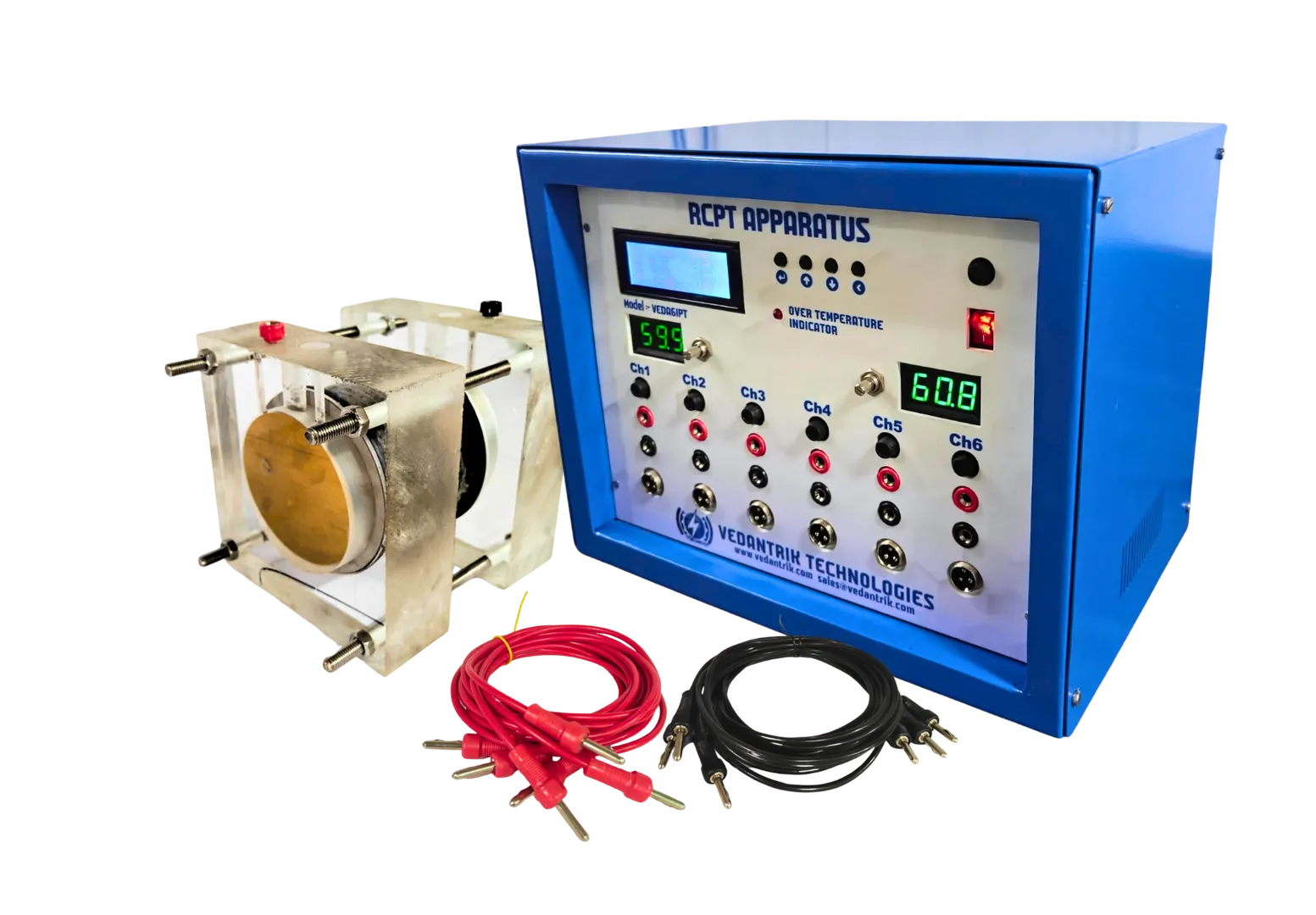
Rapid Chloride Penetration Test (RCPT) Apparatus
Description
Rapid Chloride Penetration Test (RCPT)
The RCPT Rapid Chloride penetration test is one of the concrete durability tests and is a standard test for civil engineering that measures the electrical conductance of concrete specimens. This provides an electrical indication of the concrete's ability to resist the penetration of chloride ions. The Rapid Chloride Permeability Test (RCPT) is used to determine how well your concrete is resisting chloride ions against the penetration over decades.
In RCPT test chloride ions are rapidly passed through the concrete to understand the effect over decades, within 6hrs in the laboratory.
RCPT Sample conditioning requires vacuum pumps and desiccator setup with vacuum creation of less than 50 mm of Hg from the atmospheric pressure to remove the entrapped air from concrete sample to provide accurate results.
For RCPT sample preparation a concrete core of 100 mm dia and 50 mm thickness is taken and placed between RCPT assembly of two chambers containing sodium chloride (NaCl) and sodium hydroxide (NaOH) solutions.
RCPT solution preparation requires 3% Sodium Chloride (NaCl) solution for one reservoir (catholyte) and a 0.3N Sodium Hydroxide (NaOH) solution for the other reservoir (anolyte).
RCPT test Procedure involves 60 volts dc constant electrical potential for 6 hours, and current passing through the concrete is recorded with interval of 30 minutes, and total of 13 readings are logged in 6 hrs considering the initial reading as per ASTM C 1202 These values are then used to calculate the total charges passed in coulombs as per ASTM C1202.
Purpose of RCPT in Concrete testing:
The results are crucial for:
1. Assessing concrete’s ability to resist permeability of chloride ions, which is critical for concrete durability.
2. Assessing the long-term durability and predicting the service life of concrete structures, especially in environments with high chloride
exposure, like coastal regions.
3. Evaluating and ensuring the quality of concrete mixes during construction.
4. Studying the effectiveness of different concrete mix designs and admixtures.
5. Quality control tool for comparing different mix designs in terms of durability.
6. Helps in optimising concrete mix for structures exposed to aggressive environments.
Principle of RCPT test:
The principle behind Rapid Chloride Permeability Test (RCPT), as mentioned in ASTM C 1202, is based on the correlation between the chloride ion transport through the concrete, under applied voltage potential, to concrete’s porosity, which directly influences its durability performance over decades, particularly in terms of chloride induced corrosion of the embedded steel reinforcements (Rebar).
The resistivity of a concrete mix design against chloride ion penetration measured within a 6-hour test, serves as a rapid method to predict long-term durability of concrete.
The magnitude of charge passed acts as an indirect indicator of chloride ion permeability through concrete specimens. The durability and porosity of the concrete are inversely co-related, where higher charge mobility indicates high chloride permeability, consequently higher porous structure which is associated with poor durability of the concrete and vice versa. However, it is important to note that the test does not measure the total chloride diffusion or its rate, rather the total ionic conductance through the concrete, which could be affected by different factors such as temperature, degree of saturation, sample conditioning, presence of conductive materials in the mix design.
Though RCPT provides a rapid and practical method for assessing the relative resistance of the concrete to chloride penetration, its result must be interpreted with caution, when comparing the concrete specimen of different concrete mix or curing histories.
Measurement of RCPT:
The final result of the RCPT test is generally expressed in coulombs, which is the SI unit of charge, and is calculated by integrating current (in Ampere) over time (in seconds). The formula is expressed in the following way:
Charge (Q) = It . dt
However, in the actual test the current is measured at 30 minutes interval as per ASTM C1202, and total charge is often approximated numerically using a trapezoidal rule, and is used with an electronic calculator to perform the integration:
Q = 900 (Io + 2I30 + 2I60 + …… + 2I300 + I360)
Where:
Q = charge passed (coulombs),
Io = current (amperes) immediately after voltage is applied, and
It = current (amperes) at t sec after voltage is applied.
Components of RCPT:
a) RCPT Cell (Test Cell): Holds the concrete specimen and creates chambers for NaCl and NaOH solutions.
b) Concrete Specimen: The sample to be tested for chloride ion permeability. Cylindrical core of standard dimension 100 mm diameter and 50 mm thickness.
c) 3% Sodium Chloride (NaCl) Solution: Placed in the cathode chamber; source of chloride ions.
d) 0.3 N Sodium Hydroxide (NaOH) Solution: Placed in the anode chamber; completes the electrical circuit.
e) Power Supply (DC Voltage Source): Provides constant 60V across the specimen during the test.
f) Ammeter (Current Meter): Measures the current passing through the specimen to calculate charge passed.
g) Sealing Gaskets / Stainless steel O-rings: Ensure leak-proof sealing between the specimen and the chambers.
h) Electrodes: Transfer electrical current into the solutions.
i) Data Logger / Computer Interface: Records current over time to compute total charge passed (in coulombs).
Standard procedure: Overview (as per ASTM C1202)
1. Sample Conditioning (Vacuum Saturation):
Before testing, the concrete specimen (typically a 100 mm diameter × 50 mm thick cylinder) must be fully saturated to ensure accurate ion transport measurements. This is done by placing the specimen under vacuum, pressure less than 50mm of Hg from the atmospheric pressure for a specified duration (usually 3 hours) followed by immersion in de-aerated water under vacuum for at least 1 hour, then atmospheric pressure soaking for 18 ± 2 hours.
2. Cell Assembly and Electrolyte Setup:
The saturated specimen is mounted in a split test cell where one side of the specimen (anode side) is in contact with a 0.3 N sodium hydroxide (NaOH) solution. The other side (cathode side) is in contact with a 3.0% sodium chloride (NaCl) solution. Each chamber is equipped with a non-reactive electrode (usually stainless steel or brass), ensuring proper electrical contact with the electrolyte solution.
3. Electrical Testing Procedure:
A constant direct current (DC) voltage of 60 volts is applied across the specimen for a total duration of 6 hours. The initial current is recorded immediately after voltage application. Current readings are then taken at a 30 minutes interval throughout the test, generating a total of 13 readings. The current flow is due to the movement of chloride ions through the pore structure of the concrete.
4. Calculation of Total Charge Passed:
The total charge (in coulombs) is calculated by integrating the current over the 6-hour period using the trapezoidal rule. This charge represents the electrical indication of the concrete's ability to resist chloride ion penetration.
RCPT result interpretation:
The RCPT result interpretation are based on the total charge passed through the concrete specimen. The final values are obtained in coulombs which reflects the resistivity of the concrete to chloride ion transport, which is directly associated with concrete’s durability.
How to interpret the RCPT table:
The chloride ion penetrability of concrete can be evaluated based on the charge passed in coulombs. If the charge passed is >4000 C, the concrete is rated as High penetrability. A charge between 2000 and 4000 C indicates Moderate penetrability. Charges in the range of 1000 to 2000 C correspond to Low penetrability, while a charge between 100 and 1000 C is classified as Very Low penetrability. If the charge passed is <100 C, the concrete has Negligible chloride ion penetrability..
Factors influencing RCPT results:
1. Influence of Moisture Content: The test results are highly affected by the moisture content, and may lead to current fluctuations ultimately skewing the final results of the test.
2. Temperature rise: The flow of the current causes internal heating of the specimen. This may increase ion permeability and change the final results by making a concrete sample appear more permeable than it really is.
3. Influence of other ions: The presence of ions other than chloride can contribute to the total charge passed, leading to false results.
4.Effect of Admixtures: Use of chemical or supplementary cementitious materials (SCMs) like silica fume, fly ash may reduce the pore size of the concrete sample, increasing the resistance to movement of chloride ion.
Rapid Chloride Penetration Test (RCPT) Apparatus by Vedantrik Technologies:
Ensuring the durability of concrete structures has always been a major challenge in modern construction. One of the most reliable ways to assess durability is through the Rapid Chloride Penetration Test (RCPT). This test helps measure how easily chloride ions can penetrate into concrete, which is a crucial indicator of its long-term performance. By detecting permeability levels, engineers can predict how resistant a structure will be against corrosion, especially in coastal regions or environments where exposure to salt and moisture is high.
The Rapid Chloride Penetration Test (RCPT) Apparatus by Vedantrik Technologies is designed to evaluate the electrical indication of concrete’s ability to resist chloride ion penetration and to determine the chloride diffusion coefficient. It is used for predicting structural integrity, long-term durability and quality control of concrete structures.
The device features internal data logging systems through which it automatically logs the data in every 30 minutes along with automatic calculation, and report generation with graphical representation of current vs. time. It displays real-time readings from all three channels simultaneously during the test.
A key feature is its automatic shutdown after 6 hours, allowing tests to run unattended, making it ideal for overnight operation. Data is stored in internal memory or on a USB drive.
The apparatus includes an in-built Wi-Fi hot-spot, enabling wireless access to logged data from any PC, laptop, Android device, or iPhone, regardless of the operating system. It complies with national and international standards, including ASTM C1202, and offers a reliable and user-friendly solution for RCPT testing. The RCPT Apparatus comes with different channels 3, 4, 6, 8, 12.
Key Features of Vedantrik RCPT Apparatus
1. Automatic data logging at 30-minute intervals: Vedantrik RCPT apparatus is fully automated and logs the test data at every 30 minutes (also provides user defined interval option). The data is saved to internal memory.
2. Automatic calculation and report generation: Vedantrik RCPT system automatically performs the necessary calculations after the 6-hour test and can generate reports based on the logged data.
3. Graphical representation of current vs. time: Vedantrik RCPT Apparatus plots a graph of current versus time, which is a key part of the RCPT analysis. This gives a visual representation of the concrete's permeability over the test duration.
4. Uninterrupted wireless connectivity: Vedantrik RCPT equipment features wireless connectivity, typically via in-built Hotspot, which allows for remote data access.
5. Multi-device compatibility: Vedantrik RCPT wireless feature is compatible with a range of devices, including PCs, laptops, Android mobile phones, and iPhones, ensuring that users can access and share data regardless of their operating system.
6. Web-based software: Vedantrik RCPT comes with powerful web-based software that can be accessed with a range of devices, including PCs, laptops, Android mobile phones, and iPhones to access the data in real time.
7. In-built data acquisition system: Vedantrik RCPT features in-built data acquisition system that captures and stores all the test data, without the need for internet connection.
8. Stable Voltage Supply: Vedantrik RCPT is independent of input voltage, always provides stable required output voltage (60V dc for RCPT with accuracy of +/- 0.1 Volts As per ASTM C 1202)
9. Highly accurate Current measurement: Vedantrik RCPT apparatus is with accuracy of +/- 1 mA.
10. Protection: Vedantrik RCPT apparatus provides short circuit and over current over voltage protection.
11. RCPT cell Assembly: It’s easy RCPT cell assembly made up of clear transparent acrylic in two halves with flexible silicon gasket makes it seal proof and avoids use of silicon sealant.
12. RCPT Result Interpretation: RCPT result interpretation in coulombs by generating the automating result in excel sheet.
At Vedantrik Technologies in Mumbai, advanced RCPT equipment is designed for accuracy, reliability, and ease of use. Builders, consultants, and quality control labs rely on this test to ensure that concrete meets international durability standards. Since chloride-induced corrosion is one of the leading causes of structural damage, using RCPT at the right stage ensures reduced maintenance costs and extended service life of buildings, bridges, and infrastructure projects.
With a focus on innovation, Vedantrik Technologies provides testing instruments that not only deliver precise results but also support faster decision-making on construction sites. For projects that demand higher resilience and performance, RCPT becomes an essential quality control step that safeguards structural investments.
Looking for high-quality RCPT equipment in Mumbai? Contact Vedantrik Technologies today and take the first step towards stronger, more durable concrete structures.
Technical Specifications:
a) Voltage: 60V DC ± 0.1V.
b) Current measurement accuracy: ± 1mA.
c) Voltage Cell: Symmetrical poly (methyl methacrylate) Chamber suitable for NaCl and NaOH to conduct RCPT as per ASTM C1202.
d) Ambient Temperature: 20-25°C.
e) Temperature sensing with individual sensor accuracy ± 1°C.
f) Current measuring range: 1mA - 1000mA.
g) Input Voltage: 230V-265V.
As a best RCPT Rapid Chloride Penetration test system Manufacturer in India we have supplied in Mumbai, Pune, Nashik, Aurangabad, Surat, Vadodara, Ahmedabad, Indore, Bhopal, Nagpur, Jaipur, Ludhiana, Ghaziabad, Delhi, Lucknow, Kanpur, Prayagraj, Patna, Ranchi, Dhanbad, Bengaluru, Hyderabad, Chennai, Coimbatore, Madurai, Visakhapatnam, Kolkata, and Srinagar.
Also we have supplied our RCPT Rapid Chloride Penetration Test system including Dubai, Abu Dhabi, the United Arab Emirates, Oman, Saudi Arabia, Kuwait, and Iran. We also serve clients in Singapore, Indonesia, Thailand, and other international locations.
We also have Installed our RCPT Rapid Chloride Penetration Test system in IIT Mandi (Himachal Pradesh), IIT Jodhpur (Rajasthan), IIT (BHU) Varanasi (Uttar Pradesh), IIT RAM, Maninagar, Ahmedabad (Gujarat),IIT Guwahati (Assam), Nirma University, Ahmedabad (Gujarat), Veermata Jijabai Technological Institute (VJTI), Mumbai (Maharashtra), and the College of Military Engineering (CME), Pune (Maharashtra), along with various National Institutes of Technology (NITs) and government engineering colleges across multiple states in India.
Various Construction company like Larsen & Toubro (L&T), Ashoka Buildcon Limited, Adani Realty Limited, Kalpataru Limited, NCC Limited , National Council for Cement NCCBM, Quality Council of India (QCI), Megha Engineering and Infrastructure Limited (MEIL), TCR Engineering Services, Global Lab.